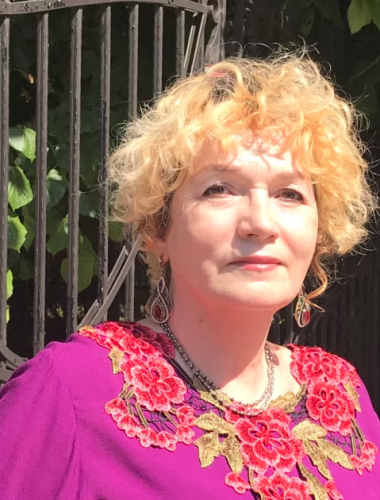
Human rights lawyer Maria Bontsler sentenced to 12 years on treason charges
Aleksandr Marochkin, a judge of the Kaliningrad Oblast Court, sentenced the lawyer Maria Bontsler to 12 years in a penal colony on charges of treason (Article 275 of the Russian Criminal Code), the legal news project Slovo Zashchite (A Word for the Defence) reports.
Prosecutors had asked for 15 years. The trial was held behind closed doors, and Bontsler herself was absent from some of the hearings. She was forced to have herself removed from the proceedings because the conditions in which she was transported to and from court amounted to torture: she suffered attacks of hypertension and atrial fibrillation.
Bontsler was not allowed to deliver her final statement in public, so Slovo Zashchite published it. In it, she writes: ‘I cannot call this court “honourable”, because it has done everything it could to forfeit that title […] I could still forgive the personal abuse I have suffered. I could forgive the court for showing complete disregard for my many years of service to the people of the oblast and of Russia, as chair of the Committee of Soldiers’ Mothers (30 years) and as a human rights lawyer (almost 20 years), for my unblemished reputation, and for the fact that I am a widow who recently lost her beloved husband and a mother who has lost her younger son. What matters now is something else entirely: I am being persecuted not as a private citizen, Maria Bontsler, but as a lawyer, Maria Bontsler! A defence lawyer who for so many years did her job honestly and fulfilled her professional duty. A lawyer accused of a crime I did not commit, in gross breach of lawyer–client confidentiality, which the state is supposed to protect. They deliberately tried to provoke me into breaking the law by disclosing a “state secret”, and when that failed, they carried on doing everything in their power to make a non-existent charge stick.’
All the lawyers Bontsler had engaged to represent her had already been removed from the case on the pretext that they lacked security clearance: Ilya Sidorov and Aleksandr Chauzov in the summer and Roman Morozov on 2 September. Bontsler and her lawyers maintain that classifying material in the case as secret was unlawful. ‘Not least as an experienced lawyer, I made a fully informed decision to refuse to have the information allegedly constituting state secrets (volumes 4 and 5 of the criminal case) examined in court, and I categorically forbade the lawyers of my choosing to do so. I did this to expose the sham classification of the prosecution’s “evidence” by regional FSB operatives and an investigator beholden to them, and to open the hearings to the public and the media,’ she wrote in her final statement.
According to investigators, Bontsler was in contact with an officer of the Security Service of Ukraine (SBU), Diachuk, and ‘provided information about officers of a law enforcement agency that she had learned in the course of her work as a lawyer’. It had already emerged that she had passed on information about the case of Ivan Kveselevych, who was sentenced in April 2025 to two and a half years in a general-regime penal colony for confidential cooperation with a foreign entity. Her final statement reveals that she also passed on information about ‘the arrest of Matsyuts and Kushnirenko, their detention in Remand Prison No. 1 in Kaliningrad and the legal classification of their actions, as well as Maria Bontsler’s intention, in her capacity as a lawyer, to represent Kushnirenko, and Kushnirenko’s refusal to accept her as defence counsel; the fact that Nikolayenkova had been prosecuted under Article 205.2, Part 2 of the Russian Criminal Code and was being held in Remand Prison No. 1 in Kaliningrad; and the fact that the defendant Kirilenko was being held in Remand Prison No. 1 in Kaliningrad’. Bontsler maintains that all of this information had already been disclosed in open court.
For many years, Bontsler defended people in Kaliningrad persecuted for political reasons. She also founded the Committee of Soldiers’ Mothers of Kaliningrad Oblast in the 1990s and chaired it for 30 years.