
Terrorism-Related Cases in Russia: Final Results for 2025
Research Lead and Lead Author: Kirill Parubets, Parubets Analytics (France)
Co-Author and Research Analyst: Mikhail D., Parubets Analytics (France)
This analytical report was prepared by the non-profit research association Parubets Analytics (France), SIREN 994 155 984, specifically for the human rights project First Department.
Key Figures for 2025
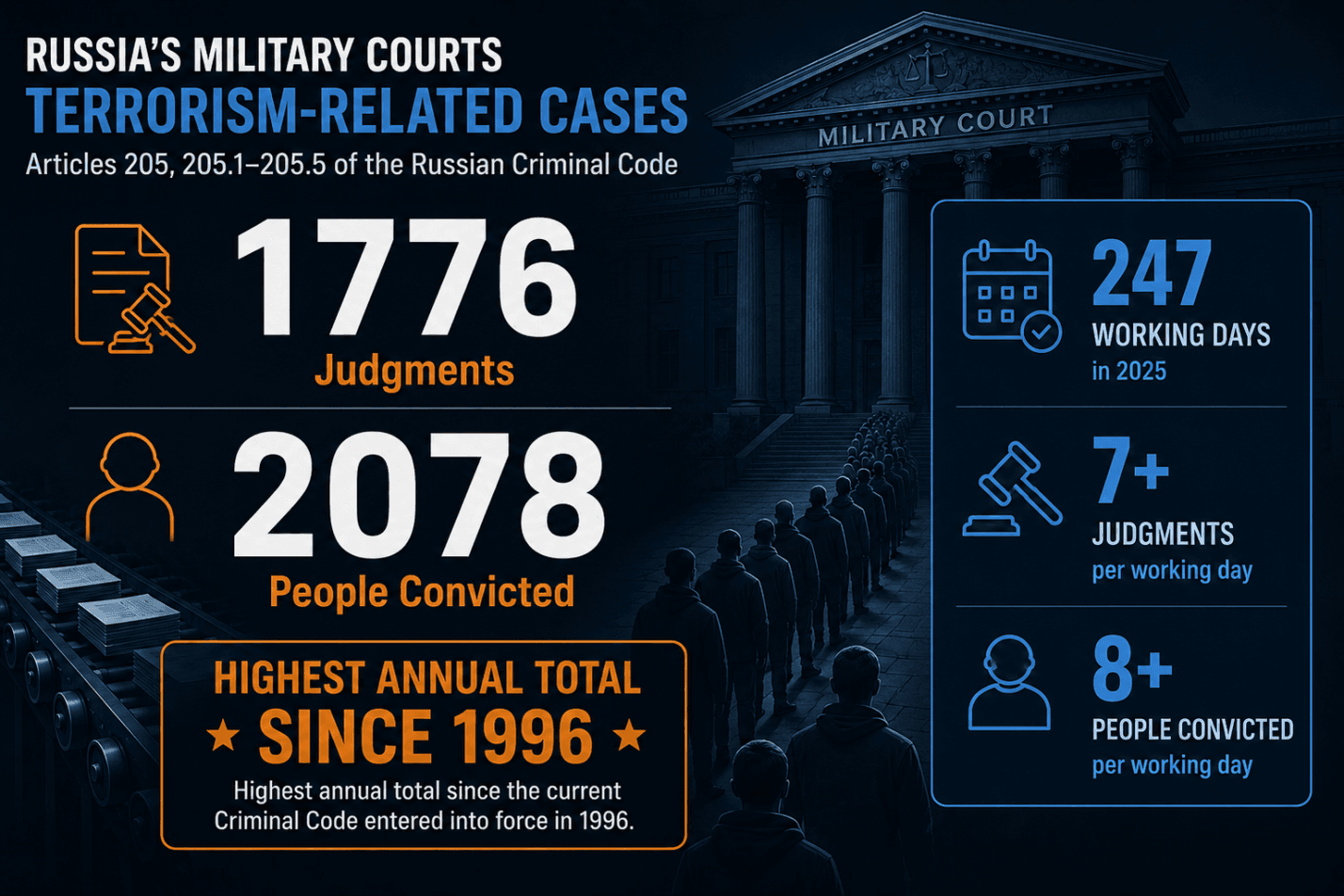
- 1,776 judgments were handed down under terrorism-related provisions of the Russian Criminal Code (Articles 205–205.5), the highest annual figure recorded since the current Criminal Code came into force.
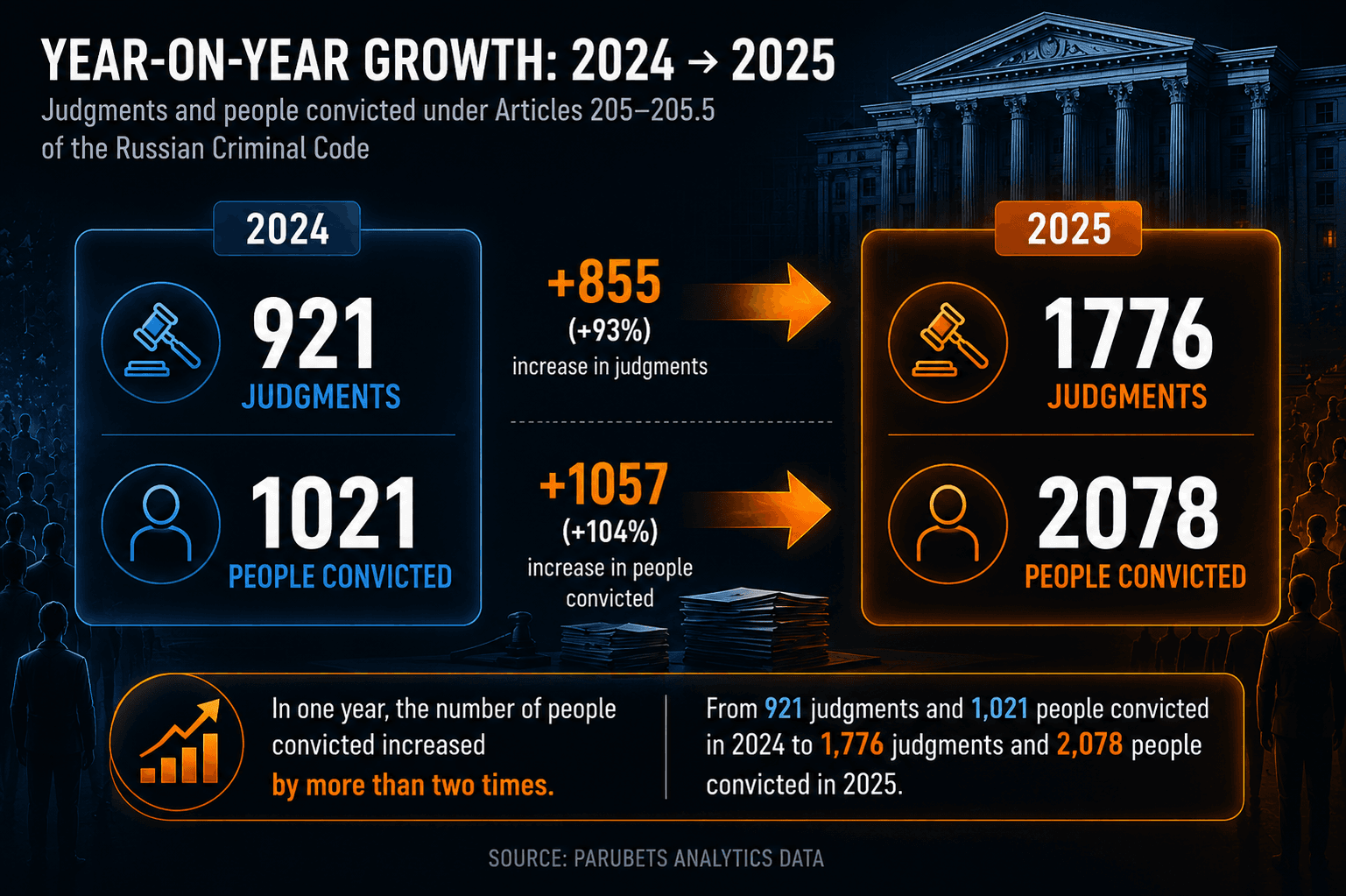
- 2,078 people were convicted in terrorism-related cases, more than twice as many as in the previous year, when 1,021 people were convicted in 2024.
- Almost every second defendant —889 of the 2,078 people convicted — faced charges under Article 205.2 of the Russian Criminal Code: “public calls to engage in terrorist activity, public justification of terrorism, or propaganda of terrorism.”
- 588 people were convicted solely under Article 205.2, without any additional charges.
- At least 630 Ukrainian citizenswere convicted under terrorism-related provisions, accounting for approximately 30% of all those convicted.
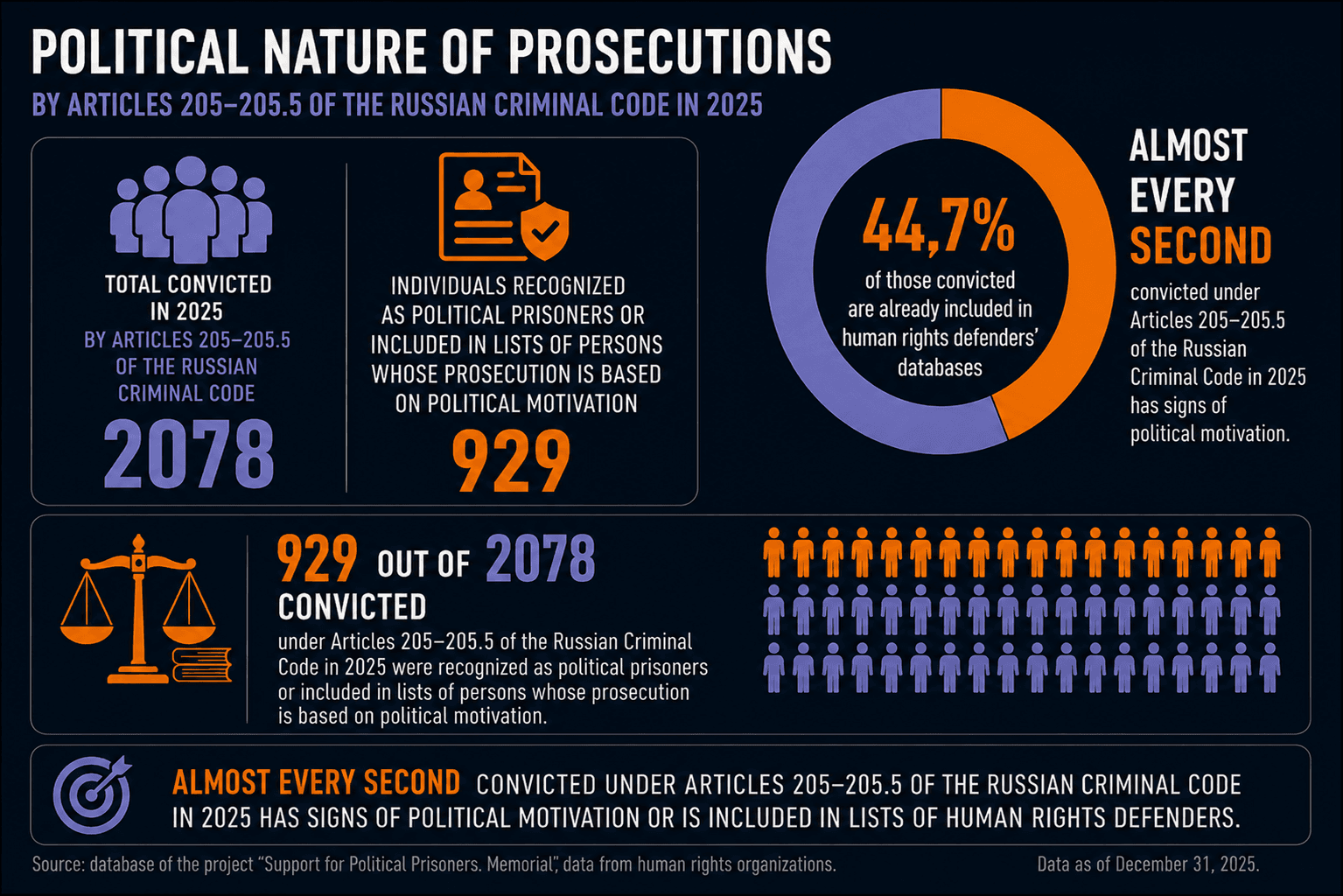
- 45% of those convicted under the “terrorism-related block” of provisions — 929 people— showed indications that their prosecution may have been politically motivated, according to data compiled by the Memorial Political Prisoners Support Project.
- On average, Russian courts handed down more than seven judgments and convicted more than eight people per working day in 2025.
- At least 72 people were ordered to undergo compulsory psychiatric treatment, representing approximately 3.5% of all defendants.
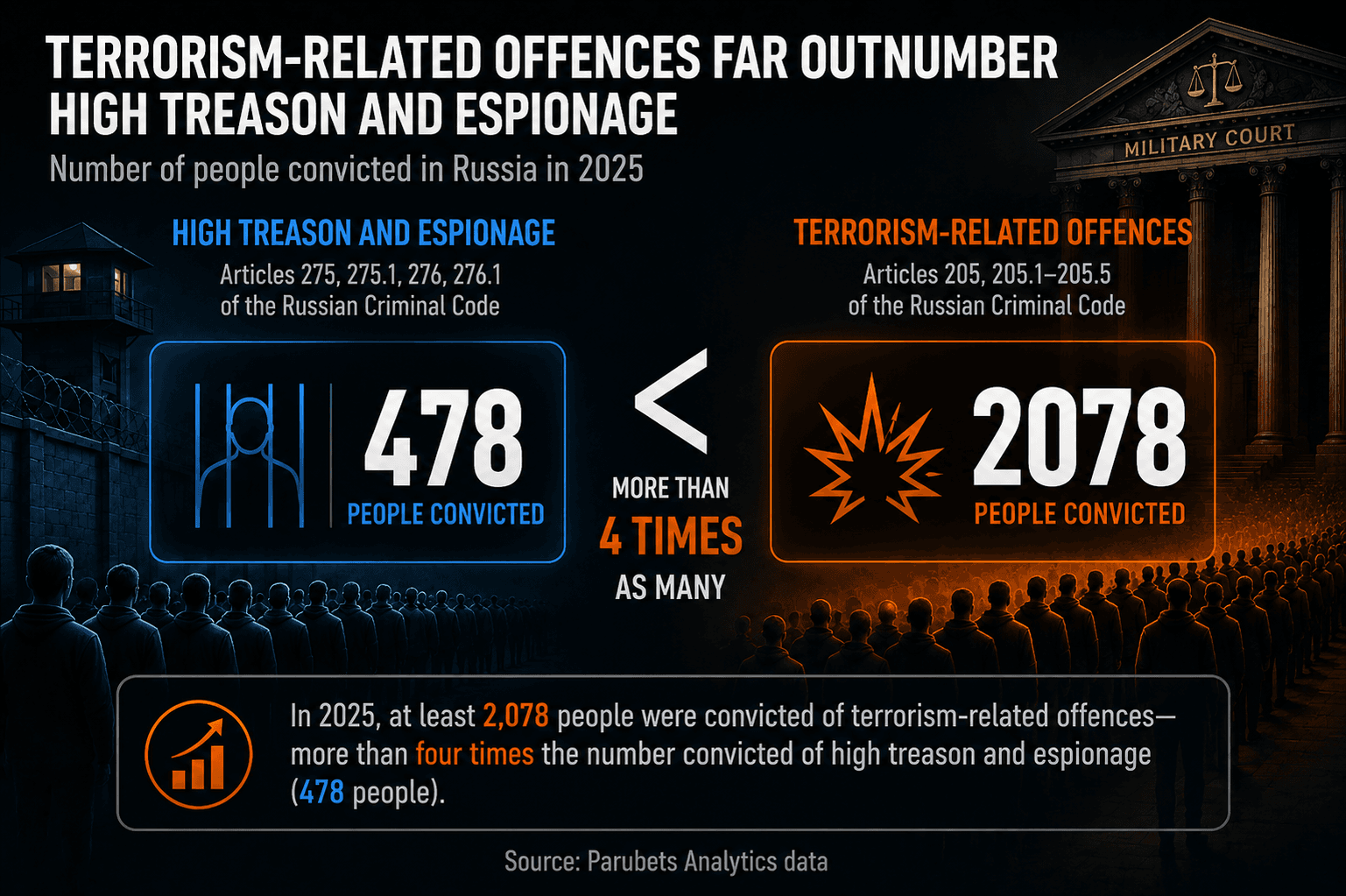
- In 2025, more than four times as many people were convicted under terrorism-related provisions as under provisions concerning high treason and espionage: 2,078 compared with 478 people.
- 166 people convicted, or 8%, were simultaneously charged under terrorism-related provisions and provisions concerning high treason or espionage.
Introduction
In recent years, terrorism-related provisions of the Russian Criminal Code have assumed an increasingly prominent role in Russia’s system of criminal prosecution. While these provisions were originally associated primarily with the investigation of violent offences and the activities of armed groups, their application has expanded significantly. Today, they encompass a broad range of conduct, from participation in armed formations and acts of sabotage to online publications that courts have classified as the public justification of terrorism or public calls for terrorist activity.
This report represents the first comprehensive attempt to assess the scale of the application of Articles 205–205.5 of the Russian Criminal Code in contemporary Russia through an analysis of court judgments delivered in 2025. The study examines both quantitative indicators of criminal prosecution and the structure of charges, sentencing patterns, characteristics of judicial practice, the demographic profile of those convicted, and the role of Ukrainian citizens among defendants in terrorism-related cases.
The analysis demonstrates that 2025 was a record year in modern Russian history in terms of both the number of judgments delivered and the number of people convicted under terrorism-related provisions. A substantial proportion of these cases, however, did not involve the planning or commission of violent acts. Instead, they were based on charges under Article 205.2 of the Russian Criminal Code, which criminalizes certain forms of public expression and the dissemination of information deemed to constitute public justification of terrorism or public calls for terrorist activity. At the same time, cases linked to Russia’s war against Ukraine occupied a prominent place in the overall pattern of prosecutions, including criminal proceedings against both Ukrainian military personnel and civilians.
Taken together, these findings indicate that terrorism legislation has become one of the principal instruments of criminal prosecution in contemporary Russia. In 2025, the scale of its application substantially exceeded even the rapidly growing use of provisions relating to high treason and espionage.
Key Trends in 2025
Throughout 2025, Russian courts, including military courts, delivered at least 1,776 judgments under terrorism-related provisions of the Russian Criminal Code (Articles 205 and 205.1–205.5). These proceedings involved 2,078 defendants.
These figures represent the highest annual totals recorded since the adoption of the current Russian Criminal Code in 1996, making 2025 a record year over the nearly three decades of its application.
Given that Russia had 247 working days in 2025, courts delivered more than seven terrorism-related judgments per working da yon average. During the same period, more than eight people were convicted under Articles 205 and 205.1–205.5 each working day.
Terrorism-Related Criminal Prosecutions in Russia in 2025
The scale of prosecutions under terrorism-related provisions continues to grow rapidly. In 2024, Russian courts delivered 921 judgments under the terrorism-related provisions (Articles 205–205.5), involving 1,021 defendants. By 2025, these figures had risen to 1,776 judgmentsand 2,078 convicted persons, respectively. In other words,the number of people convicted in terrorism-related cases more than doubled within a single year.
Terrorism-Related Criminal Prosecutions in Russia in 2025
At the same time, terrorism-related prosecutions now vastly exceed even the rapidly expanding category of high treason and espionage cases. In 2025, at least 478 people were convicted under Articles 275, 275.1, 276, and 276.1 of the Russian Criminal Code, compared with at least 2,078 people convicted under terrorism-related provisions. Put differently, more than four times as many people were convicted on terrorism-related charges as on charges of high treason or espionage in Russia during 2025.
Terrorism-Related Criminal Prosecutions in Russia in 2025
A further notable development is the increasing use of compulsory medical measures. In 2025, such measures were imposed on at least 72 individuals, representing approximately3.5%of all defendants in terrorism-related cases. By comparison, at least 45 such cases were recorded in 2024.
In addition, three criminal cases that had already been referred to court were terminated. Two were dismissed due to the absence of the elements of a criminal offence, while one was terminated because the statutory limitation period had expired.
Finally, 14 caseswere returned to the prosecutor or the head of the investigative authority. In 10 cases, the court identified procedural violations in the indictment; in three cases, it found that the offence had been incorrectly classified; and in one case, it concluded that the evidence was insufficient to justify the application of compulsory medical measures.
Monthly and Quarterly Trends
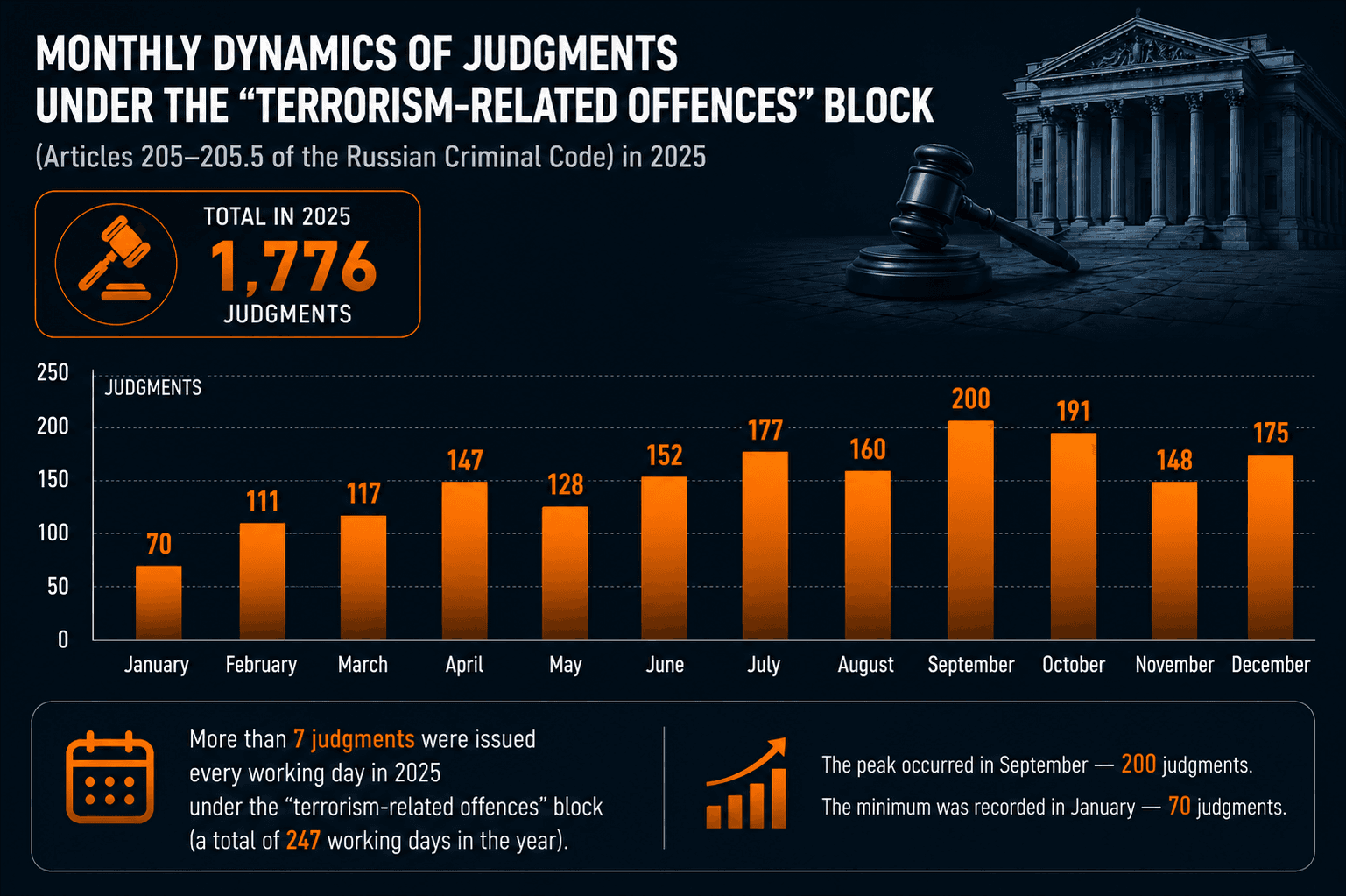
The number of judgments delivered under terrorism-related provisions increased steadily throughout 2025. While Russian courts handed down only 70 judgmentsin January, the monthly total had risen to nearly 200 by the autumn. The highest monthly figure was recorded in September 2025, when courts delivered 200 judgments
Overall, almost 60% of all terrorism-related judgments issued during the year were delivered in the second half of 2025, indicating a continued expansion in the scale of criminal prosecutions under terrorism-related provisions.
Terrorism-Related Criminal Prosecutions in Russia in 2025
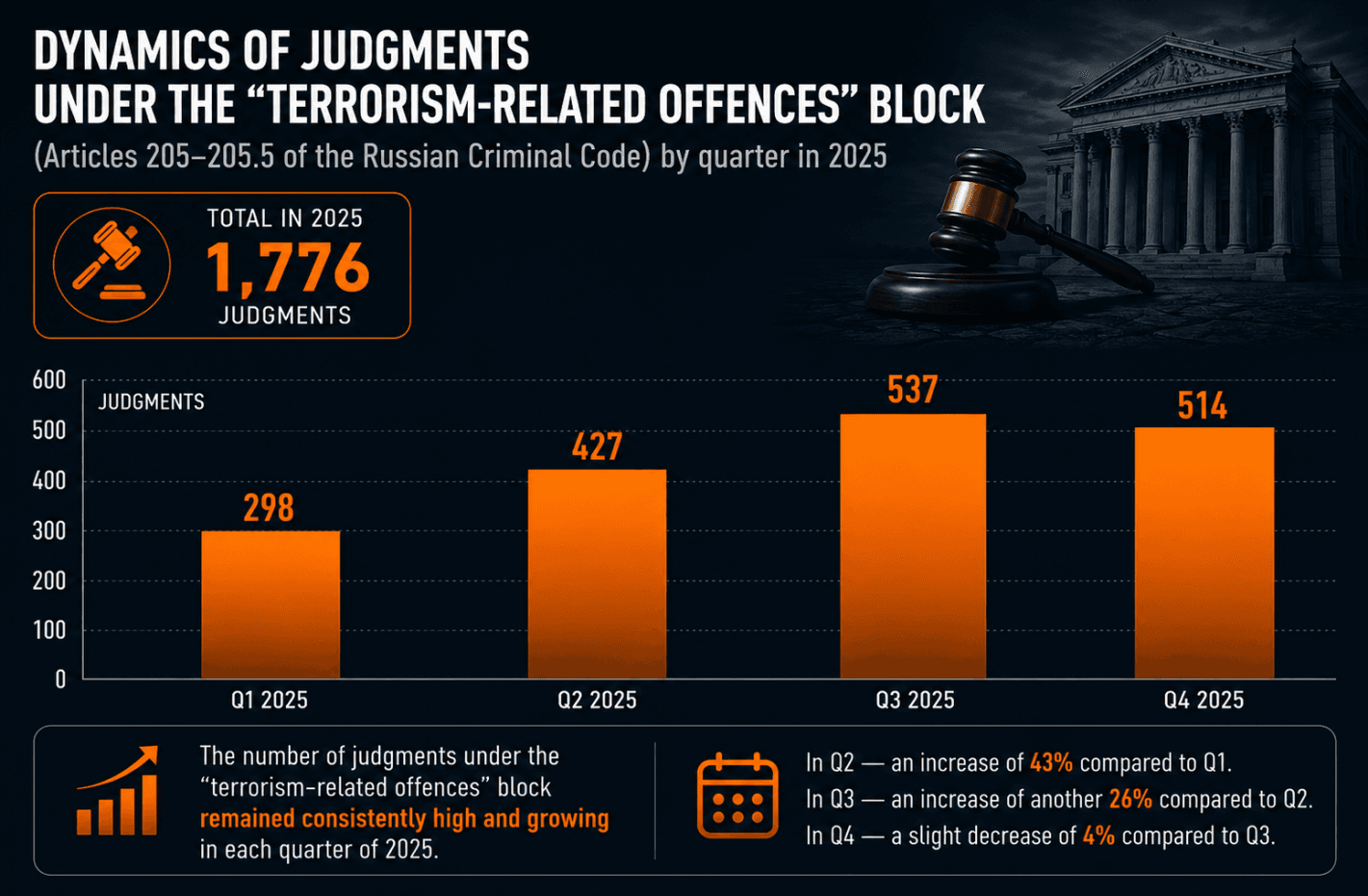
The quarterly data further illustrate this sharp upward trend. In the first quarter of 2025, Russian courts delivered 298 judgments under terrorism-related provisions. This number increased to 427 judgments in the second quarter. The third quarter marked the peak of the year, with 537 judgments — almost twice as many as in the first quarter.
Although the number of judgments declined slightly in the fourth quarter, the overall level of prosecutions remained exceptionally high. During the last six months of 2025, Russian courts delivered 1,051 terrorism-related judgments, accounting for approximately 59% of all judgments in this category during the year.
Taken together, these figures demonstrate that the overwhelming share of the annual increase occurred during the second half of 2025, reflecting a substantial escalation in the use of terrorism-related provisions by the Russian authorities.
Terrorism-Related Criminal Prosecutions in Russia in 2025
Distribution by Criminal Code Articles
Before examining the distribution of convictions across individual provisions of the Russian Criminal Code, it is important to note that defendants in terrorism-related cases are frequently charged under more than one terrorism-related provision simultaneously. It is therefore useful to begin by examining the overall structure of legal qualification in these cases and assessing how often Russian courts convict individuals under a single terrorism-related provision versus multiple provisions.
The data show that most terrorism-related convictions involve only one terrorism-related offence. Although cases involving multiple terrorism-related charges occur on a regular basis, they remain comparatively uncommon.
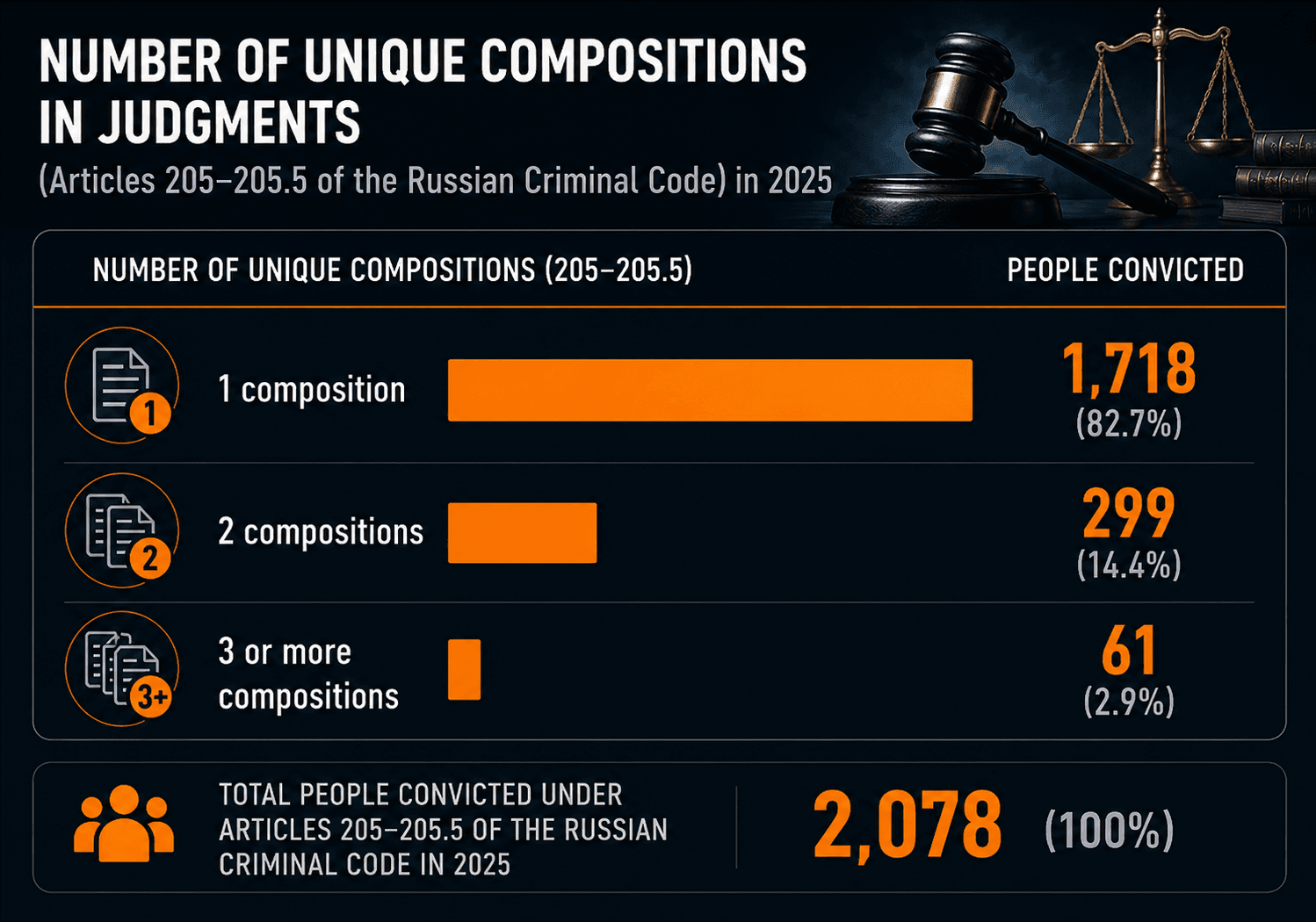
Of the 2,078 people convicted in 2025,1,718 (83%)were convicted under only oneof the provisions contained in Articles 205–205.5of the Russian Criminal Code. A further 299 individuals (14%) were convicted undertwoterrorism-related provisions, while 61 people (3%)were convicted under three or more such provisions.
Terrorism-Related Criminal Prosecutions in Russia in 2025
Since the overwhelming majority of those convicted (83%) were found guilty under only a single terrorism-related provision, the remainder of this analysis focuses on this group. This approach makes it possible to assess the prevalence of individual Criminal Code provisions without the distortions introduced by multiple legal qualifications and to identify which offences form the core of contemporary terrorism-related prosecutions in Russia.
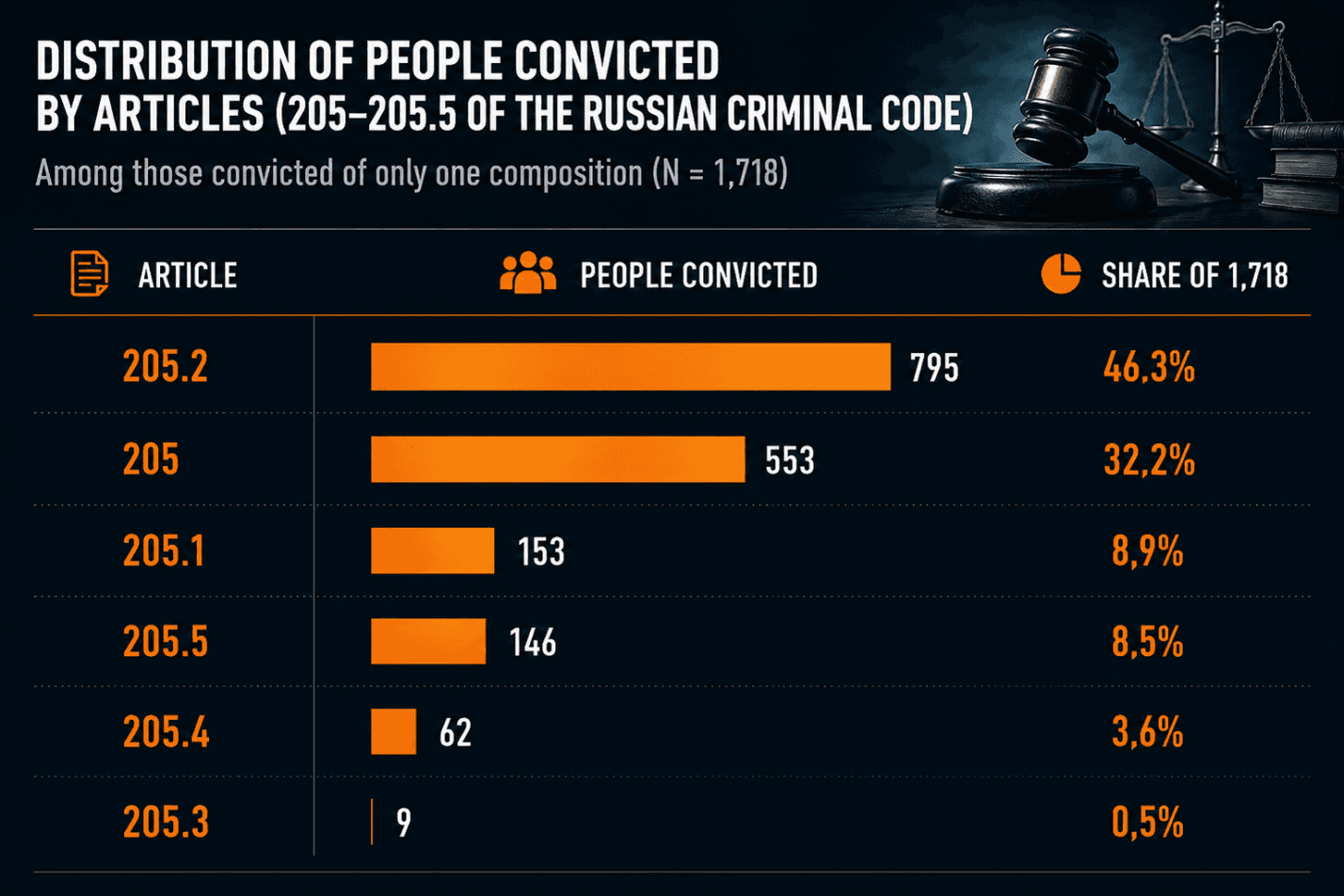
Among those convicted under a single terrorism-related provision,Article 205.2 was by far the most frequently applied, accounting fo r795 convictions (46.3%). The second most common was Article 205 (“Terrorist Act”), under which 553 people (32.2%) were convicted. Together, these two provisions accounted for nearly four out of every five convictions involving a single terrorism-related offence. All other terrorism-related provisions were applied substantially less frequently.
Terrorism-Related Criminal Prosecutions in Russia in 2025
It should be noted that Article 205.2 (“Public Calls for Terrorist Activity, Public Justification of Terrorism, or Propaganda of Terrorism”) has increasingly been used in recent years to prosecute public statements, online publications, anti-war comments, and other forms of expression. Human rights organizations and international bodies have repeatedly raised concerns about the Russian authorities’ broad interpretation of this provision and its use against individuals who are not accused of preparing or committing violent offences.
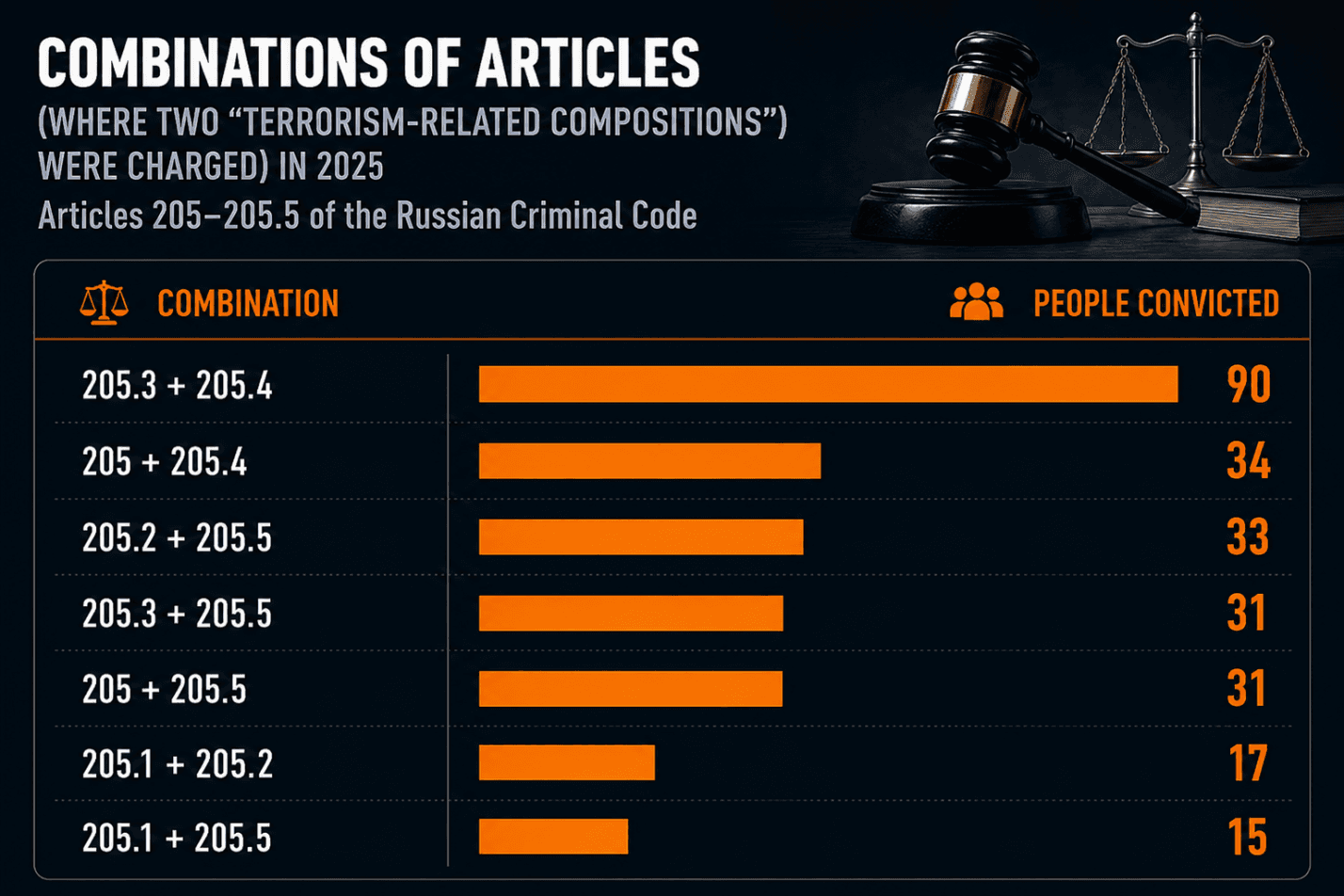
Among defendants convicted under two terrorism-related provisions, the most common combination was Articles 205.3 and 205.4of the Russian Criminal Code. This combination was identified in 90 cases, accounting for approximately one-third of all convictions involving two terrorism-related provisions.
Terrorism-Related Criminal Prosecutions in Russia in 2025
The Intersection of Terrorism and Extremism Charges
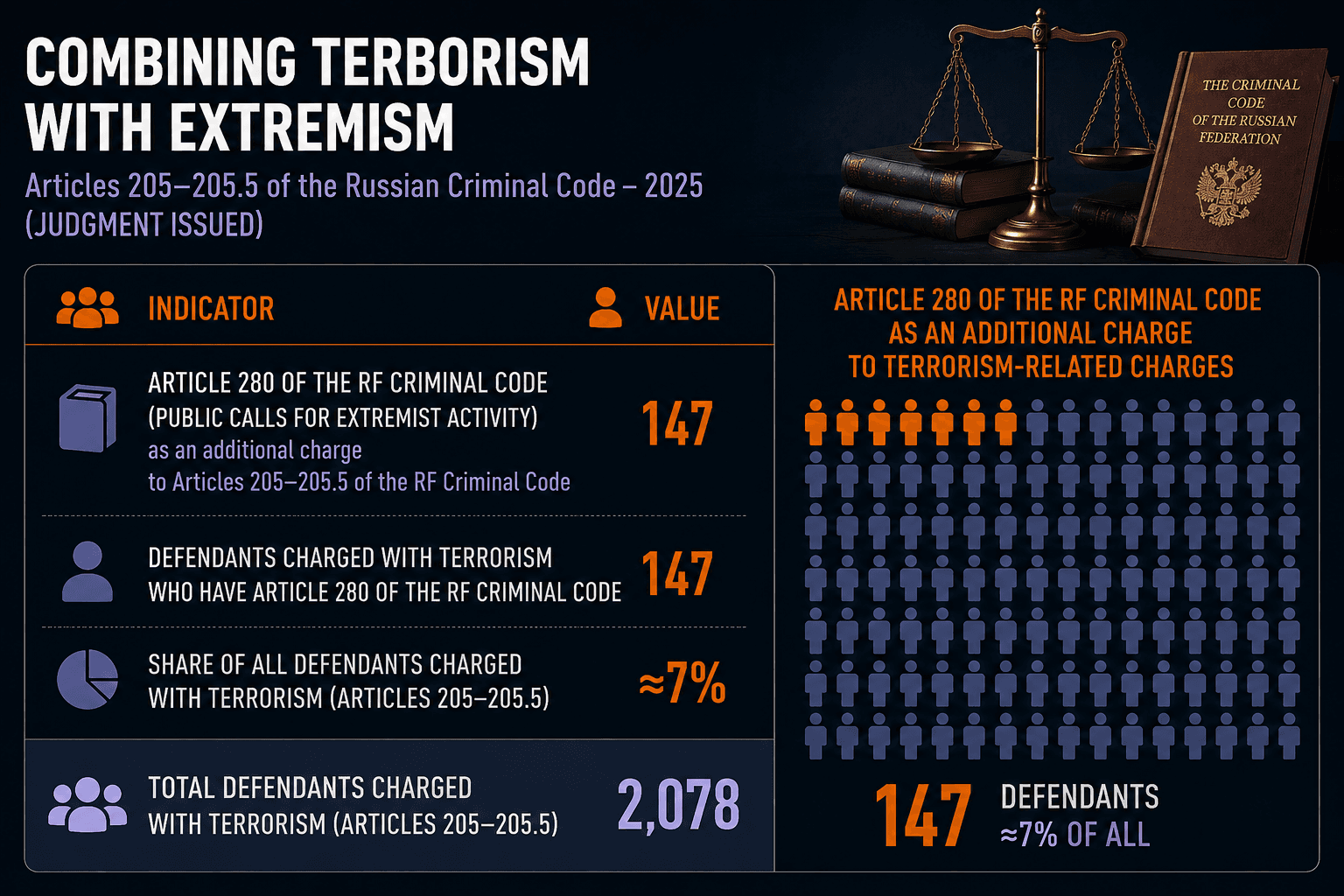
Article 280 of the Russian Criminal Code (“Public Calls for Extremist Activity”) was the provision most frequently charged alongside terrorism-related offences. In 2025, it appeared in the cases of 147 people convicted under Articles 205–205.5, representing approximately 7% of all individuals convicted in terrorism-related cases.
In the overwhelming majority of these cases— 133 out of 147 convictions (90%) —Article 280 was combined specifically with Article 205.2 (“Public Calls for Terrorist Activity, Public Justification of Terrorism, or Propaganda of Terrorism”).
As a result, the most common combination of charges consisted of simultaneous allegations of extremist and terrorist speech-related offences. This pattern illustrates the increasingly close convergence of terrorism- and extremism-related provisions in the practice of criminal prosecution in contemporary Russia.
Terrorism-Related Criminal Prosecutions in Russia in 2025
Overlap Between Terrorism, High Treason, Espionage, and Sabotage Charges
Particular attention should be paid to the overlap between terrorism-related prosecutions and other categories of criminal offences associated with state security.
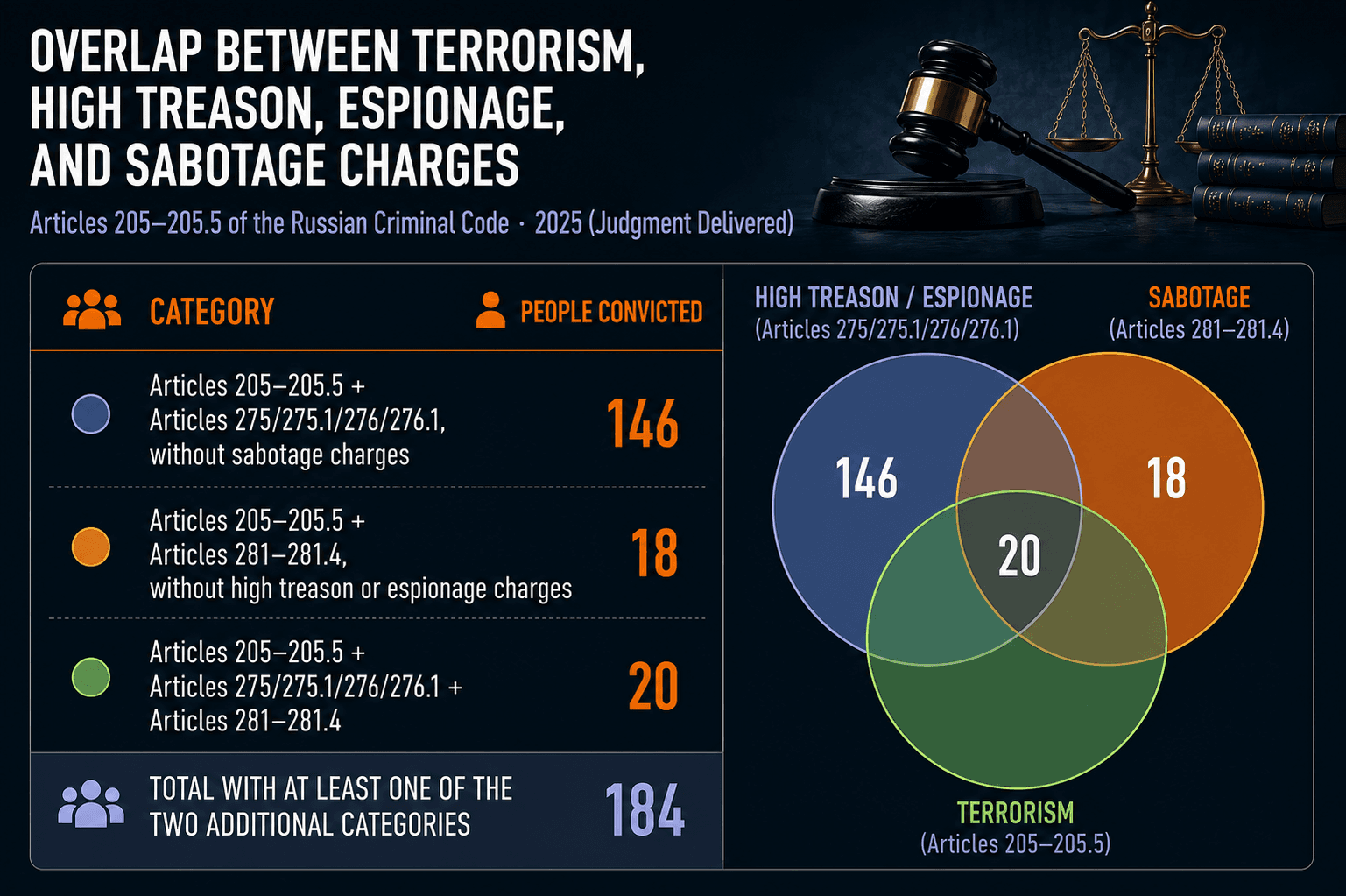
The analysis found that at least 166 of the 2,078 people convictedunder Articles 205–205.5 of the Russian Criminal Code in 2025 were simultaneously charged under Articles 275, 275.1, 276, or 276.1, which concern high treason, confidential cooperation with a foreign state, espionage, and assistance to activities directed against Russia’s security, respectively.
In 146 cases, these charges were not accompanied by sabotage-related offences. In contrast,20 individuals faced simultaneous charges under terrorism-related provisions, sabotage provisions, and provisions concerning high treason or espionage. Overall approximately 8% of those convicted in terrorism-related caseswere also prosecuted under provisions relating to state security.
The overlap between terrorism-related and sabotage-related charges was considerably less common. In total, 38 peoplewere convicted under both terrorism-related provisions and the sabotage provisions of the Russian Criminal Code (Articles 281–281.4). Of these, 18 individualsfaced only terrorism- and sabotage-related charges, while the remaining20were also charged with high treason or espionage. In other words, more than half of those simultaneously charged with terrorism- and sabotage-related offences were also prosecuted under Articles 275, 275.1, 276, or 276.1.
Overall,184 convicted individualswere found to have been charged under terrorism-related provisions in combination withat least oneof the above categories of state security offences.
Terrorism-Related Criminal Prosecutions in Russia in 2025
Courts Handling the Largest Number of Terrorism-Related Cases
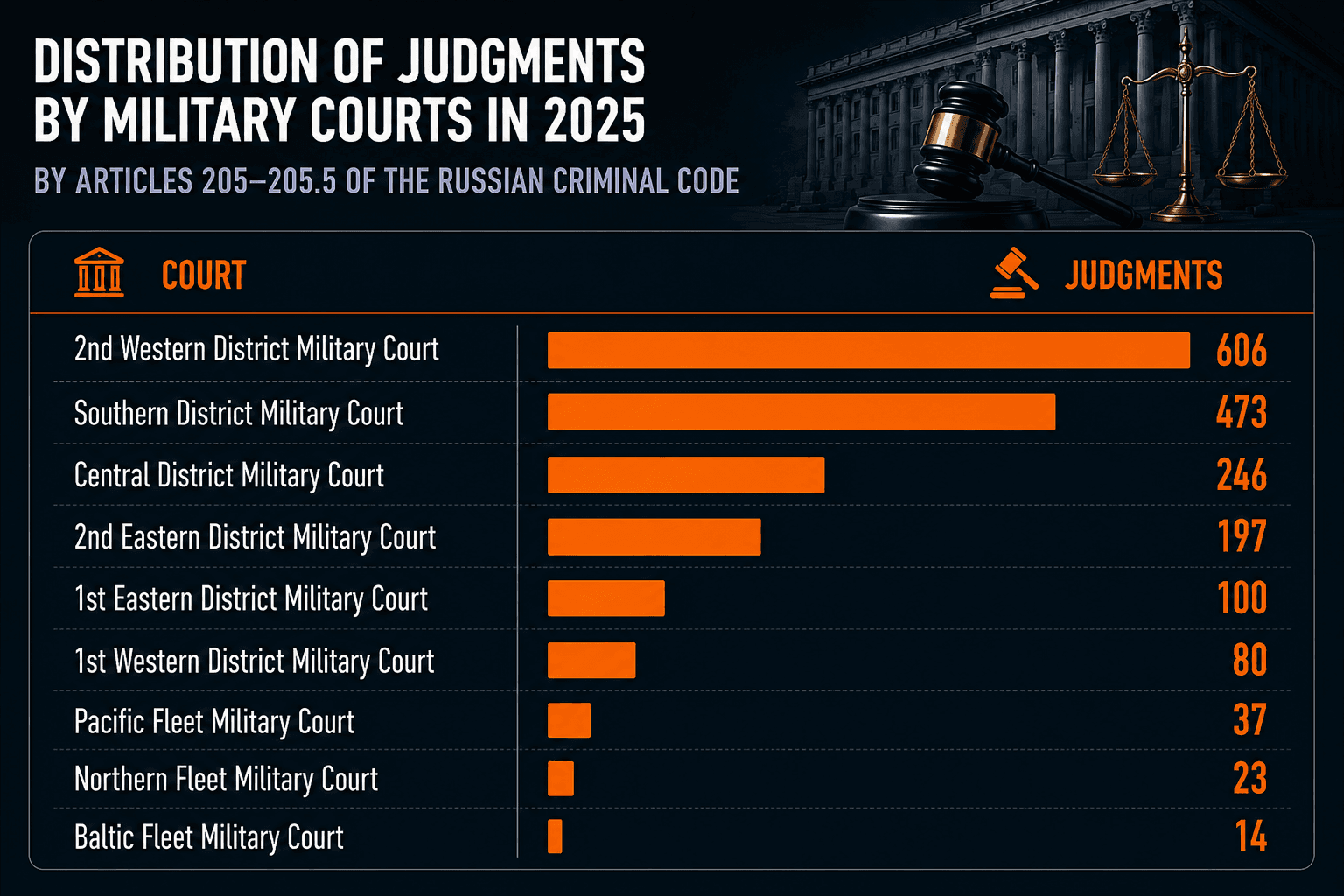
The adjudication of terrorism-related cases in Russia is highly concentrated within a small number of specialized military courts. In 2025, the Second Western District Military Court and the Southern District Military Court alone delivered 1,079 judgments, accounting for more than 60% of all judgments under Articles 205–205.5of the Russian Criminal Code. When the Central District Military Court is also included, these three courts together were responsible for nearly three-quarters of all convictions in terrorism-related cases. This demonstrates the exceptionally high concentration of such proceedings within Russia’s military justice system.
Terrorism-Related Criminal Prosecutions in Russia in 2025
Particular attention should be paid to the fact that the two courts handling the largest number of terrorism-related cases—the Second Western District Military Court and the Southern District Military Court —also serve as the principal venues for criminal proceedings connected to Russia’s war against Ukraine. These courts regularly hear cases involving Ukrainian military personnel, Ukrainian civilians, and other defendants prosecuted under terrorism-related provisions in connection with events in Ukraine and in Russia’s border regions.
This pattern suggests that criminal prosecutions linked to the armed conflict between Russia and Ukraine have made a substantial contribution to the sharp increase in terrorism-related judgments observed in 2025.
Concealment of Defendants’ Identities
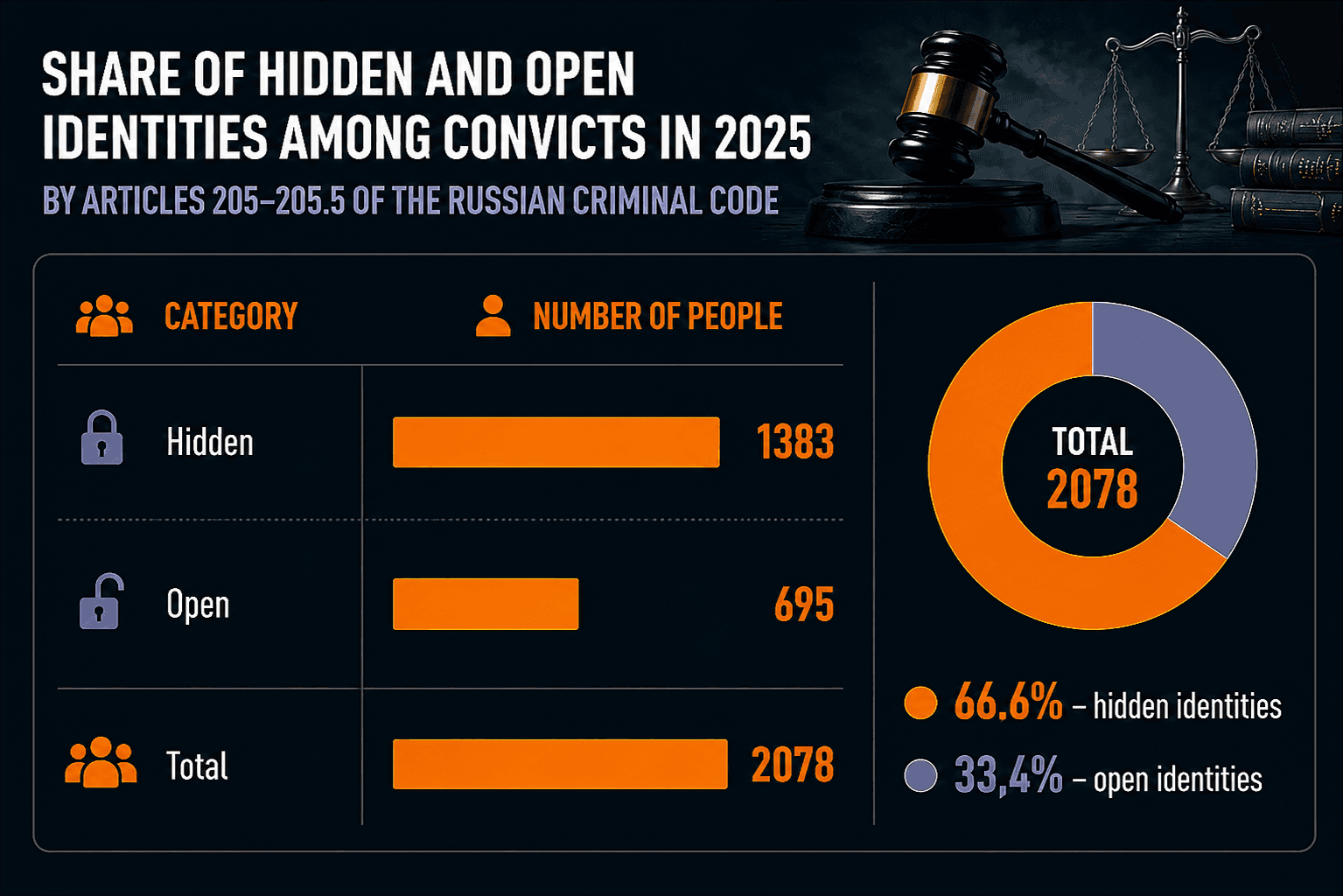
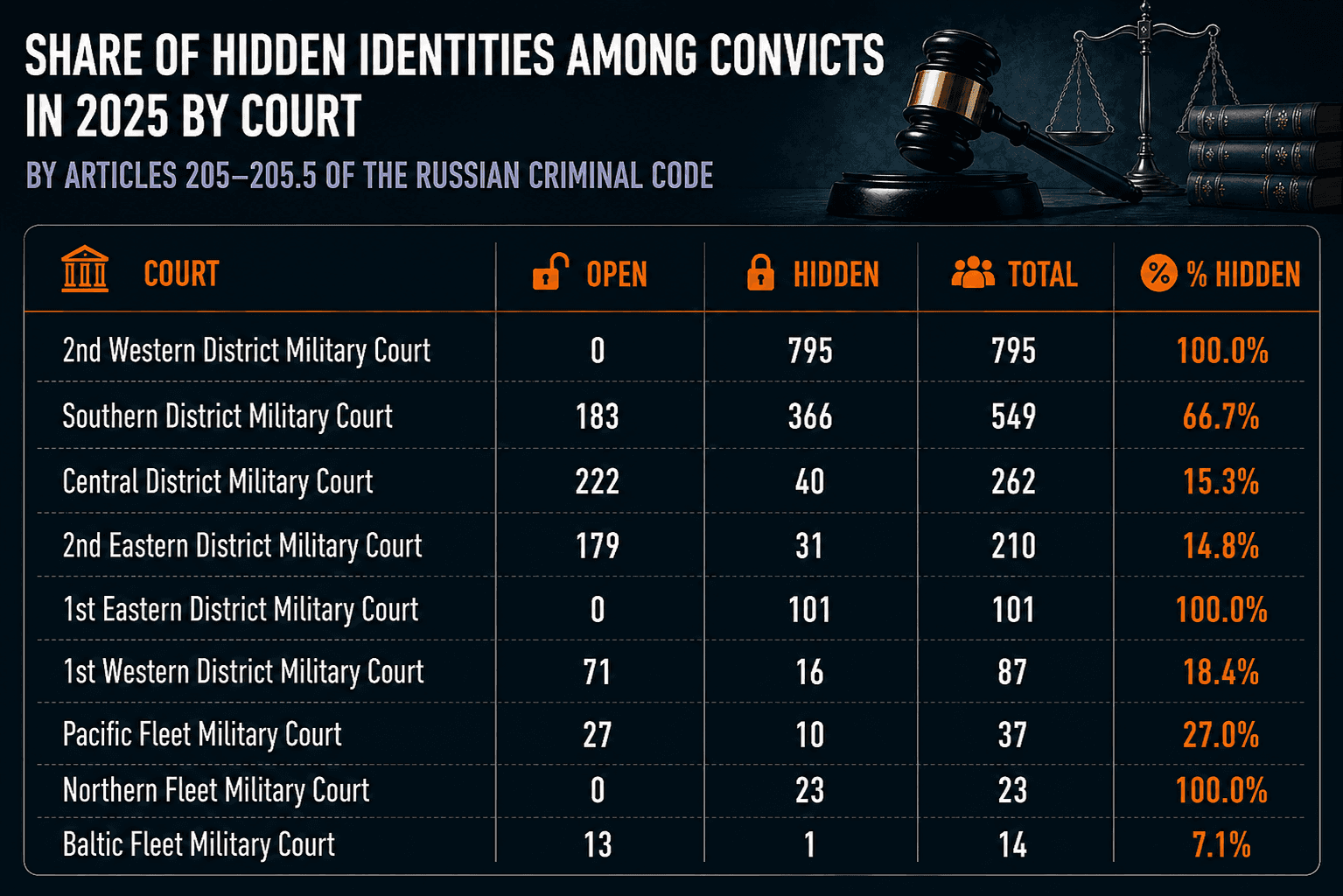
The extent to which information about defendants in terrorism-related cases is withheld from public access also warrants particular attention. An analysis of official court records shows that in 2025, the names of at least 1,383 of the 2,078 people convicted under Articles205–205.5of the Russian Criminal Code were concealed. This represents66.6% of all identified defendants, meaning that the identities of approximately two out of every three convicted individuals were absent from publicly available court records.
Terrorism-Related Criminal Prosecutions in Russia in 2025
The practice of anonymizing defendants varies considerably across courts. The Second Western District Military Court, the First Eastern District Military Court, and the Northern Fleet Military Courtconcealed the identities ofevery person convicted in terrorism-related cases. By contrast, theCentral District Military Court and the Second Eastern District Military Court disclosed the identities of most defendants, withholding names in onlyaround one out of every six cases.
It should also be noted that the level of secrecy surrounding terrorism-related prosecutions continues to increase not only through the anonymization of newly published court records, but also through the subsequent removal of information that had previously been made public. For example, in the spring of 2026, the Southern District Military Courtremoved the names of defendants from a large number of publicly available terrorism-related case records.
Terrorism-Related Criminal Prosecutions in Russia in 2025
Political Motivation
It should be noted that not all terrorism-related criminal cases can be regarded as politically motivated. Unlike provisions that directly restrict freedom of expression—such as those criminalizing the “discrediting” of the Russian Armed Forces (Article 280.3 of the Russian Criminal Code) or the dissemination of “false information” about the Armed Forces (Article 207.3)—Articles 205–205.5 cover a broad spectrum of conduct, ranging from the preparation and commission of violent offences to online publications that courts have classified as the public justification or propaganda of terrorism. As a result, this category of criminal cases is highly heterogeneous and requires a separate assessment of both the structure of charges and the profile of those convicted.
Particular attention should be paid to Article 205.2 of the Russian Criminal Code (“Public Calls for Terrorist Activity, Public Justification of Terrorism, or Propaganda of Terrorism”). Unlike many other provisions within the terrorism-related chapter of the Criminal Code, Article 205.2 is frequently applied to public statements, online publications, and other forms of information-related activity.
The analysis found that in 2025, Article 205.2 formed part of the charges against at least 889 of the 2,078 people convicted under Articles 205–205.5, representing 42.8% of all identified defendants. In other words, nearly one out of every two people convicted in terrorism-related cases during 2025 was prosecuted under a provision targeting public expression and the dissemination of information.
A comparison of the identified defendants with the database maintained by theMemorial Political Prisoners Support Project found that at least 929 individuals convicted under Articles 205–205.5 in 2025 have already been recognized by the organization as cases displayingindications of political motivation and wrongful criminal prosecution. This represents approximately 45% of all identified individuals convicted under terrorism-related provisions during the year.
This estimate is likely to be conservative. A substantial proportion of terrorism-related cases has not yet been comprehensively examined by independent human rights organizations, while information about many defendants remains unavailable to the public or has been concealed by the courts. Consequently, the actual proportion of convictions exhibiting indications of politically motivated prosecution may be significantly higher.
Terrorism-Related Criminal Prosecutions in Russia in 2025
Types of Sanctions
The analysis of sanctions imposed is of particular interest given the severity of the penalties prescribed for most terrorism-related offences under the Russian Criminal Code. For offences under Articles 205, 205.1, 205.3, 205.4, and 205.5,imprisonment is the principal—and in practice almost the only—form of punishment. The statutory penalties for these offences frequently range from 10 to 20 years’ imprisonment, and in some cases are even longer.
A notable exception is Article 205.2of the Russian Criminal Code (“Public Calls for Terrorist Activity, Public Justification of Terrorism, or Propaganda of Terrorism”). Unlike most other terrorism-related provisions, Article 205.2 provides for alternative sanctions. Depending on the specific paragraph of the article, courts may impose either imprisonment or a fine ranging from 100,000 to 1 million rubles (1,120 – 11,200 euro). It is therefore relevant to examine how frequently Russian courts make use of non-custodial sanctions and how penalties are distributed across different terrorism-related offences in practice.
According to statistics published by the Judicial Department of the Supreme Court of the Russian Federation for the first half of 2025 — the most recent period for which such data are available—fineswere imposed as the principal sanction in 55.1% of convictions under Article 205.2, while 44.4% resulted inimprisonment.
These figures should, however, be interpreted with caution. The statistics compiled by the Judicial Department classify sanctions according to the principal offence of conviction and therefore do not fully capture the many cases involving multiple criminal charges. As a result, the statistics for Article 205.2 primarily reflect cases in which this provision constituted the principal offence.
In 2025, 795 peopl ewere convicted under Article 205.2 as the only terrorism-related provisionincluded in their cases. However, in a substantial number of instances, Article 205.2 was combined with other provisions of the Russian Criminal Code.
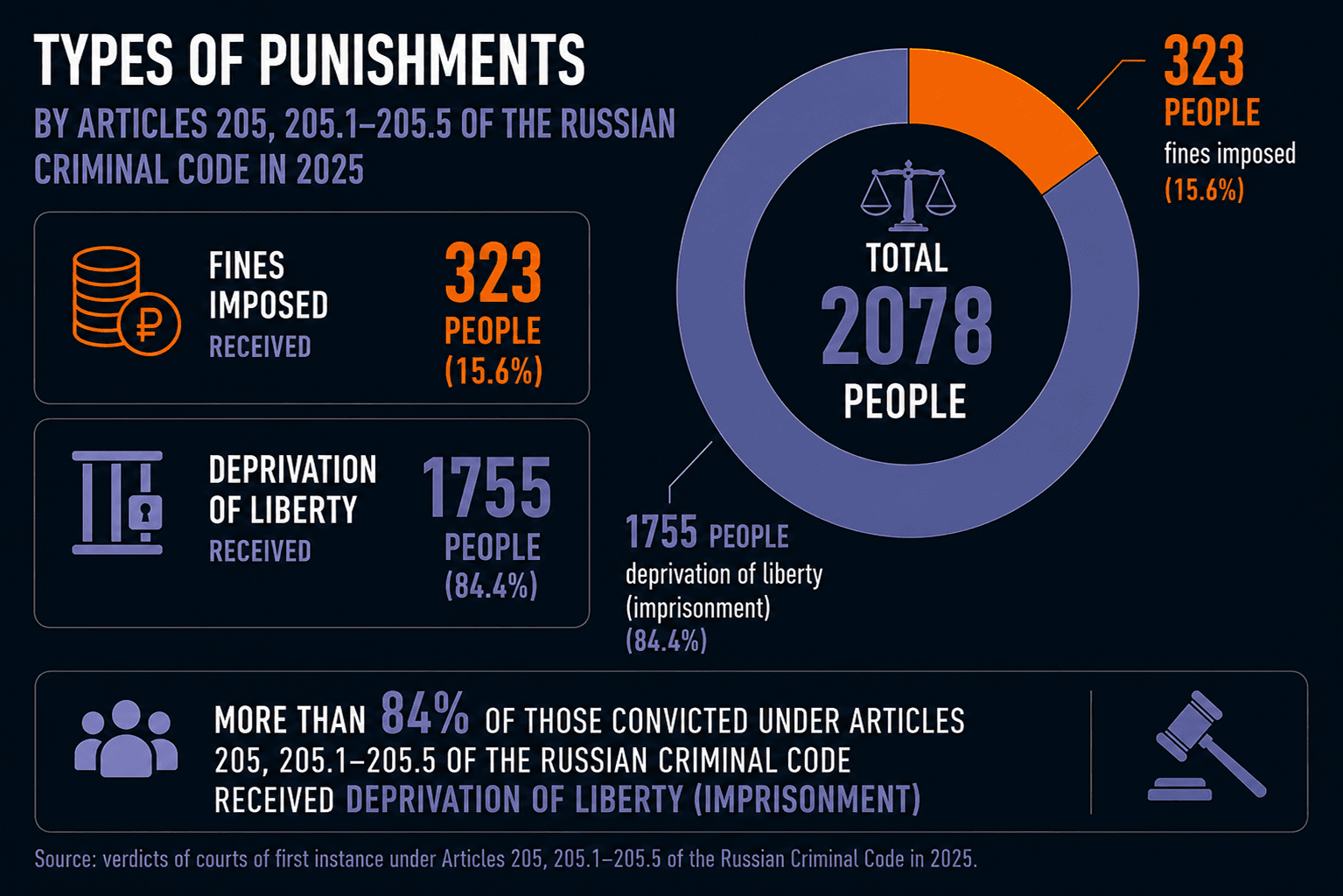
For 588 convicted individuals, Article 205.2 constituted the sole criminal charge. It is this group to which the Supreme Court’s sentencing statistics for Article 205.2 can most appropriately be applied. Assuming that approximately55%of such cases resulted in a fine, it can be estimated tha around 323 individuals received fines, while approximately 265 were sentenced to imprisonment solely under Article 205.2.
Taking into account convictions under all other terrorism-related provisions (Articles205–205.5), the total number of people sentenced to imprisonment in terrorism-related cases during 2025 can be estimated at approximately 1,755.
Terrorism-Related Criminal Prosecutions in Russia in 2025
Lengths of Prison Sentences
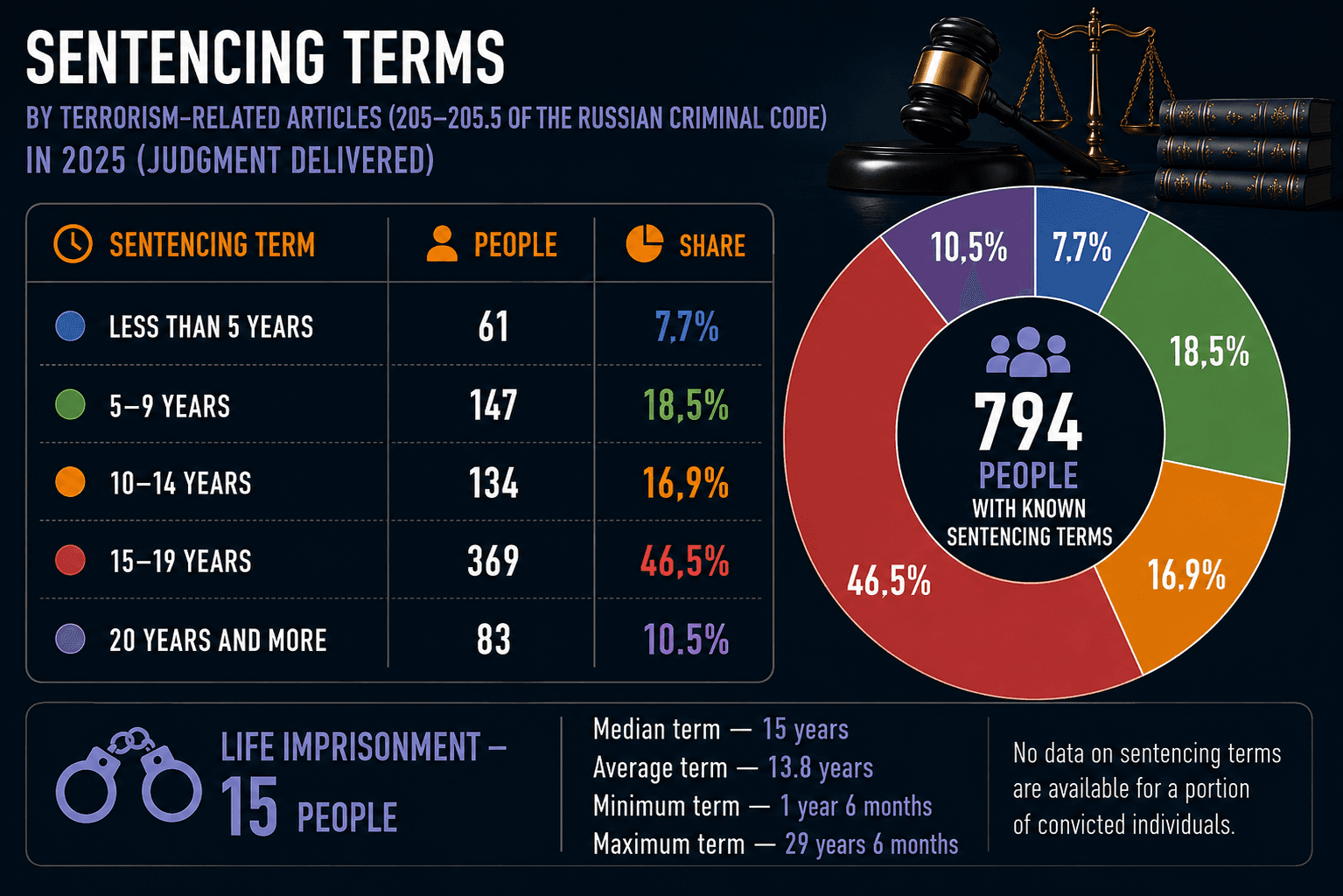
The analysis of prison sentence lengths is based on data from the Memorial Political Prisoners Support Project, which contains information on sentences imposed in terrorism-related criminal cases. In total, sentencing information was identified for 809 people convictedin 2025. Among them, 15 individuals were sentenced to life imprisonment, while the exact term of imprisonment was established for a further794 individuals. Notably, 8 of the 15 people sentenced to life imprisonmentwere defendants in the case concerning the Crimean Bridge explosion.
When the analysis is limited to primary criminal cases—excluding cases involving cumulative convictions for multiple offences and repeated criminal prosecutions—the median sentence remains 15 years’ imprisonment, indicating that the severity of sentencing is consistently high regardless of the procedural complexity of the case.
The shortest identified sentence was 1 year and 6 months’ imprisonment, imposed on Aleksandr Kapichnikov, Anton Yevdokimov, and Yevgeny Podolyak, all convicted underArticle 205.2 of the Russian Criminal Code. Th elongest fixed-term sentence identified was 29 years and 6 months’ imprisonment, imposed on Dmytro Popovych under Part 2 of Article 205.4 and Article 205.3.
It should be noted, however, that Popovych’s sentence was imposed in the course of a second criminal prosecution involving cumulative convictions under Articles205.4and205.3. When only primary criminal cases are considered—excluding cumulative convictions and repeated prosecutions—the longest identified prison sentence was 28 years’ imprisonment, imposed on Andrii Antonenko.
For comparison, the median sentenceinhigh treason and espionage cases during 2025 was 14 years’ imprisonment across all categories of cases, and 15 years’ imprisonmentin “classic” prosecutions under Articles 275 and 276 of the Russian Criminal Code.
The distribution of prison sentences demonstrates the exceptional severity of sentencing in terrorism-related cases. The most common category consisted of sentences ranging from 15 to 19 years’ imprisonment, imposed on 369 convicted individuals. A further 83 peoplereceived 20 years’ imprisonment or more, while 15 individualswere sentenced to life imprisonment.
Overall, 467 of the 794 convicted individuals (58.8%) for whom a specific prison term could be established received sentences of at least 15 years’ imprisonment or life imprisonment. Thus,well over half of all identified convicted individuals received penalties comparable to those imposed for the most serious criminal offences under Russian law.
Terrorism-Related Criminal Prosecutions in Russia in 2025
Demographic Profile
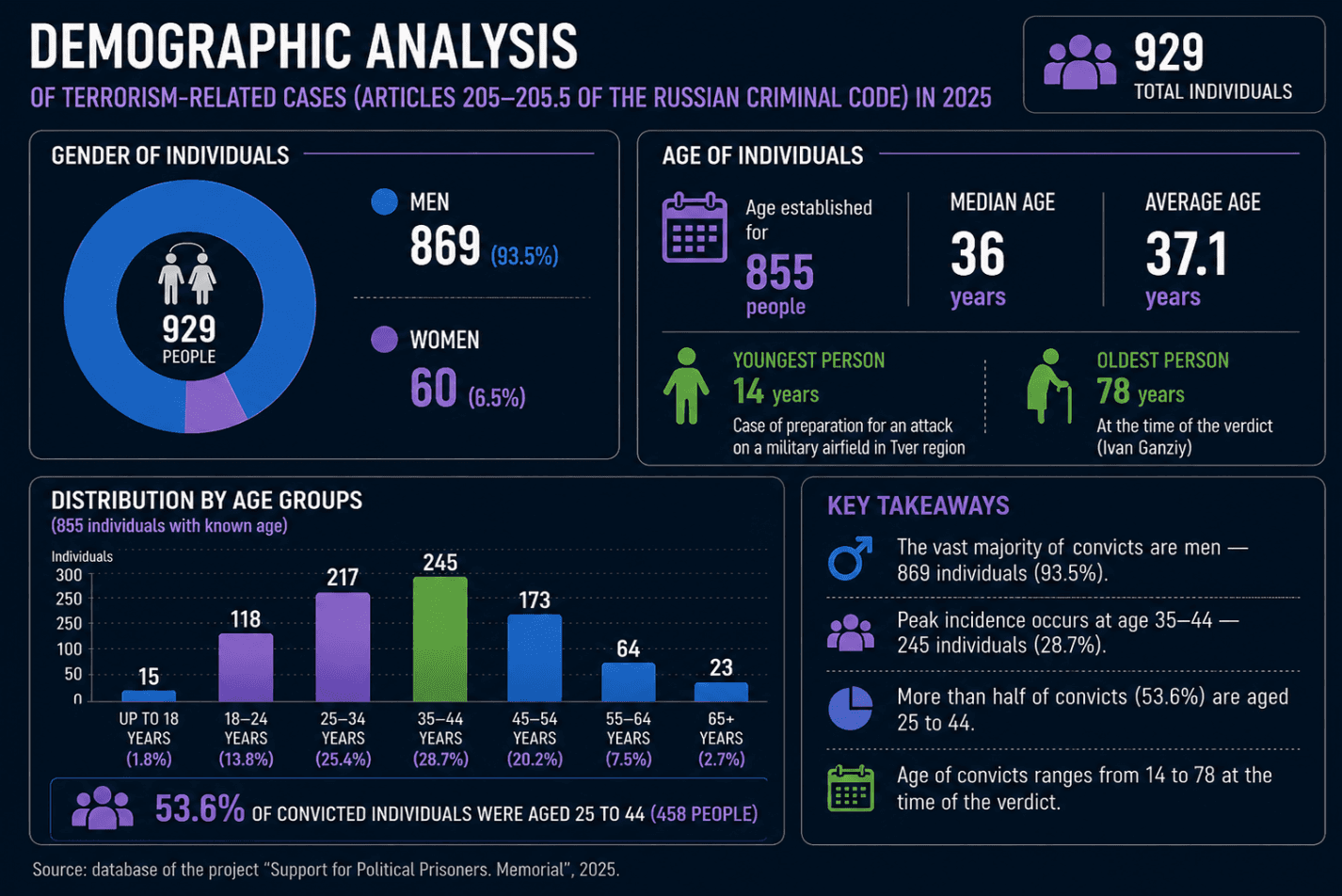
The demographic analysis shows that the overwhelming majority of individuals convicted in terrorism-related cases during 2025 were men. Among the 929 defendantsfor whom gender could be established, 869 (93.5%) were male, while 60 (6.5%) were female.
Age was established for 855 convicted individuals. The median age was 36 years, while themean age was 37.1 years. The largest age group consisted of individuals aged 35–44 years, accounting for 245 people (28.7% of those with known age). Overall, more than half of all convicted individuals (53.6%) were between 25 and 44 years of age.
The youngest identified person convictedin 2025 was14 years old, in a case involving thepreparation of an arson attack on a military recruitment office in the Tver Region. The oldest was 78-year-old Ivan Hanzii.
Terrorism-Related Criminal Prosecutions in Russia in 2025
Convictions of Ukrainian Citizens
Particular attention should be paid to the role ofUkrainian citizensin the overall pattern of terrorism-related prosecutions in Russia.
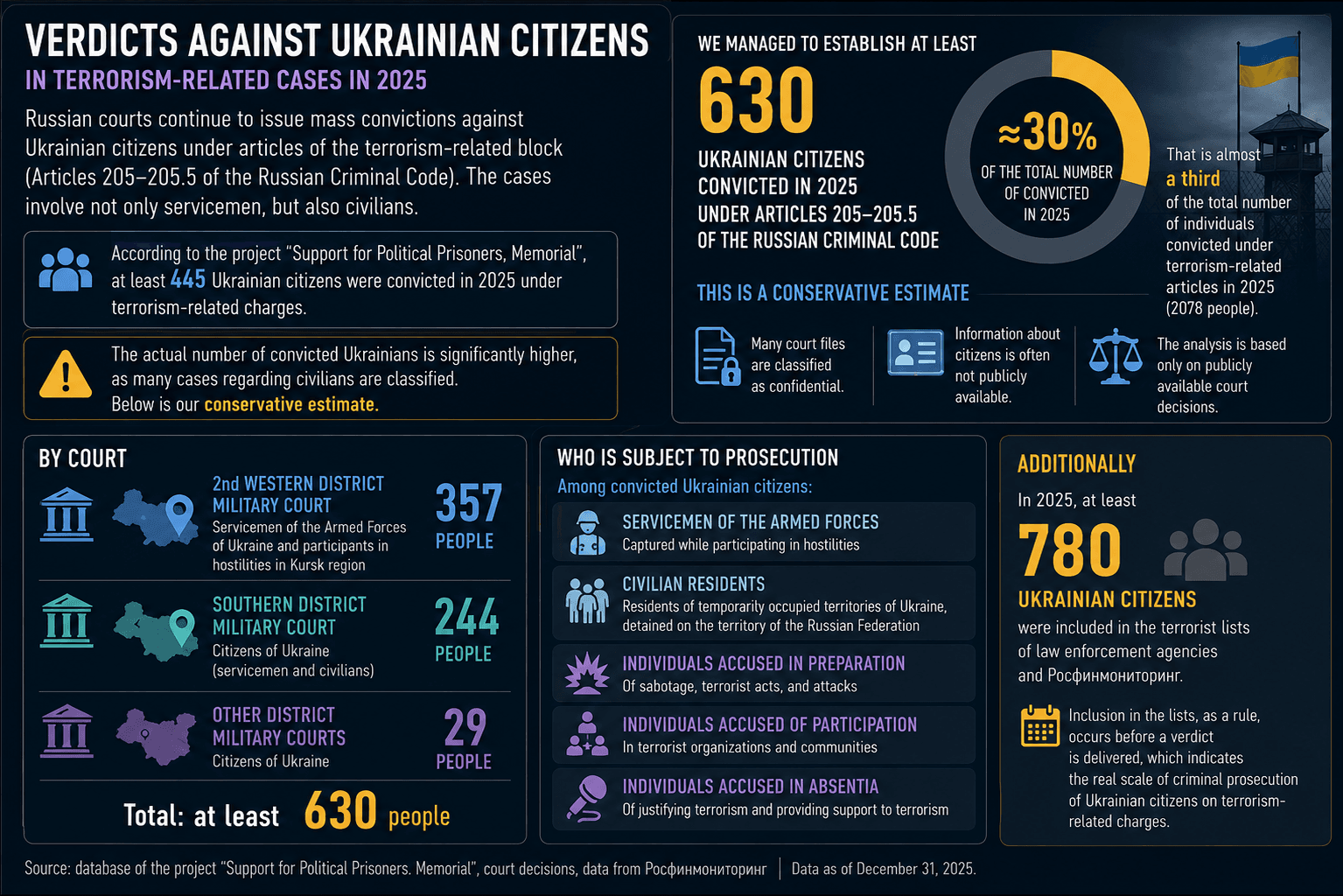
According to data from the Memorial Political Prisoners Support Project,at least 498 people convicted under terrorism-related provisions in 2025 werecitizens of Ukraine. This group includes not only Ukrainian military personnel captured during hostilities, but also civilians. Among those convicted are prisoners of war, residents of the Russian-occupied territories of Ukraine, and civilian defendants prosecuted for the preparation of sabotage or terrorist attacks, participation in terrorist organizations, assisting terrorist activities, or the public justification of terrorism.
The Memorial database, however, reflects only those cases in which the defendants’ nationality has been identified and documented by the organization’s researchers. Additional analysis of court records, appellate decisions, and other open sourcesindicates that the actual number of convicted Ukrainian citizens wassubstantially higher.
In 2025 alone, the Second Western District Military Court convicted at least 357 members of the Armed Forces of Ukraine who had participated in military operations in theKursk Region. TheSouthern District Military Court convicted at least 244 additional Ukrainian citizens, while other district military courts convicted at least 29 more.
By combining information from multiple sources, this study identified at least 630 Ukrainian citizens convicted under Articles 205–205.5 of the Russian Criminal Code during 2025. This represents approximately 30% of all identified individuals convicted under these terrorism-related provisions.
In other words, nearly one out of every three people convicted on terrorism-related charges in Russia during 2025 was a Ukrainian citizen.
Further evidence of the scale of criminal prosecutions targeting Ukrainian citizens can be found in the practice of adding them to Rosfinmonitoring’s List of Terrorists and Extremists. According to the available data,at least 780 Ukrainian citizens were added to theterrorist sectionof the list during 2025 alone. Because inclusion on the list typically occurs before a criminal conviction is handed down, this figure provides an additional indicator of the overall scale of terrorism-related criminal prosecutions against Ukrainian citizens.
Terrorism-Related Criminal Prosecutions in Russia in 2025
Conclusions
This analysis demonstrates that 2025 marked an unprecedented expansion in the use of terrorism-related provisions in Russia. During the year, at least 1,776 judgmentswere delivered under Articles205–205.5 of the Russian Criminal Code, resulting in the conviction of 2,078 individuals—the highest annual total recorded since the adoption of the current Criminal Code.
Several key trends emerge from the findings.
First, terrorism-related offences have become one of the largest categories of criminal prosecution in Russia. In 2025, the number of people convicted under terrorism-related provisions exceeded the number convicted of high treason and espionage by more than four to one.
Second,Article 205.2 has become a central feature of contemporary terrorism-related prosecutions. Nearlyone out of every two convicted individuals was charged under this provision, and for hundreds of defendants it constituted either the only terrorism-related offence or the sole criminal charge in the case. This indicates that the application of Russia’s terrorism legislation increasingly extends to public statements, online publications, and other forms of information-related activity.
Third, a substantial proportion of terrorism-related prosecutions is linked to Russia’s war against Ukraine. At least 630 Ukrainian citizens were convicted under terrorism-related provisions during 2025, accounting for approximately one-third of all identified convicted individuals. This group includes not only members of the Ukrainian armed forces but also civilians. The inclusion of at least 780 Ukrainian citizensin theterrorist section of Rosfinmonitoring’s List of Terrorists and Extremists during the same year further illustrates the scale of these prosecutions.
Fourth, the sentencing analysis demonstrates the exceptional severityof punishments imposed in terrorism-related cases. The median prison sentence was 15 years, while more than half of all convicted individuals for whom sentencing information was available received at least 15 years’ imprisonment or life imprisonment. In terms of severity, these penalties are comparable to those imposed in cases involving high treason and espionage.
Finally, the study highlights the high level of opacity within the judicial system. The identities ofapproximately two-thirds of all convicted individuals were concealed in publicly available court records, significantly limiting public scrutiny of terrorism-related proceedings.
Taken together, these findings indicate that terrorism-related provisions became one of the principal instruments of criminal prosecution in Russia during 2025. The unprecedented scale of their application, the growing prominence of prosecutions involving public expression, the substantial number of Ukrainian citizens among those convicted, and the exceptional severity of the resulting sentences point to a qualitative expansion of the role of terrorism legislation within Russia’s system of criminal justice.