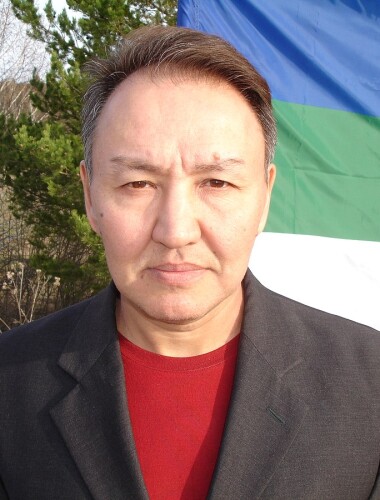
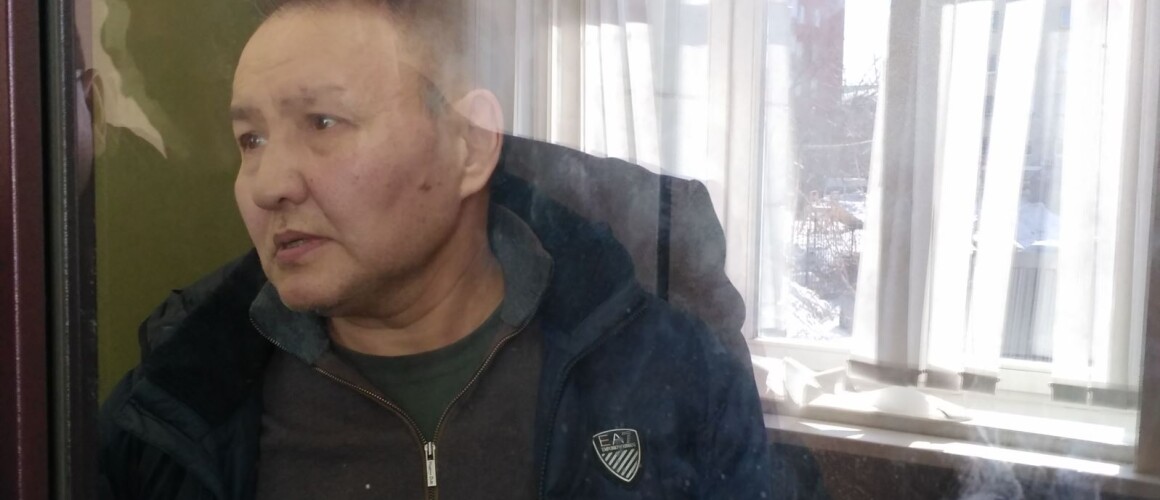
Bashkir writer and journalist Airat Dilmukhametov is a political prisoner
Opposition writer and journalist, and a participant in the Bashkir national movement, Airat Dilmukhametov, has been charged with committing a crime under Article 280.1, Section 2, of the Russian Criminal Code (‘Public incitement to commit actions intended to violate the territorial integrity of the Russian Federation,’ that carries a maximum sentence of up to five years’ deprivation of liberty). Dilmukhametov has been held on remand on this new charge since 14 March 2019.

Dilmukhametov stands accused of having posted a video on YouTube in April 2018 entitled ‘APPEAL by Airat Dilmukhametov, a candidate for the presidency of Bashkortostan, to the Fifth Forum of Free Russia.’ The video, according to investigators, ‘contains linguistic evidence of incitement, including sloganising, to actions intended to create a different federation by means of leaving Russia and creating a new state with new laws and regulations that would satisfy a newly created government of the Republic of Bashkortostan.’
We consider Airat Dilmukhametov a political prisoner for two reasons. First, Article 280.1 of the Russian Criminal Code has, in our opinion, no right to exist as a matter of law. We concur with the view of the Sova Centre, according to which a state should criminalise only such aspects of separatism as are linked with violence, or with the propaganda of acts of violence, conducted with the intention of separating one or other region from the Russian Federation, and not theoretical speculations about the permissibility of their separation.
Second, having examined the video on which the accusations against Dilmukhametov are based, we conclude that there is no evidence of incitement to violence, of stirring up ethnic or religious hatred, or of any crime whatsoever. The video cannot even be called separatist, in the strict sense of the word. Dilmukhametov maintains he is innocent of the charges of separatism and asserts that ‘in my numerous speeches, articles and interviews I always stressed that the Republic of Bashkortostan will not leave Russia: the Republic will propose a new treaty-based model of federation, created from below.’
Given the circumstances of the criminal case brought against Airat Dilmukhametov, the conclusion can be drawn that the prosecution has been politically motivated and is directly related to Dilmukhametov’s civic and political activities. Dilmukhametov has been a consistent critic of the political leadership of both the Republic of Bashkortostan and the Russian Federation. He has actively promoted the ideas of Bashkir nationalism in his articles on popular Bashkir websites, at the same time holding firmly to opposition views and speaking out in favour of collaboration with those in the political opposition who had different views and came from different ethnic and religious background. Dilmukhametov has been repeatedly prosecuted for his statements and, in the preceding criminal case, was recognised as a political prisoner by Memorial.
Recognition of an individual as a political prisoner, or of a prosecution as politically motivated, does not imply that Memorial Human Rights Centre shares or approves the individual’s views, statements or actions.
More information about his case is available here.