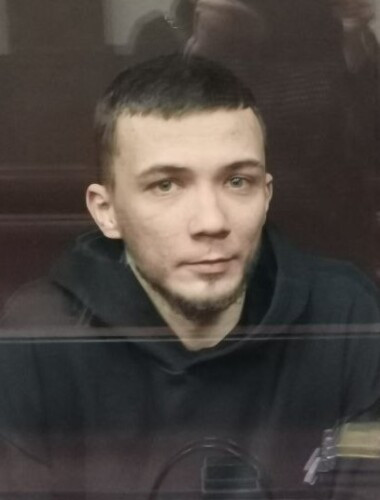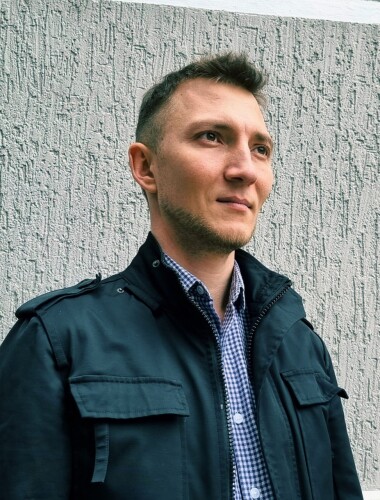
Boris Goncharenko and Bogdan Abdurakhmanov are political prisoners
The residents of Krasnodar Krai face up to 20 years’ imprisonment for the attempted arson of a military recruitment centre
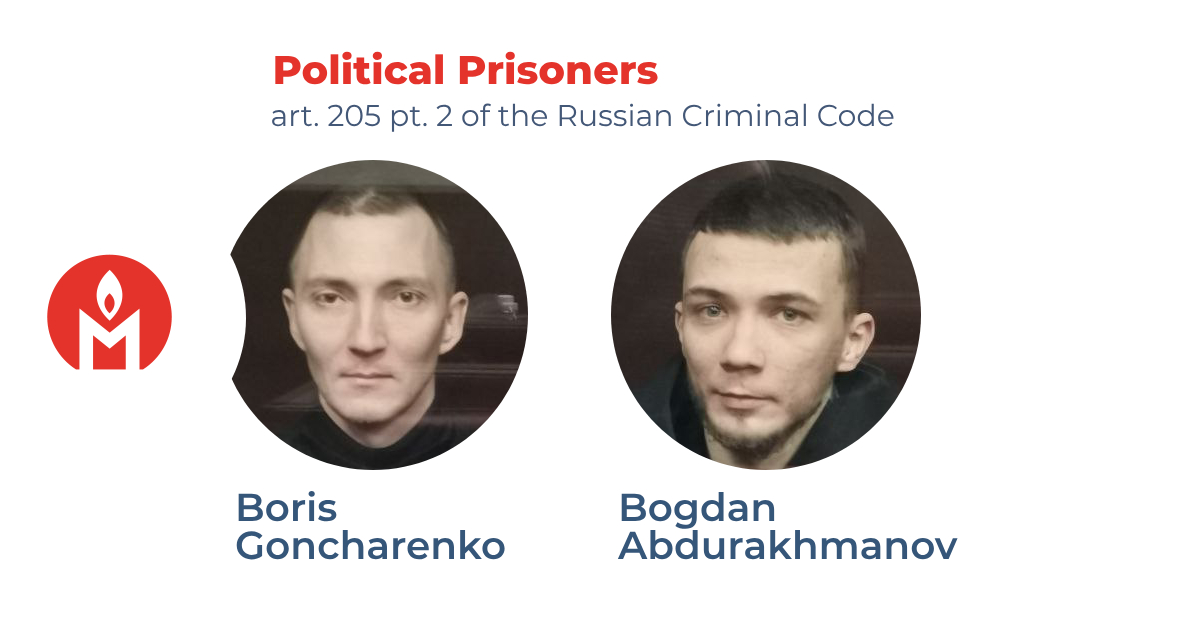
The ‘Political Prisoners. Memorial’ human rights project, in accordance with international standards, considers Boris Goncharenko and Bogdan Abdurakhmanov political prisoners. They are being prosecuted for terrorism after attempting to set fire to a military recruitment centre. Their criminal prosecution and the fact that they have been remanded in custody violate their right to fair trial.
We demand that the terrorism charges against Goncharenko and Abdurakhmanov be dropped and that the two men be given a fair trial.
What are the charges against Boris Goncharenko and Bogdan Abdurakhmanov?
On the night of 6 October 2022, Bogdan Abdurakhmanov, a resident of the town of Goryachy Klyuch in Krasnodar Krai, drew a peace symbol on the wall of the local military recruitment centre and tried to set fire to its door with three Molotov cocktails that had been made by his acquaintance, Boris Goncharenko. The fire was extinguished before the firefighters arrived.
On 7 October, Goncharenko and Abdurakhmanov were detained, and on 24 October, they were remanded in custody.
Initially, the two men were charged with attempted destruction of property (Article 30, Part 3, in conjunction with Article 167, Part 2, of the Russian Criminal Code), but after the intervention of the FSB the charges were reclassified as ‘commission of a terrorist act by a group of persons in prior conspiracy’ (Article 205, Part 2, of the Russian Criminal Code). Goncharenko and Abdurakhmanov face up to 20 years’ imprisonment if convicted.
Why do we consider them political prisoners?
The actions of Abdurakhmanov and Goncharenko caused no significant harm to anyone. We believe their actions can be classified as the much less serious offence of ‘deliberate destruction of, or damage to, property’.
We do not agree with the classification of the attempted arson of the military recruitment centre as an act of terrorism. An essential feature of an act of terrorism is the presence of the motive of ‘intimidation of the public.’
In reality, the actions of Abdurakhmanov and Goncharenko were motivated by the desire to protest against Russian aggression in Ukraine, as evidenced both by their own testimonies and the peace symbol they drew on the wall of the military recruitment centre.
A detailed description of the case of Boris Goncharenko and Bogdan Abdurakhmanov and the position of the ‘Political Prisoners. Memorial’ human rights project are available on our website.
Recognition of an individual as a political prisoner does not imply the ‘Political Prisoners. Memorial’ human rights project agrees with, or approves, their views, statements, or actions.
How can you help?
You can write to Boris Goncharenko and Bogdan Abdurakhmanov at the following address:
In Russian: 344022, Ростов-на-Дону, ул. Максима Горького, д. 219, ФКУ СИЗО-1 ГУФСИН России по Ростовской области, Гончаренко Борису Андреевичу 1988 г. p. / Абдурахманову Богдану Руслановичу 1995 г. р.
In English: Boris Andreevich Goncharenko (born 1988) / Bogdan Ruslanovich Abdurakhmanov (born 1995), Remand Prison No. 1, Federal Penitentiary Service of Russia for Rostov region, 219 Ulitsa Maksima Gorkogo, Rostov-on-Don, 344022, Russia.
You can also send an electronic letter via OVD-Info (free of charge) and via Zonatelecom (Russian bank cards) or PrisonMail (other bank cards).
Please note that letters in languages other than Russian are highly unlikely to reach the recipient.
You can donate to support all political prisoners in Russia.