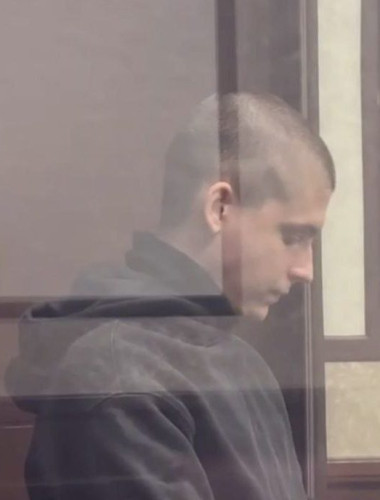
Dmitry Levin is a political prisoner
A native of Ukraine’s Donetsk Oblast, sentenced to 15 years’ imprisonment on charges of treason and participation in a terrorist organisation, was most likely a victim of a sting operation by Russian intelligence agencies
The ‘Political Prisoners. Memorial’ human rights project, in accordance with international standards, considers Dmitry Levin a political prisoner. Levin was convicted on criminal charges of treason and participation in the activities of a terrorist organisation for sharing photographs of Russian military ships and Ministry of Defence facilities in Novorossiysk via Telegram. Levin’s criminal prosecution and conviction violated his right to a fair trial. We demand a review of Levin’s criminal case in a fair trial in accordance with international legal standards.
What were the charges against Dmitry Levin?
Dmitry Levin, born in the city of Horlivka in Ukraine’s Donetsk region, at age 10 in 2014 moved with his parents to Novorossiysk following the outbreak of hostilities. He subsequently obtained Russian citizenship. After the start of Russia’s full-scale invasion of Ukraine in 2022, Levin repeatedly publicly expressed opposition to the war. In particular, he refused to attend college lectures on the ‘reasons for the special military operation.’
On 5 April 2024, Levin was detained while putting up flyers. He was initially jailed for 15 days on an administrative-law charge of disobeying the police. Subsequently, a criminal case was opened against him. On 11 April, a search was carried out at the apartment where Levin lived with his parents, and he was remanded in custody. Levin was charged with ‘treason in the form of aiding a foreign state in activities directed against the security of the Russian Federation’ (Article 275 of the Criminal Code of the Russian Federation), and with ‘participating in the activities of a terrorist organisation’ (Article 205.5, Part 2, CC RF). According to the verdict, he passed information to Ukrainian intelligence and the Russian Volunteer Corps about ‘the number and location of military ships in Tsemesskaya Bay’ in Novorossiysk and about military facilities located in the city.
On 6 March 2025, Levin was sentenced to 15 years’ imprisonment, the first three of which are to be served in a cell-type prison and the rest in a strict regime penal colony.
Why do we consider Dmitry Levin a political prisoner?
There is every reason to believe Dmitry Levin fell victim to a sting operation by Russian security services and that all his supposed contacts with ‘Ukrainian intelligence’ and the ‘Russian Volunteer Corps’ were in fact with FSB officers or their agents. This is evidenced by the history of his correspondence and the absurdity of the tasks assigned to him by the ‘representatives of Ukraine.’
Even if the theory of a sting operation is discarded, helping Ukraine repel Russian aggression does not pose a threat to the security of the Russian Federation. The main threat to Russia’s security is the war launched by Russia against Ukraine.
It is also doubtful that information provided by a college student would have been of interest to Ukrainian intelligence.
Furthermore, the Russian Volunteer Corps is a unit of the Ukrainian armed forces participating legitimately in the defence of Ukraine from Russian aggression. Its designation as a ‘terrorist organisation’ is unlawful. Even the court’s verdict explicitly admits that the Russian Volunteer Corps is an armed formation that is part of the Ukrainian military. The charge against Levin of participating in the activities of a terrorist organisation is therefore untenable.
A detailed description of Dmitry Levin’s case and of our position is available on our website.
How can you help?
You can write to Dmitry Levin at the following address:
RU:
Российская Федерация, 600020, г. Владимир, ул. Большая Нижегородская, д. 67, ФКУ Т-2 УФСИН России по Владимирской области, Левин Дмитрий Олегович, 2003 г. р.
EN:
Dmitry Olegovych Levin (born 2003), Prison No. 2, Federal Penitentiary Service of Russia for Vladimir Oblast, 67 Bolshaya Nizhegorodskaya Street, Vladimir, 600020, Russia.
You can also send emails via ZT (for payment with all bank cards) and Memorial-France (free of charge).
Please note that letters in languages other than Russian are highly unlikely to reach the intended recipient.
You can donate to help all political prisoners in Russia.