
Gennady Artyomenko is a political prisoner
A military pensioner from Nizhny Novgorod Oblast was sentenced to 18 years for anti-war leaflets and correspondence with the Ukrainian movement Atesh
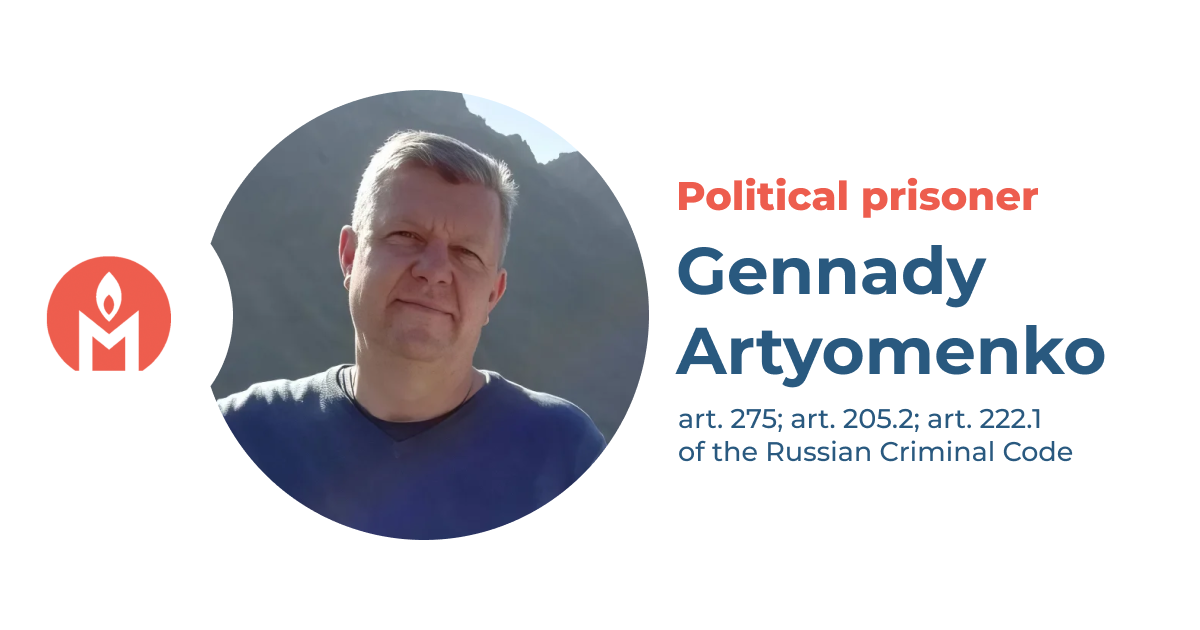
Gennady Artyomenko is a native of Dniprodzerzhynsk, Ukraine. He served in the Soviet and Russian armed forces and retired with the rank of lieutenant colonel. He lived with his family in Dzerzhinsk, Nizhny Novgorod Oblast. After the start of the full-scale war, he attempted to travel to Ukraine to see his elderly mother, who had been left there alone. In October 2023, Artyomenko was detained and placed in pre-trial detention.
Initially, a criminal case was opened against Artyomenko for possession of explosives (Article 222.1 of the Russian Criminal Code): during a search of his home, officers allegedly found smokeless powder and imitation explosive devices. Artyomenko himself maintained that these items had been planted — either during an unexpected visit by gas service workers shortly before his arrest or during the search itself. No biological traces linking him to the seized items were found.
In the summer of 2024, Artyomenko was additionally charged with high treason (Article 275 of the Russian Criminal Code) and public calls for terrorism (Article 205.2 of the Russian Criminal Code). According to investigators, he contacted a representative of the Ukrainian and Crimean Tatar military movement Atesh via Telegram, distributed anti-war leaflets in Dzerzhinsk, sent photographs of those leaflets, and also took pictures of a military facility and an FSB building.
Artyomenko himself did not deny distributing the leaflets but explained that he had done so because of his anti-war views. He stressed that he had photographed only the exterior walls of buildings where he had pasted or intended to paste leaflets — places visible to any passerby.
During the investigation, Artyomenko was tortured, and his wife was threatened, forcing her to leave Russia. In June 2025, a court sentenced Artyomenko to 18 years in a strict-regime penal colony and imposed a fine of 350,000 rubles. On appeal, the prison term remained unchanged, while the fine was reduced to 60,000 rubles.
The investigation failed to prove that Artyomenko had transmitted classified information or that his actions posed any threat to Russia’s security. The leaflets of the Atesh movement — which had not yet been designated a terrorist organization in Russia at the time of Artyomenko’s trial — did not contain calls for violence.
A detailed description of Gennedy Artyomenko’s case and of our position is available on our website.
How can you help?
You can write to Gennady Artyomenko at the following address:
Ru:
603098, Нижний Новгород, пр-т Гагарина, д. 26А, ФКУ СИЗО-1 ГУФСИН России по Нижегородской области, Артёменко Геннадию Васильевичу, 1968 г. р.
En:
Remand Prison No. 1, Federal Penitentiary Service of Russia for Nizhny Novgorod Oblast, 26A Prospekt Gagarina, Nizhny Novgorod, 603098, Russia, Artyomenko Gennady Vasilievich, born 1968.
You can also send emails via the ZT service (for payment with all bank cards), and Memorial-France (free of charge).
Please note that letters in languages other than Russian are highly unlikely to reach the intended recipient.
You can donate to help all political prisoners in Russia.
