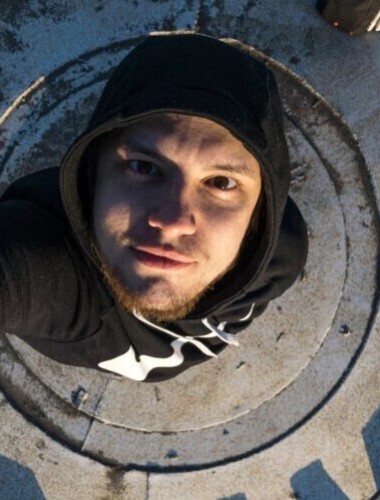
Grigory Skvortsov is a political prisoner
A photographer and musician from Perm has been sentenced to 16 years in a strict regime penal colony on a charge of treason for passing publicly available materials about Moscow’s underground bunkers to a foreign journalist
The ‘Political Prisoners. Memorial’ human rights project, in accordance with international standards, considers Grigory Skvortsov a political prisoner. Skvotsov was convicted on a charge of treason for collecting and transmitting freely available information about Moscow’s underground bunkers. Grigory Skvortsov’s criminal prosecution and conviction violated his right to a fair trial. We demand that Grigory Skvortsov be released and that all criminal charges against him be dropped.
What were the charges against Grigory Skvortsov?
Grigory Skvortsov is a photographer of industrial and underground sites who played in the rock band Jagath. On 29 November 2023, he was detained in Perm and his apartment was searched. According to Skvortsov, FSB officers beat him and forced him to testify against himself. He was later transferred to Moscow and remanded in custody in the Lefortovo detention centre.
Skvortsov was charged with treason in the form of espionage and aiding a representative of a foreign state in activities directed against the security of the Russian Federation (Article 275 of the Criminal Code of the Russian Federation). According to the investigative authorities, Skvortsov collected diagrams of ‘special fortifications on the territory of Moscow city’ from open sources on the Internet, superimposed their coordinates on Google Maps, and sent files with these diagrams to a foreign journalist. The FSB alleged that the journalist was working with the CIA, while a forensic examination established that some of the information collected by Skvortsov contained state secrets. Skvortsov denied his guilt and stated that all the data he had collected was freely available.
On 26 June 2025, Grigory Skvortsov was sentenced to 16 years in a strict regime penal colony with one year’s probation after serving his sentence. On 12 September 2025, a court of appeal upheld the sentence.
Why do we consider Grigory Skvortsov a political prisoner?
At trial, the prosecution failed to prove that Skvortsov’s actions constituted a crime. Skvortsov had no access to state secrets and all the information he obtained came from open sources. This information included material from Dmitry Yurkov’s book Sovetskie ‘sekretnye bunkery’: gorodskaya spetsialnaya fortifikatsiya 1930-1960-x godov [Soviet ‘Secret Bunkers’: Urban Special Fortification of 1930s-1960s], which had been based on declassified archival materials. However, after Yurkov’s book had been published in 2021, these materials were subsequently reclassified. This then became the basis for the charge of treason against Skvortsov.
Skvortsov did not know and could not have known about the reclassification of the materials, since at the time of collecting and sending the materials to the journalist, they were still freely available on the Internet. Furthermore, the court did not provide any convincing evidence of the journalist’s involvement with the CIA or that Skvortsov knew of such involvement.
Skvortsov may have attracted the attention of FSB officers because of his public anti-war statements. His criminal prosecution can be seen as yet another example of the fabrication of criminal cases as part of the state’s repressive campaign against so-called ‘spies’ and ‘traitors to the motherland.’
A detailed description of Grigory Skvortsov’s case and of our position is available on our website.
How can you help?
You can write to Grigory Skvotsov at the following address:
RU:
165651, Архангельская область, г. Коряжма, Магистральное шоссе, д. 101, ФКУ ИК-5 УФСИН России по Архангельской области, Скворцов Григорий Александрович, 1989 г. р.
EN:
Grigory Aleksandrovich Skvortsov (born 1989), Penal Colony No. 5, Federal Penitentiary Service of Russia for Arkhangelsk Oblast, 101 Magistralnoye Shosse, Koryazhma, Arkhangelsk Oblast, 165651, Russia.
You can also send emails via ZT (for payment with all bank cards) and Memorial-France (free of charge).
Please note that letters in languages other than Russian are highly unlikely to reach the intended recipient.
You can donate to help all political prisoners in Russia.