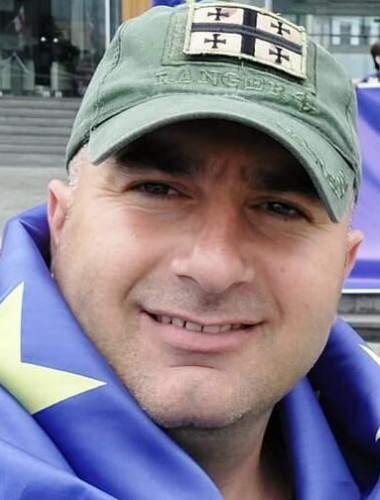
Irakli Khufenia is a political prisoner
The Georgian opposition activist was detained upon entering Russia and sentenced to two years in a penal colony on charges of justifying terrorism
The ‘Political Prisoners. Memorial’ human rights project, in accordance with international standards, considers Irakli Khufenia a political prisoner. Khufenia was convicted on a charge of ‘public justification of terrorism using the internet’ for posts on social media. Khufenia’s criminal prosecution violated his rights to freedom of expression and a fair trial. We demand his immediate release and that all criminal charges against him be dropped.
What were the charges against Irakli Khufenia?
Irakli Khufenia, a Georgian citizen, is a blogger and a member of the United National Movement, a Georgian opposition party. On 16 January 2025, Khufenia was detained crossing the border into Russia as he was travelling on business with relatives. His detention was followed by two short-term consecutive jail terms for administrative-law offences of petty hooliganism. Khufenia was then charged with justifying terrorism (Article 205.2, Part 2, of the Criminal Code of the Russian Federation).
The grounds for the criminal case against Khufenia were two Georgian-language social media posts. In one, Khufenia posted a photograph of Bondo Gagnidze, a Georgian who died fighting on the side of Ukraine. In another, he posted an image of a road sign featuring the Ukrainian flag and symbols, with an inscription in Ukrainian: ‘Welcome to Kursk Oblast.’
On 18 June 2025, Irakli Khufenia was sentenced to two years in a general regime penal colony.
Why do we consider Khufenia a political prisoner?
We have no information about the exact content of Khufenia’s comments in Georgian. However, their approximate description and context allow us to make a basic assessment of the legality of his criminal prosecution.
The first episode is based on a Russian court’s unlawful decision to designate the Georgian National Legion, in which Gagnidze allegedly fought, as a terrorist organisation. The Georgian National Legion is a civil society organisation that supports Georgian citizens serving in official units of the Ukrainian armed forces. Neither the activities of this organisation nor participation in military operations can be considered terrorism. Accordingly, Irakli Khufenia’s post regarding the death of Bondo Gagnidze cannot be considered justification of terrorism.
The second episode relates to the endorsement of the Ukrainian armed forces’ incursion into Russia’s Kursk Oblast. The Russian authorities regard the actions of the Ukrainian armed forces on the territory of Kursk region as terrorism. This is an utterly absurd assertion. Under international law, warring parties may engage in combat across the entire theatre of operations, i.e. on both sides of a state border. Expressing support for the Ukrainian army in its lawful actions does not constitute justification of terrorism.
Furthermore, a Georgian citizen cannot as a rule be held criminally liable on Russian territory for publications made whilst in his own country. In law, this is possible only if their actions are directed against Russia’s interests. Support for Ukraine does not conflict with these interests.
A more detailed description of the case of Irakli Khufenia and of our position is available on our website.
How can you help?
If you have information about Irakli Khufenia’s place of detention, please let us know by email: [email protected].
You can donate to help all political prisoners in Russia.