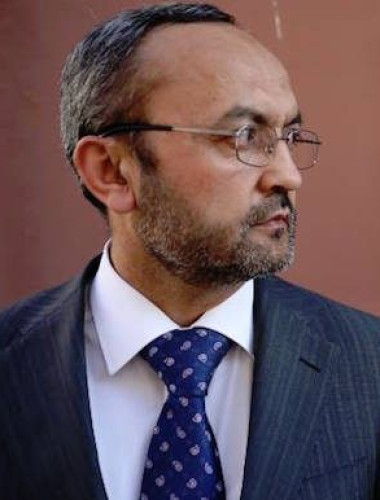
Months in punishment cells, medication withheld, frozen during exercise — Bakhrom Khamroyev’s wife speaks out about conditions at Kharp
The health of human rights defender Bakhrom Khamroyev is deteriorating at Polar Owl penal colony due to lack of medical care and harsh conditions, according to his wife, Zuhra Khamroyeva, following a prison visit.
Bakhrom Khamroyev arrived at Penal Colony No. 18 in the Yamalo-Nenets Autonomous District on 17 June 2025. On his first day, he was placed in a so-called stakan — literally a ‘glass’ in Russian, a narrow standing cell in which it is only possible to remain upright — in the colony’s administrative building, where he spent four hours without medication, food or water, until he became dizzy and began struggling to breathe. A prison officer released him only after he began shouting and calling staff fascists.
Following quarantine, Bakhrom Khamroyev was held in a punishment isolation cell for three months, then transferred to a stricter cellular unit for a further six.
‘For the first month, Bakhrom was given no medication, and the food was appalling. His glasses and his Quran were confiscated,’ Zuhra Khamroyeva writes. ‘The lack of medication and poor nutrition brought on severe vomiting. Medical staff, alerted by surveillance cameras, came and intervened, and it was only then that he began to receive his medication.’
Bakhrom Khamroyev is currently being denied access to a glucometer and a blood pressure monitor. According to his wife, Cardiomagnyl, prescribed to prevent blood clots, has been replaced with aspirin. ‘They have also stopped providing Preductal,’ she adds, referring to a cardioprotective drug. ‘The colony refuses to accept the medication I send and returns it.’
During winter, Bakhrom was denied warm trousers for walks in freezing temperatures. ‘As a result, he developed severe pain in his left leg, which lasted for several weeks,’ Zuhra writes.
Bakhrom Khamroyev is the director of Yordam, a foundation providing legal and social support to migrants. Before its forced liquidation, he was a member of Memorial Human Rights Defence Centre, and is an activist with the Uzbek opposition movement Birlik. He was sentenced to thirteen years and nine months in a penal colony, having been convicted of membership of Hizb ut-Tahrir under Part 2 of Article 205.5 of the Russian Criminal Code, and of reposting material associated with the organisation under Part 2 of Article 205.2. Bakhrom Khamroyev categorically denies any involvement in the organisation’s activities.