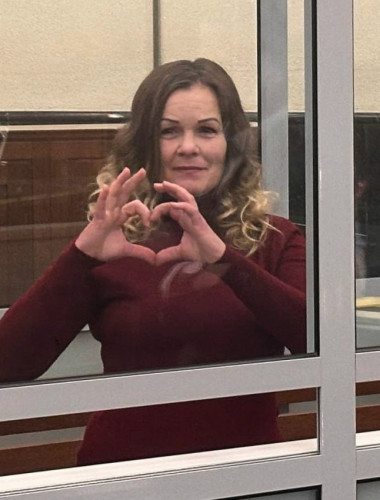
Oksana Hladkykh is a political prisoner
A Ukrainian woman has been sentenced to 14 years’ imprisonment for on a charge of treason against Russia

The ‘Political Prisoners. Memorial’ human rights project, in accordance with international criteria, considers Oksana Hladkykh a political prisoner. Hladkykh was convicted on a charge of treason in the form of espionage, allegedly for passing information to Ukrainian intelligence. Hladkykh’s criminal prosecution and conviction violated her right to a fair trial. We demand the immediate release of Oksana Hladkykh and that all criminal charges against her be dropped.
What were the charges against Oksana Hladkykh?
Oksana Hladkykh, a mother of three young children, lived in the settlement of Priazovske in Ukraine’s Zaporizhzhia region. After the Russian invasion of Ukraine and the occupation of the settlement where she was living, she was forced to obtain Russian citizenship so her children could continue attending school. Nevertheless, Hladkykh did not hide her opposition to Russian soldiers and openly expressed her views on social media. As a result, a denunciation of her appeared on the Telegram channel Zhduny of Zaporizhzhia Province, which aims to identify and expose individuals with pro-Ukrainian views in territories under Russian occupation.
On 24 November 2023, law enforcement officers searched Hladkykh’s home and detained her on a charge of treason in the form of espionage (Article 275 of the Russian Criminal Code). According to the prosecution, she allegedly passed information about Russian troops and facilities to Ukrainian intelligence.
Hladkykh reported that after her detention, she was initially held in Mariupol, moved ‘from place to place’ with a bag over her head, poorly fed and given insufficient water. Over several months she lost 13 kilograms. She was later placed in a remand prison.
On 7 June 2024, the Russian-controlled Zaporizhzhia Oblast Court sentenced Oksana Hladkykh to 14 years in a general regime penal colony.
Why do we consider Oksana Hladkykh a political prisoner?
Russian authorities initiated the prosecution of the Ukrainian citizen Oksana Hladkykh after Russian troops launched a full-scale invasion of Ukraine and partially occupied Zaporizhzhia Oblast, where she lived. The Russian occupiers pressure Ukrainians to accept Russian citizenship. In this context, it is absurd to speak of treason against an occupying power.
Hladkykh is accused of passing unclassified information about Russian facilities in occupied territories to an online contact. The facilities in question were not connected to Russia’s security, since they are located on the territory of another country.
Oksana Hladkykh’s prosecution and conviction violated the Geneva Convention on the Protection of Civilian Persons in Time of War, in particular her rights to humane treatment and to a fair and impartial trial.
It appears that Hladkykh was convicted on the basis of an anonymous denunciation, although we do not rule out the possibility of a deliberate provocation by Russian security forces.
Hladkykh, a mother of four children, three of whom are minors, was sentenced to 14 years’ imprisonment. This punishment is clearly disproportionate to the public danger of her alleged actions and is intended to intimidate Ukrainians living under Russian control.
A detailed description of Oksana Hladkykh’s case and of our position is available on our website.
Recognition of an individual as a political prisoner does not imply the ‘Political Prisoners. Memorial’ human rights project agrees with, or approves, their views, statements, or actions.
How can you help?
You can write to Oksana Hladkykh at the following address:
RU: 612100, Кировская область, Котельнич, Даровской тракт, ФКУ ИК-33 УФСИН России по Кировской области, Гладких Оксана Николаевна, 1976 г. р.
EN: Oksana Mykolayivna Hladkykh (born 1976), Penal Colony No. 33, Federal Penitentiary Service of Russia for Kirov Oblast, Darovskoi Trakt, Kotelnich, Kirov Oblast, 612100, Russia.
You can also send emails via the ZT service (for payment with Russian bank cards).
Please note that letters in languages other than Russian are highly unlikely to reach the intended recipient.
You can donate to help all political prisoners in Russia.