
Anton Yevdokimov is a political prisoner
An IT specialist from Moscow has been sentenced to one and a half years’ imprisonment on a charge of justifying terrorism for a comment about the explosion on the Crimean Bridge
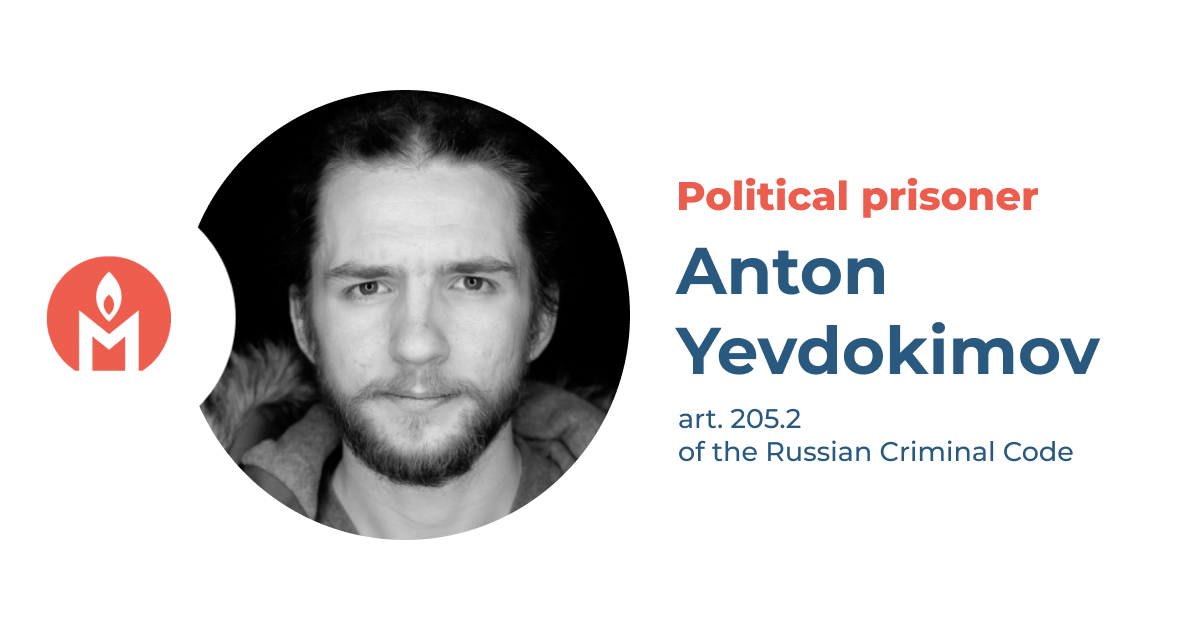
The ‘Political Prisoners. Memorial’ human rights project, in accordance with international criteria, considers Anton Yevdokimov a political prisoner. Yevdokimov was convicted on a charge of public justification of terrorism for a comment on social media allegedly approving the explosion on the Crimean Bridge. Yevdokimov’s prosecution violated his rights to freedom of expression and fair trial. We demand the immediate release of Anton Yevdokimov from custody and that all criminal charges against him be dropped.
What are the charges against Anton Yevdokimov?
Anton Yevdokimov is a 36-year-old systems administrator from Troitsk near Moscow. He held anti-war views, regularly wrote on social media about political prisoners and repression, and criticised the Russian authorities. In 2021, he was detained for participating in a rally in support of Aleksei Navalny.
According to his relatives, in October 2024, a criminal case was opened against Yevdokimov on a charge of public justification of terrorism (Article 205.2, Part 2, of the Russian Criminal Code) for a comment on the VK social media site in which he spoke positively about the bombing of the Crimean Bridge. On 23 October, law enforcement officers, with the assistance of a Special Rapid Response Unit, broke down the door to his apartment and detained Yevdokimov. Yevdokimov has been on remand ever since. He refused to engage a lawyer and admitted to being the author of the posts.
In January 2025, he was fined for ironic posts in support of LGBT people.
Subsequently, he was convicted on the terrorism justification charge and sentenced to one and a half years’ imprisonment.
Why do we consider Anton Yevdokimov a political prisoner?
We do not know exactly what statements by Anton Yevdokimov formed the basis for the charge, but we believe that, in any case, they cannot be classified as a justification of terrorism. The attack on the Crimean Bridge was not an act of terrorism. Responsibility for it was claimed by the Ukrainian side, which is resisting Russian aggression. The bridge connecting occupied Crimea with Russia has a dual purpose, both civilian and military, which means it can be considered a legitimate target in an armed conflict. Consequently, the attack on the bridge was not an act of terrorism but an episode in the ongoing hostilities.
Even if Yevdokimov’s statement did pose a danger to society, it would be minimal. His online comment was unlikely to have been read by many people, and it certainly could not have influenced Ukraine’s military planning. Imprisoning Yevdokimov is a disproportionately harsh punishment that is linked to his anti-war stance.
The offence of justifying terrorism, on charges with which Anton Yevdokimov was convicted, has become an instrument of censorship and a means to prosecute dissidents in Russia. This is particularly true in relation to statements about Russia’s war against Ukraine. We oppose the broad interpretation of the concept of ‘justification of terrorism’ and the unjustified criminalisation of actions for which this law is being used.
A detailed description of Anton Yevdokimov’s case and of our position is available on our website.
Recognition of an individual as a political prisoner does not imply the ‘Political Prisoners. Memorial’ human rights project agrees with, or approves, their views, statements, or actions.
How can you help?
You can donate to help all political prisoners in Russia.