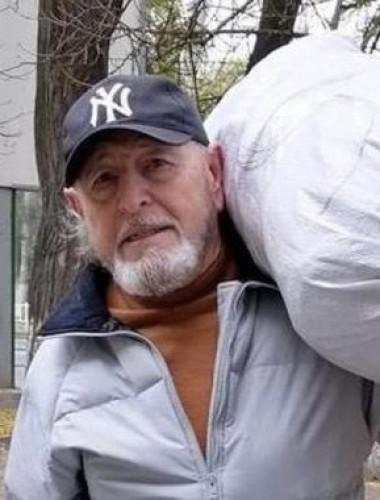
Mariano García Calatayud is a political prisoner
An elderly Spanish man who moved to Kherson and engaged in volunteer work was abducted by Russian security forces in 2022
The ‘Political Prisoners. Memorial’ human rights project, in accordance with international standards, considers Mariano García Calatayud a political prisoner. García Calatayud has been abducted by Russian security forces and is being held in an undisclosed location without charge. We demand the immediate release of Mariano García Calatayud, compliance with international humanitarian law in his regard, and an investigation into reports that he has been tortured.
What is the reason for Mariano García Calatayud’s abduction?
In 2014, Mariano García Calatayud retired and moved from Spain to live in Kherson, Ukraine, where he became a volunteer. He helped orphanages and collected humanitarian aid.
García Calatayud supported Ukraine’s independence, and after the occupation of Kherson, he participated in protests. On 19 March 2022, after one of these protests, the 74-year-old Spaniard was abducted by men in balaclavas.
When Mariano’s wife and friends tried to find him, they learned that he had been initially held in a detention centre in Kherson. He had then been transferred to a pre-trial detention centre in Simferopol, where fellow inmates reported he had been tortured and refused medical care. Mariano García Calatayud’s location was concealed from both his lawyer and the Spanish Ministry of Foreign Affairs. Not until April 2023 did the FSB confirm García Calatayud was being held in the pre-trial detention centre. Some parcels were then accepted in his name. However, on 4 December 2023, his lawyer received a letter stating that Mariano García Calatayud ‘had left the territory of the Republic of Crimea and travelled to Kherson Oblast on 1 June 2023.’ Since then, his whereabouts have not been known.
Why do we consider Mariano García Calatayud a political prisoner?
Mariano García Calatayud’s detention without charge violates the provisions of the Geneva Convention on the Protection of Civilian Persons in Time of War. According to the Convention, civilians can be interned, but García Calatayud’s case does not comply with the requirements of internment.
The Convention prohibits violations of the life and physical integrity of those deprived of liberty, including torture, and inhuman or degrading treatment. The Convention also states that detainees have the right to inform their families of their whereabouts. These provisions have been violated in the case of García Calatayud. According to the Rome Statute, enforced disappearance is considered a war crime.
As a victim of enforced disappearance by the security forces, Mariano García Calatayud, aged 77, has been placed outside the protection of the law. His age and the condition of his health raise serious concerns for his life.
A detailed description of Mariano García Calatayud’s case and of our position is available on our website.
Recognition of an individual as a political prisoner does not imply the ‘Political Prisoners. Memorial’ human rights project agrees with, or approves, their views, statements, or actions.
How to help?
If you have any information about the whereabouts of Mariano García Calatayud, please let us know via our Telegram bot or email us at: [email protected]
You can donate to help all political prisoners in Russia.