
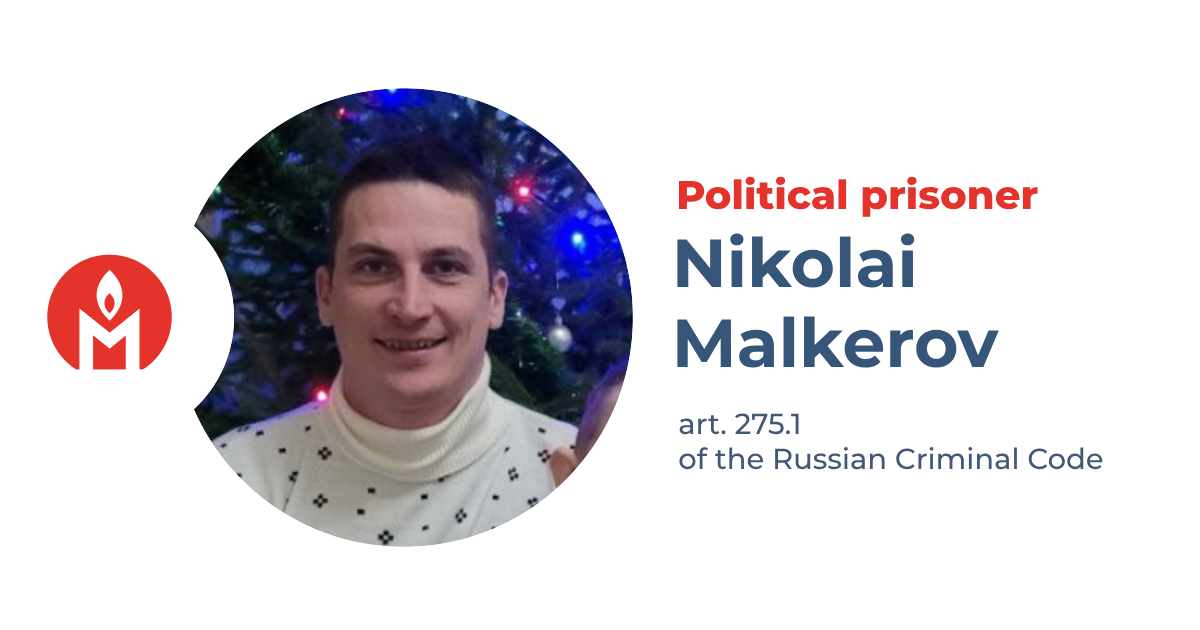
Nikolai Malkerov is a political prisoner
A construction worker from Kostroma was sentenced to four years’ imprisonment for messaging an FSB agent pretending to be a representative of Ukraine.
The ‘Political Prisoners. Memorial’ human rights project, in accordance with international standards, considers Nikolai Malkerov a political prisoner. Malkerov was convicted of ‘collusion with a foreign organisation for the purpose of assisting in activities known to be directed against the security of the Russian Federation’ based on an exchange of messages with a Russian security service officer. Malkerov’s criminal prosecution and conviction violated his right to a fair trial. We demand the immediate release of Nikolai Malkerov and that all criminal charges against him be dropped.
What were the charges against Nikolai Malkerov?
Nikolai Malkerov is a construction worker from Kostroma. When, according to the prosecution, in April 2024, Malkerov believed he had contacted the Free Russia Legion online, he was in fact communicating with FSB officers. Malkerov allegedly offered to collect and send his ‘handler’ specific information but was unable to do so as he was detained on 3 May 2024. He had also begun filling out an application form on the Legion’s website but never completed it.
Malkerov was charged with ‘collusion with a foreign organisation for the purpose of assisting in activities known to be directed against the security of the Russian Federation’ (Article 275.1 of the Russian Criminal Code). In court, he pleaded guilty and asked for a lenient sentence so that he could continue to support his family.
On 14 February 2025, the court sentenced Malkerov to four years’ imprisonment in a general regime penal colony.
Why do we consider Nikolai Malkerov a political prisoner?
The article on ‘collusion’ was added to the Russian Criminal Code in July 2022 and has become yet another tool of repression used against opponents of the regime. The article’s provisions violate the principle of legal certainty, in particular, they fail to define what constitutes ‘collusion.’ In practice, the article serves to criminalise any communication between Russian citizens and foreigners, enabling punishment not for concrete actions, but for a presumed intent to ‘assist’ in some undefined ‘activity.’ This article must be rescinded, all related criminal convictions quashed, and ongoing prosecutions dropped.
We believe that the greatest threat to Russia’s security is the war of aggression launched against Ukraine. The Free Russia Legion, as part of the Ukrainian army, is resisting this aggression. Therefore, even if Malkerov had in fact corresponded with members of the Legion and completed the unit’s online application form, his actions would not have posed any public danger and should not be subject to criminal prosecution.
The security services and the court did not hide the fact that Malkerov’s plans were to a significant degree provoked by FSB officers. Operational entrapment that incites a person to commit a crime is prohibited under both Russian and international law. Moreover, since Malkerov did not manage to carry out any actions within the framework of ‘collusion with a foreign state’, he could not, in any case, be held liable for a completed offence.
A detailed description of Malkerov’s case and of our position is available on our website.
Recognition of an individual as a political prisoner does not imply the ‘Political Prisoners. Memorial’ human rights project agrees with, or approves, their views, statements, or actions.
How can you help?
If you know the location where Nikolai Malkerov is being held, please contact our Telegram bot or email us at [email protected].
You can donate to help all political prisoners in Russia.