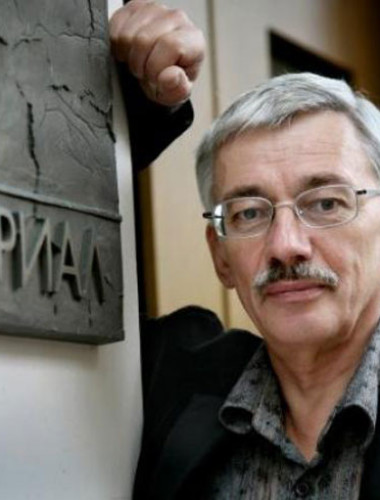
Human rights defender Oleg Orlov is a political prisoner
Oleg Orlov, one of the founders of Memorial, has been sentenced to two and a half years’ imprisonment for an article in which he opposed the war and called the Putin regime fascist
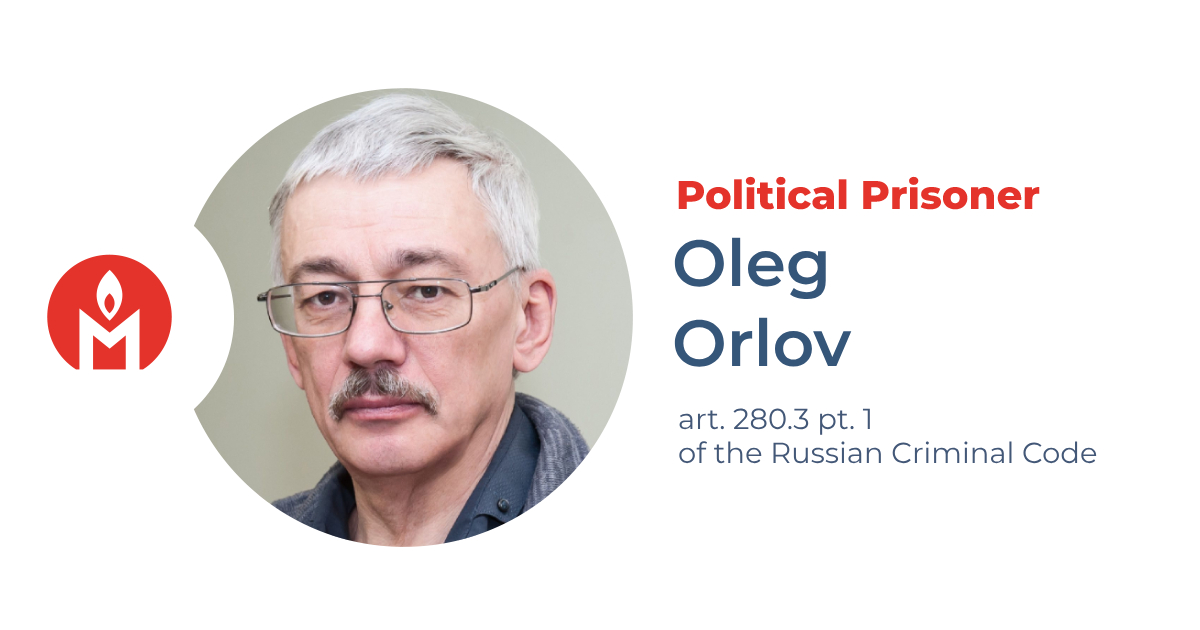
The ‘Political Prisoners. Memorial’ human rights project, in accordance with international standards, considers Oleg Orlov a political prisoner. He has been prosecuted for the criminal offence of ‘discrediting’ the Russian army for an article he wrote, entitled ‘They wanted fascism. They got it.’ Orlov’s prosecution and conviction violates his rights to freedom of expression and a fair trial.
We demand the immediate release of Oleg Orlov and that his conviction be quashed.
Who is Oleg Orlov and what were the charges against him?
Oleg Orlov is our senior colleague. He was a founding member of the Memorial Society and subsequently for many years he led the work of the Memorial Human Rights Centre. Throughout this time, he consistently worked to advance the protection of human rights.
On 14 November 2022, Oleg Orlov published on Facebook the text of an article he had written, entitled ‘They wanted fascism. They got it’. In the article, he condemned the war against Ukraine unleashed by the Putin regime and argued that the country has turned to fascist totalitarianism.
The investigative authorities considered the article ‘discredited’ the Russian army. On the grounds that Orlov had previously been twice convicted of the administrative-law offence of ‘discrediting’ the army, in March 2023 a criminal case was opened against him for repeated ‘discrediting’ (Article 280.3, Part 1, of the Russian Criminal Code).
On 11 October 2023, Orlov was convicted and fined 150,000 roubles.
The prosecutor’s office appealed this decision on the grounds that the court had failed to take into account the motive of ‘political hatred’, namely ‘ideological enmity towards traditional Russian spiritual, moral, and patriotic values.’
In February 2024, there was a retrial in the same court.
Orlov refused to participate in the unlawful trial and in the courtroom, he spent his time reading Franz Kafka’s The Trial.
In his final speech at his trial, Orlov declared, ‘I have no regrets! I do not regret that I took part in pickets against the war, or that I wrote the article for which I am being tried. All my previous life left me no other choice.’
On 27 February, the court sentenced the 71-year-old human rights activist to two and a half years in a penal colony. He was taken into custody in the courtroom.
Why do we consider Orlov a political prisoner?
The article of the Russian Criminal Code on the repeated ‘discrediting’ of the army was adopted to suppress dissent after the start of Russia’s war against Ukraine. It effectively prohibits any criticism of the war or of the Russian authorities. The article violates the right to freedom of expression and contradicts the principle of legal certainty.
This article should be rescinded, all criminal convictions under it quashed, and all ongoing criminal charges dropped.
Oleg Orlov has been sent to prison for his work as a human rights defender, defending human and civil rights and freedoms in Russia, including freedom of expression, and for speaking the truth. Orlov’s trial once again exposed the nature of the Russian regime. Russia is in fact a totalitarian fascist regime waging a war of aggression against a neighbouring state and suppressing dissent within its own borders.
A detailed description of the case of Oleg Orlov and the position of the ‘Political Prisoners. Memorial’ human rights project are available on our website.
Recognition of an individual as a political prisoner does not imply ‘Political Prisoners. Memorial’ human rights project agrees with, or approves, their views, statements, or actions.
How can you help?
You can donate to support all political prisoners in Russia.