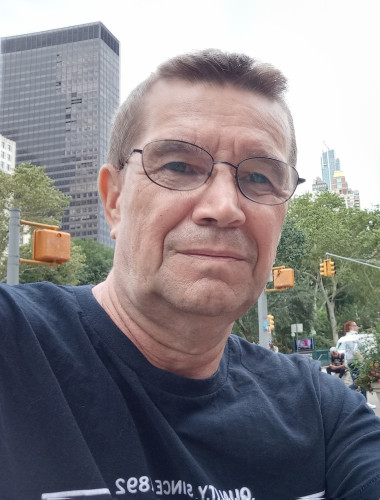
Philosopher and sociologist from Komi sentenced to seven years over project to develop opposition media and protect Indigenous peoples
Nikolai Zyuzev, an academic with Russian and Canadian citizenship, was sentenced on 10 September to seven years in a high-security penal colony on charges of high treason (Article 275 of the Russian Criminal Code). The sentence was reported by the pro-Kremlin Russian state news agency TASS.
According to the FSB, Nikolai Zyuzev was implementing a project covering 12 areas of work, ‘including training abroad for leaders of national liberation movements among Russia’s Indigenous Small-Numbered Peoples, the distribution of extremist materials, and the collection and analysis of information at the request of EU government bodies and think tanks’. The project was funded by grants from 12 foreign organisations, some of which have been designated ‘undesirable’ in Russia.
TASS names the following among the grant-makers: the Hanns Seidel Foundation, the Prague Civil Society Centre, the German Council on Foreign Relations (DGAP), the Swedish Institute, IREX Europe (France), Chatham House, and the Black Sea Trust for Regional Cooperation (UK). According to the prosecution, Nikolai Zyuzev received more than €2 million for the project.
TASS has published a video containing excerpts of Nikolai Zyuzev discussing his case. He says he was charged with high treason over his involvement with an organisation in Lithuania between the second half of 2022 and the first half of 2023. According to Nikolai, he had originally planned to set up an educational website focused on teaching the humanities, but this failed to interest potential grant-makers. In the end, he says, the project allegedly shifted towards ‘spreading false information about what is happening in Russia’. Nikolai Zyuzev calls it a ‘media incubator’, where Russian journalists are trained abroad so that they can go on to set up media outlets aimed, in his words, ‘broadly at inciting ethnic hatred in Russia, at criticising the policies of the Russian authorities, and at criticising Russia’s actions abroad, including, again, the situation in and around Ukraine’.
Nikolai Zyuzev claims the West views Russia’s multi-ethnic make-up as a weakness, and sums up: ‘The goal, of course, of all these foundations and those behind them is to destabilise Russia as a whole by developing national movements that are meant to promote the idea that Russia’s indigenous peoples are in a disadvantaged position.’
The video shows Nikolai Zyuzev’s column for the Canadian outlet Maclean’s, titled ‘I fled Putin’s Russia for Canada. It opened my eyes’, published on 3 January 2023. Nikolai recounts that he lived in Canada from 2009 to 2015, where he was inspired by the way Canadian society and the state were rethinking their colonial past and trying to address historical injustices against Indigenous peoples. He tried to address similar issues in Russia, where he returned in 2015 to teach at Syktyvkar State University. Nikolai Zyuzev had the idea of founding a ‘Finno-Ugric online university’; Leonid Zilberg, founder of the outlet 7×7, in turn suggested extending the project to include the protection of all national minorities. Both men left Russia in 2022, and since then, according to Nikolai Zyuzev, they have ‘been travelling around Europe, raising awareness and raising funds’ to develop the Indigenous Russia Information and Education Center.
‘We see an opportunity arising from Putin’s catastrophic invasion of Ukraine: indigenous peoples have suffered disproportionately from the war […] Minorities in the republics are once again becoming aware of the threat the Kremlin poses. We hope calls for decolonisation will grow louder, and that the Kremlin will lose control of the republics,’ the text states.
It is not known when or why Nikolai Zyuzev returned to Komi. Komi Daily has reported that even after 2022 he ‘occasionally returned to his home village in Kortkeros District’. On 26 August 2025, it emerged that the Syktyvkar City Court had extended Nikolai Zyuzev’s pre-trial detention. At the time, he had been charged under the lesser offence of confidential cooperation with a foreign entity (Article 275.1 of the Russian Criminal Code).
Nikolai Zyuzev is 69. He holds a Doctor of Philosophical Sciences degree and specialises in the work of sociologist Pitirim Sorokin.