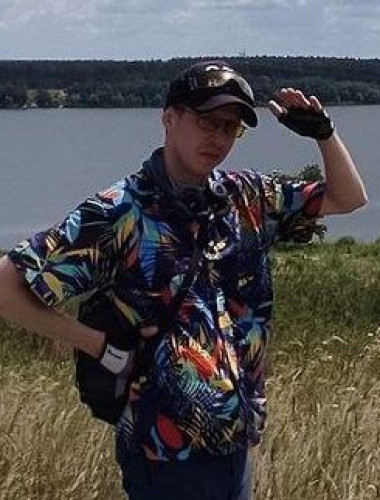
Vasily Pavlov is a political prisoner
A PhD student from Belgorod has been sentenced to 16 years’ imprisonment for distributing leaflets from the Free Russia Legion and passing on to that organisation publicly available information about a military unit
The ‘Political Prisoners. Memorial’ human rights project, in accordance with international standards, considers Vasily Pavlov a political prisoner. Pavlov was convicted on charges of ‘participation in the activities of a terrorist organisation’ for distributing leaflets of the Free Russia Legion, and of treason for passing on publicly available information about a military unit to an interlocutor. Pavlov’s criminal prosecution violated his right to a fair trial. We demand the release of Vasily Pavlov and that all criminal charges against him be dropped.
What were the charges against Vasily Pavlov?
Vasily Pavlov, a PhD student in journalism at Belgorod University, was detained on 8 December 2023. According to the prosecution, he was at that time posting leaflets from the Free Russia Legion into mailboxes. That same day, Pavlov’s home was searched and technical equipment and recordings were seized.
Formally, Pavlov was jailed for an administrative-law offence until 21 December. However, according to his own account, he spent the entire time at FSB offices where he was subjected to violence. He was then charged with participating in a terrorist organisation (Article 205.5, Part 2, of the Criminal Code of the Russian Federation). Signs that Pavlov had been beaten were visible at the court hearing on pre-trial conditions on 22 December.
Pavlov was later also charged with treason (Article 275 CC RF). The investigative authorities claimed Pavlov not only communicated with a representative of the Legion on Telegram and printed leaflets at their request but also passed on information about a military unit to that organisation.
Pavlov himself maintained he had engaged in the correspondence for the purposes of journalism and that information he passed on was already in the public domain.
The court handed down its verdict in just two hearings. The defendant was not brought to the courtroom but appeared via video link. On 10 December 2024, Vasily Pavlov was sentenced to 16 years’ imprisonment, of which the first three years are to be served in a cell-type prison, and the remainder in a strict-regime penal colony.
Why do we consider Vasily Pavlov a political prisoner?
The 12-day jail term for an administrative-law offence was effectively a means of isolating Pavlov and depriving him of legal representation, leaving him vulnerable to pressure from the security forces. His claims of torture and documented injuries cast doubt on any testimony obtained during this period.
The terrorism charge against Pavlov concerned his alleged correspondence with the Free Russia Legion and distribution of their leaflets. The decision by the Russian courts to designate this Ukrainian unit as a terrorist organisation is unlawful and unfounded. The Free Russia Legion is part of the Ukrainian armed forces; cooperation with the Free Russia Legion does not constitute terrorist activity. Furthermore, there is no evidence of Pavlov’s actual involvement in the Legion.
The charge of treason concerned the passing on of publicly available information. Such actions cannot be considered espionage or ‘aiding a foreign organisation.’ There is no evidence that Pavlov’s actions caused or could have caused actual harm to Russia’s security. A broad interpretation of the offence of treason has long been used for purposes of political persecution.
There are also indications of a sting operation by the security services in this case. The identity of ‘Miron S.,’ with whom Pavlov corresponded, has not been established. Pavlov was arrested immediately after he carried out actions on the instructions of this unidentified person.
A detailed description of Vasily Pavlov’s case and of our position is available on our website.
How can you help?
You can write to Vasily Pavlov at the following address:
RU:
457670, Челябинская область, г. Верхнеуральск, ул. Северная, д. 1, ФКУ Т ГУФСИН России по Челябинской области, Павлов Василий Михайлович, 1994 г. р.
EN:
Vasily Mikhailovich Pavlov (born 1994), Prison of the Federal Penitentiary Service of Russia for Chelyabinsk Oblast, 1 Severnaya, Verkhneuralsk, Chelyabinsk Oblast, 257670.
You can also send emails via ZT (for payment with all bank cards) and Memorial-France (free of charge).
Please note that letters in languages other than Russian are highly unlikely to reach the intended recipient.
You can donate to help all political prisoners in Russia.