
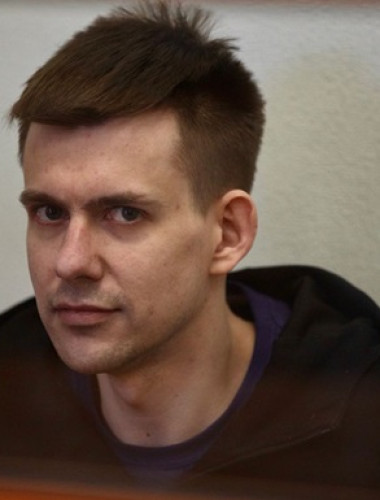
Vladimir Malina is a political prisoner
An anti-war activist from Moscow has been sentenced to 25 years’ imprisonment on charges of sabotage, terrorism and treason
The ‘Political Prisoners. Memorial’ human rights project, in accordance with international standards, considers Vladimir Malina a political prisoner. Malina was convicted on a charge of treason for providing information that is publicly available; and on charges of terrorism and sabotage for setting fire to a railway relay cabinet. Malina’s criminal prosecution and conviction violated his right to a fair trial. We demand that Vladimir Malina’s allegations of torture be investigated and that the charges against him be reviewed in a fair trial.
What were the charges against Vladimir Malina?
Law enforcement officers detained bartender Vladimir Malina on 5 June 2023 at the Barybino railway station in Moscow Oblast. They found in his possession an incendiary mixture and a nail puller. Malina later reported that during his first interrogation, FSB officers beat him and threatened to send him to fight in the war and to fabricate cases against him, demanding a confession and access to his phone. Doctors at the temporary detention facility recorded evidence of torture, but investigators refused to open an investigation.
According to the prosecution, Malina contacted a member of the Free Russia Legion via Telegram and, on their instructions, attempted to set fire to railway relay cabinets. Malina was charged with sabotage for arson near Naro-Fominsk (Article 281, Part 2 [a], of the Criminal Code of the Russian Federation) and two unsuccessful attempts at arson (Article 30, Part 1, CC RF in conjunction with Article 281, Part 2 [a], CC RF; Article 30, Part 3, CC RF in conjunction with Article 281, Part 2 [a], CC RF), as well as preparing to commit a terrorist act (Article 30, Part 1, CC RF in conjunction with Article 205, Part 1, CC RF) for attempting to set fire to a police station with fireworks.
Malina was also charged with participating in a terrorist organisation (Article 205.5, Part 2, CC RF) and in terrorist and sabotage groups (Article 205.4, Part 2, CC RF and Article 281.3, Part 2, CC RF), of ‘undergoing training’ in terrorism and sabotage (Article 205.3 CC RF and Article 281.2 CC RF), as well as treason (Article 275 CC RF) for sending a video of an air defence facility visible from the road and the coordinates of other facilities that were in the public domain.
On 23 May 2024, Malina was sentenced to 25 years’ imprisonment, with the first five years to be served in a cell-type prison and 20 years in a strict regime penal colony.
Why do we consider Vladimir Malina a political prisoner?
The verdict was based on confessions Malina gave under torture. Malina’s allegations of torture were confirmed by medical professionals, but the court simply referred to the formal investigation and used this evidence as the basis for the case.
The charge of preparing for a terrorist attack was unfounded. The investigative authorities believed Malina wanted to set fire to a police station with fireworks — a method that does not pose a real threat to life or serious consequences. This does not meet the criteria for a terrorist attack, because there is no intention to intimidate the population or cause serious harm.
The intent to commit ‘sabotage’ was not proven either. Setting fire to railway relay cabinets only leads to temporary train delays, not to undermining the country’s economic security or defence capability.
The charges of undergoing training in terrorism and sabotage were based on correspondence and instructions via Telegram, which does not constitute training in the legal sense. The charge of treason was based on the transfer of information in the public domain, which therefore cannot be considered a threat to Russia’s security. Moreover, the verdict was based on an unjustified decision by the Russian Supreme Court to designate the Free Russia Legion a terrorist organisation, even though this unit is officially part of the Ukrainian armed forces.
The court repeatedly referred to Malina’s anti-war views and found his ‘disagreement with the ongoing special military operation’ to be a motive of ‘political hatred,’ and considered this to be an aggravating circumstance for each charge. This, together with the lack of evidence for the charges and the use of confessions obtained under torture, clearly indicates the political nature of Malina’s prosecution.
A detailed description of Vladimir Malina’s case and of our position is available on our website.
How can you help?
You can write to Vladimir Malina at the following address:
RU:
399783, Липецкая область, г. Елец, ул. Пролетарская, д. 1Б, ФКУ Т-2 УФСИН России по Липецкой области, Малине Владимиру Петровичу, 1988 г. р.
EN:
Vladimir Petrovich Malina (born 1988), Prison No. 2, Federal Penitentiary Service of Russia for Lipetsk Oblast, 1B Proletarskaya Street, Yelets, Lipetsk Oblast, 399783, Russia.
You can also send emails via ZT (for payment with all bank cards) and Memorial-France (free of charge).
Please note that letters in languages other than Russian are highly unlikely to reach the intended recipient.
You can donate to help all political prisoners in Russia.
Political prisoners
-
 Malina
Vladimir Petrovich275 205.5 pt.2 "Committing by a criminal organization of actions aimed at forcible seizure of power and forcible change of the constitutional order of the Russian Federation", up to 20 years' imprisonment 205.3 205.4 pt.2 281 pt.2 281.2 281.3 pt.2 30 pt. 3, 281 pt. 2 30 pt.1, 205 pt.2 33 pt. 1, 281 pt. 2