
Summary
- Stability and increasing severity. Overall, the scale of politically motivated criminal prosecutions in Russia (excluding the occupied territories) remained stable during the first three quarters of 2025. However, the nature of these prosecutions changed, with a tendency towards greater severity.
- 500 new victims each quarter – or five people every day. Around 500 new individuals are prosecuted on politically motivated charges in Russia each quarter. The highest levels of repression are recorded in the Far Eastern federal district.
- Treason is the main instrument. The authorities are increasingly using more serious criminal charges. Treason has now become the most common charge in politically motivated prosecutions.
- Growth and increasing severity of repression in the occupied territories. The level of repression in Crimea and Sevastopol is three and a half times higher than in Russia, while in the so-called Donetsk People’s Republic [‘DPR’] and Luhansk People’s Republic [‘LPR’], as well as in the occupied parts of Kherson and Zaporizhzhia regions, the level is seven times higher and continues to rise. The charges used in the occupied territories are also generally more serious: in every second instance, the charges are for treason or espionage.
- A rapid increase in the number of prosecutions of Ukrainian military service personnel. The most striking trend recorded in 2025 is the sharp rise in the number of criminal prosecutions of members of the Ukrainian armed forces. This increase is linked primarily to the fighting in Kursk region but may also reflect a broader increase in the severity of prosecutions against Ukrainian military personnel. Almost all Ukrainian military service personnel captured in Kursk region have been charged with terrorism (Article 205 of the Criminal Code of the Russian Federation [CC RF]).
About this report
The current report is our regular quarterly review of political repression, covering the third quarter of 2025.
The review is based on data of politically motivated criminal prosecutions compiled by the project Political Prisoners. Memorial. Our sources include court records, press releases from law enforcement agencies, media publications, and information received directly from defendants, their relatives and others. The data are current as of 1 October 2025.
The review assigns criminal cases to a particular quarter according to the date on which a given case was added to the database. Information about the start of a prosecution usually becomes known with some delay – often of days, sometimes weeks, and occasionally longer. Therefore, not all cases classified as belonging to a particular quarter necessarily began within that period; some started earlier. This methodology therefore reflects repression with a certain lag but allows for a fuller and more accurate picture.
Overall scale of repression
The total number of newly recorded politically motivated criminal prosecutions in Russia and in the occupied Ukrainian territories continues to rise. In the third quarter of 2025, there was a marked increase in the proportion of those deprived of liberty. Of those prosecuted whose cases have been added to the database in this quarter, 83% have been deprived of liberty, the highest figure recorded to date.[1]
While these data show a general trend towards the increasing severity in the use of the criminal law for purposes of politically motivated repression, it is important to note that the prosecutions of particular groups have followed different trajectories.
In this report, politically motivated criminal prosecutions are examined with regard to three distinct groups: residents of Russia within the country’s internationally recognised borders; residents of the occupied territories; and members of the Ukrainian armed forces.
Russia (excluding the occupied territories)
When data relating to the occupied territories and Ukrainian military service personnel are excluded, the overall scale of politically motivated criminal prosecutions can be described as stable. The number of new criminal cases recorded has not changed significantly throughout 2025.
In the third quarter of 2025, the proportion of those prosecuted who were deprived of liberty increased. Whether this reflects an increase in the severity of repressive practices or is merely an incidental fluctuation is not yet clear.
The geographical distribution remains stable. The Far Eastern federal district has consistently recorded the highest per capita rate of politically motivated prosecutions since 2024. Some increase has been observed in the North-West and Siberian federal districts in 2025. Overall, the level of political repression in the country has not changed significantly: over the year, roughly 1.4 people per 100,000 inhabitants have faced politically-motivated prosecution.
Number of politically motivated criminal prosecutions per 100,000 inhabitants (excluding the occupied territories and Ukrainian military service personnel) [number of criminal cases per 100,000 residents in a year]
| Federal District | Second half of 2024 | Q1, Q2, Q3 of 2025 |
| Far East | 2,0 | 2,1 |
| North-West | 1,4 | 1,9 |
| Siberian | 1,3 | 1,7 |
| North Caucasus | 1,2 | 1,3 |
| Southern (without Crimea and Sevastopol) | 1,2 | 1,2 |
| Ural | 1,3 | 1,2 |
| Central | 1,1 | 1,1 |
| Volga | 1,1 | 1,0 |
| Russia (excluding occupied territories) | 1,35 | 1,42 |
Despite the relative stability in terms of scale, the nature of repression is changing. Law enforcement authorities are increasingly using more serious charges under the Criminal Code.
In the third quarter of 2025, treason became the most frequently used charge in politically motivated prosecutions. At present, one in five new prosecutions showing signs of political motivation and illegality is for treason. Charges of treason are typically linked to various forms of contact with Ukraine, ranging from small money transfers to Ukrainian funds or individuals, to carrying out tasks on behalf of Ukrainian organisations. The available information about such prosecutions often suggests that they have been a result of provocations by the Russian security services.
The number of Russian citizens charged with participating in the activities of terrorist organisations has also increased. This charge is usually applied in cases alleging collaboration with Ukrainian military units designated by Russian courts as ‘terrorist’, such as the Russian Volunteer Corps, the Free Russia Legion, Azov Battalion, Aidar Battalion, and others. Such charges are often brought together with charges of treason.
At the same time, the number of prosecutions related to so-called extremist organisations has declined somewhat, in part because of a decrease in prosecutions of Jehovah’s Witnesses. At the same time, however, there has been a rise in prosecutions on charges of collaboration with the so-called ‘international LGBT movement,’ which has been designated by the Russian authorities as extremist.
Another major trend in politically motivated repression in 2025 has been the increase in prosecutions for financing extremist activity, mainly in relation to donations to the Anti-Corruption Foundation. We analyse these prosecutions in more detail in the report, ‘Prosecutions Related to the Anti-Corruption Foundation’.

Vadim Tomilov — a resident of the town of Irbit in Sverdlovsk region, was a student in the final year of his secondary school at the time of his arrest. Vadim loved sport (he was a prize-winner in national youth sambo competitions) and successfully took part in national academic competitions. He strongly opposed Russia’s military aggression against Ukraine and wanted to find a way to join the Russian Volunteer Corps. In May 2024, without telling his parents, he travelled to Ekaterinburg where he bought a plane ticket to Tbilisi. Alarmed by his disappearance, his parents contacted the police. Meanwhile, they managed to contact him and persuade him not to leave. Vadim told them where he was staying in Ekaterinburg and asked them to fetch him. His parents set off to meet him. At the same time, they shared their online correspondence with Vadim with the police, including his address. In court they later said they had done this ‘without thinking.’ The police arrived before Vadim’s parents, arrested the young man and handed him over to the FSB. Vadim was subjected to physical violence and threats, including threats to beat up his parents. Under duress, he made a confession which he later retracted. He was charged with attempting to commit treason and with preparing to take part in the activities of a terrorist organisation. On 15 September 2025, he was sentenced to seven years’ imprisonment.
The occupied territories
The practice of politically motivated prosecutions in occupied territories differs significantly from that in Russia. We focus here solely on criminal prosecutions, excluding other widely used forms of repression such as abductions and unlawful detention.
Firstly, the level of politically motivated criminal prosecutions in occupied territories is much higher than in Russia. In Crimea and Sevastopol (annexed by Russia over 11 years ago), the number of prosecutions per capita is more than three and a half times higher than in Russia. In other Russian-occupied Ukrainian regions (‘DPR’, ‘LPR’, and the Kherson and Zaporizhzhia regions), this figure is more than seven times higher.
Secondly, unlike in Russia, the scale of criminal prosecutions in the occupied territories is increasing. In 2025, there were 30–50% more prosecutions than in 2024.
Number of politically motivated criminal prosecutions per 100,000 residents, excluding prosecutions of Ukrainian military service personnel (number of criminal prosecutions per 100,000 residents per year)
| Region | Second half of 2024 | Q1, Q2, Q3 of 2025 |
| ‘DPR’, ‘LPR’, occupied parts of Kherson and Zaporizhzhia regions | 7,9 | 10,2 |
| Crimea and Sevastopol | 3,5 | 5,3 |
| Russia (excluding the occupied territories) | 1,4 | 1,4 |
Source: Political Prisoners. Memorial
The different character of political repression in the occupied territories is also reflected in the charges used. Figure 4 shows the percentage of prosecutions brought using the most frequently applied charges in the occupied territories and comparable data from Russia.
In the occupied territories, more serious charges are used far more frequently:
- Almost half of prosecutions involve charges of treason or espionage.
- Charges under ‘terrorist’ laws are more frequent: Article 205 (‘terrorist act’), Article 205.4 (‘organisation of a terrorist group and participation in it’), Article 205.3 (‘training in terrorist activities’).
- At the same time, prosecutions for speech, such as ‘justifying terrorism,’ are less frequent than in Russia.

Liudmila Kolesnikova – born and raised in Yalta, is a lawyer by training. She served in the Ukrainian police before the annexation of Crimea and later worked as an investigator in the Russian police, while keeping her Ukrainian citizenship. In 2022, she moved to Ireland where she obtained temporary protection status, and changed profession to become a cosmetologist. In June 2024 Kolesnikova returned to Yalta to visit her mother, who was ill with cancer. Shortly afterwards, her mother passed away. A few days after the funeral, Kolesnikova was arrested by the FSB. According to Kolesnikova, she was accused of ‘providing financial assistance to Ukraine to the amount of 25 euros.’ She says that in 2022 she had purchased two ‘Military Ship’ NFT stamps through the Ukrainian postal service Diia, part of the proceeds of which went to buy drones in Ukraine. It is possible, however, that these NFTs may have been issued by scammers and had no connection with the Ukrainian postal authorities. In a letter from the remand prison, Kolesnikova suggested the real cause of her prosecution was a number of denunciations by former colleagues in Crimea. She considered that ‘they didn’t like that I went to Europe and that I was showing how good it is to live there.’ On 5 July 2025, she was convicted of treason and sentenced to 17 years in a general regime penal colony. Kolesnikova has filed an appeal, which is currently pending.
Ukrainian military service personnel
The sharp rise in prosecutions of members of the Ukrainian armed forces is the most significant and evident trend in politically motivated repression in 2025. The number of such prosecutions began increasing in Q3 2024 and has continued through 2025.
In Q3 2025, prosecutions of Ukrainian military service personnel accounted for nearly a third of all new politically motivated criminal prosecutions recorded by our project.
Newly recorded prosecutions of Ukrainian military service personnel [2]
| Quarter | Q3 2024 | Q4 2024 | Q1 2025 | Q2 2025 | Q3 2025 |
| Ukrainian military service personnel (no. of persons) | 22 | 38 | 52 | 106 | 298 |
Source: Political Prisoners. Memorial
The main factor behind this increase has been the conduct of military operations in Kursk region. Russian law enforcement and judicial authorities consider the mere presence of Ukrainian military service personnel on Russian territory, and all the more combat operations, as criminal acts. It can be assumed that all Ukrainian military service personnel participating in operations in Kursk region, and subsequently captured, automatically face criminal prosecution.
However, a greater number of prosecutions were also recorded of Ukrainian military service personnel who had not participated in the Kursk operation.
Overall, prosecutions related to the Kursk region in the first nine months of 2025 accounted for more than half of all prosecutions of Ukrainian military service personnel, but probably do not fully explain the overall increase in such prosecutions. [3]
Nearly all Ukrainian prisoners of war prosecuted in connection with combat in Kursk region were convicted of committing acts of terrorism (Article 205 CC RF). Other charges have almost never been used for this group.
Ukrainian military service personnel prosecuted in other regions were much less often accused of committing acts of terrorism. In many instances, they were prosecuted for serving in units designated by the Russian authorities as terrorist, or for undergoing military training, considered ‘training for terrorist activities,’ primarily related to service in the Azov and Aidar battalions.
Ukrainian military service personnel have also relatively frequently been prosecuted for murder (Article 105 CC RF). However, in most of these cases, charges were brought for attempted murder (Article 30, Part 3, CC RF in conjunction with Article 105 CC RF), allegedly committed while firing artillery or small arms.
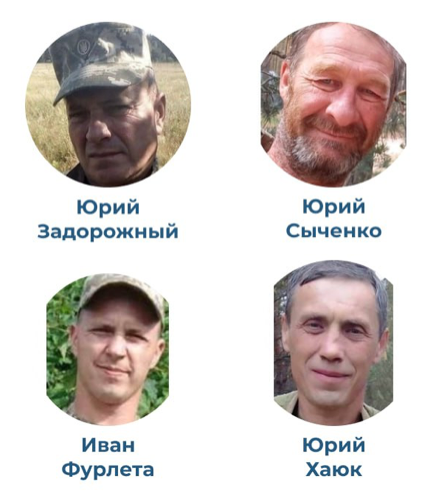
Yuriy Zadorozhny, Yuriy Sychenko, Ivan Furleta, and Yuriy Khayuk – Ukrainian military service personnel who served in the the 64th Separate Rifle Battalion of the 44th Separate Mechanised Brigade, captured by Russian forces on 10 September 2024 in the village of Snagost in Kursk region.
The prisoners were insulted and forced to praise the Russian airborne forces and Vladimir Putin on camera. The investigative authorities charged the four men with ‘committing a terrorist act as a group with prior agreement, resulting in severe consequences.’ According to the authorities, the Ukrainian military service personnel ‘illegally crossed the Russian border’ with the ‘aim of committing a terrorist act,’ set up firing positions, occupied private homes, obstructed the evacuation of civilians, and fired on Russian military service personnel and civilians. As in other similar prosecutions, the investigation proceeded very quickly (less than four months) and the charges were essentially copied from other cases. On the one hand, the charges criminalised mere participation in hostilities, in gross violation of international law. On the other, the allegations of crimes against civilians appear highly dubious. The trial was held in camera. On 5 March 2025, all the prisoners of war on trial were convicted and sentenced to 17 years’ imprisonment.
Legal Developments
The main legislative changes relating to political repression are as follows.
1. Expanded possibilities for criminal prosecution under Article 282 CC RF
On 5 July 2025, amendments to Article 282 CC RF (‘incitement of hatred or hostility, as well as degrading human dignity’) came into force, introducing the following changes:
- It is now possible to prosecute a person on this charge without a prior conviction under administrative law where there are signs of ‘justification or propaganda of the use of violence or threats of its use.’
- Prosecution without a prior conviction under administrative law is also possible if the individual has a previous conviction under Article 282 CC RF or under Articles 280 CC RF (‘making public calls to engage in extremism’) or Article 282.4 CC RF (‘propaganda or public display of Nazi symbols or symbols of extremist organisations’).
- New aggravating factors have been added to Article 282, Part 2, CC RF, providing for harsher penalties where the offence is committed by a group of persons or by a group acting in collusion (previously, only ‘an organised group’ was specified). Experts note that this opens the way for prosecutions relating to collective online posts, open letters and other joint statements.
2. Criminal liability is introduced for desecrating monuments or sites commemorating those who died defending the Fatherland or Russia’s Days of Military Glory
On 3 August 2025, amendments to Article 243.4 CC RF (‘destruction, damage or desecration of military graves, memorial structures, or other objects commemorating those who died defending the Fatherland or its interests, or dedicated to Russia’s Days of Military Glory’) entered into force. The amendments make desecration of such sites, in addition to their destruction or damage, a criminal offence.
3. Use of VPNs may be treated as an aggravating circumstance
On 1 September 2025, amendments to Article 63 CC RF (‘aggravating circumstances’) came into effect. Under these amendments, committing an offence using a VPN or other ‘software and hardware providing access to information resources or information and telecommunications networks with restricted access’ is deemed an aggravating factor.
4. ‘Searching for or accessing’ extremist materials online has become an offence in administrative law
On 1 September 2025, Article 13.53 of the Code of Administrative Offences of the Russian Federation [CAO RF] (‘searching for and accessing materials known to be extremist online’) came into force, providing fines for such actions.
5. Simplified procedure for prosecuting foreign agents
On 25 September 2025, the State Duma adopted in second and third readings (the law has yet to be approved by the Federation Council and signed by the president) amendments to Article 330.1 CC RF (‘evasion of obligations of a foreign agent’).
Previously, a person could be criminally prosecuted for violating the Russian law on foreign agents only after two administrative-law convictions under Article 19.34 CAO RF (‘violation of the regulations governing the activities of a foreign agent’) had entered into force within one year. Under the amendments, any repeated violation following an administrative-law conviction or a prior conviction for a similar act will suffice to bring criminal charges.
[1] By ‘deprived of liberty’ we mean all those prosecuted who have been remanded in custody or placed under house arrest, as well as those sentenced to terms of imprisonment, compulsory work or compulsory psychiatric treatment.
[2] Ukrainian military service personnel in this context are prisoners of war who have been prosecuted in criminal cases, including those charged in connection with their service in Ukrainian military units in the years prior to 2022. We note that we refer here exclusively to criminal prosecutions. Prisoners of war who have not been charged with criminal offences are not included here.
[3] There are serious concerns about the completeness of data on the prosecution of Ukrainian military service personnel because of difficulties in collecting information. It cannot, therefore, be excluded that the increase in the number of such prosecutions outside Kursk region may have been a result of the difficulties related to gathering data. However, the hypothesis that there has been an overall increase in criminal prosecutions of all Ukrainian military service personnel needs consideration.