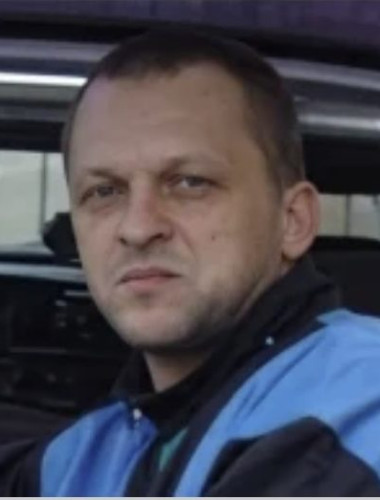
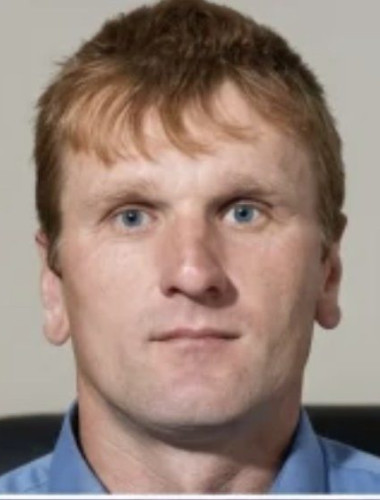
From twenty‑five to life. Four Ukrainians sentenced by Russia over a series of attacks on collaborators in occupied Melitopol
Photo: Mediazona
The Southern District Military Court in Rostov-on-Don has handed down sentences to four defendants in a case involving a series of explosions in occupied Melitopol, according to a Mediazona correspondent reporting from the courtroom. The prosecutor had sought life sentences for the men and a 28-year sentence for the woman. Ihor Haranin, 38, has been sentenced to life imprisonment. Serhiy Harkusha, 54, Serhiy Yevtushenko, 58, and Olena Roi, 46, were each sentenced to 25 years in prison.
In his final statement, Ihor Haranin described himself as a Ukrainian serviceman who “was sent to Melitopol on the orders of his command to carry out reconnaissance operations” and received “lawful orders to eliminate legitimate military targets.”
Ihor Haranin’s closing statement in court
As I have previously stated in my testimony, I am a citizen of Ukraine and hold no other citizenship. On February 24, when the full-scale invasion of Ukrainian territory by Russian troops began—as I have already told you and stated in writing—the president of my country declared a state of martial law. On the very same day, I was called up, deployed to the city of Zaporizhzhia, where I carried out my military service; I was then sent to Melitopol on the orders of my command to carry out reconnaissance operations. I have absolutely no connection whatsoever with terrorism or terrorist organisations. I was not a member of any such organisations, and to this day I am not even aware of their existence. As for the so-called “accomplices” with whom we were allegedly ‘members’ of some “terrorist organisation,” we never had any agreements with them, nor did we ever discuss any plans to undermine morale or threaten civilians. Because these are our citizens, our children, and under no circumstances did we pursue any terrorist objectives that might, God forbid, harm civilians. I was given lawful orders from my command to eliminate legitimate military targets, which were by no means Russian citizens or servicemen of the Russian Federation’s armed forces. Rather, they were solely collaborators: Ukrainian citizens who had betrayed their oath to their country and, consequently, had become legitimate military targets for Ukraine. In my actions, I never pursued any terrorist objectives, such as causing suffering to civilians or influencing any decisions. I have never had anything to do with politics, nor was I against Russia. I strictly carried out the tasks assigned to me on Ukrainian territory and against Ukrainian citizens.
Olena Roi reminded the court that her husband was an officer “who gave his life for the territorial integrity of Ukraine”, and added that she does not hold “nationalist views”, harbours no animosity towards Russian citizens and “regrets what she has done.”
Serhiy Harkusha asked to be included on the prisoner-exchange lists, while Serhiy Yevtushenko admitted that he felt betrayed. According to him, after the war began he continued to “work as usual” at a private security firm, and then found himself “drawn into” the activities of underground activists: he was asked to deliver a parcel, with the promise that “once Ukraine arrives, this will count in your favour.” “I was betrayed,” Yevtushenko said in the conclusion of his closing statement.
According to the prosecution, in 2022–2023, the four defendants, acting on instructions from the Ukrainian security services, organised several assassination attempts on collaborationist officials in occupied Melitopol. Depending on the role assigned to each of the defendants by the FSB, they were charged with membership of a terrorist organisation, the illegal trafficking of explosives, the manufacture of improvised explosive devices, a terrorist attack resulting in the death of a person, and preparation for a terrorist attack.
The first explosion, for which the Melitopol residents were charged, took place on 15 November 2022. Dmitry Trukhin, head of the department for municipal property, urban planning, property and land relations within the city’s occupying military-civilian administration, was injured on that occasion.
The second incident took place on 27 April 2023. This time, the targets were two police officers: Alexander Mishchenko, deputy head of the Melitopol District Department of the Ministry of Internal Affairs, and his colleague Yuri Akimov. Mishchenko died from his injuries.
Furthermore, according to the FSB, between February and May 2023, the group was planning an assassination attempt on Roman Pshenichny, Deputy Head for Operational Work at the Main Directorate of the Ministry of Internal Affairs for the Zaporizhzhia Region. Pshenichny declined to be registered as an injured party in the case or to participate in the proceedings.
All four defendants claimed that they had signed confessions under torture. Haranin, Harkusha and Roi deny any involvement in the plot against Pshenichny, whilst Harkusha also denies any involvement in the plot against Trukhin. All three insist that they did not know Yevtushenko prior to their arrest.
During the closing arguments, the defence insisted that the existence of a “terrorist group” in Melitopol had not been proven, and requested that the defendants be acquitted on this charge.