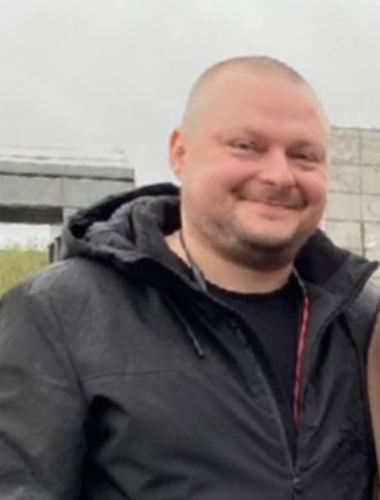
Gennady Kalashnikov is a political prisoner
A lawyer from Vorkuta has been sentenced to 15 years’ imprisonment for two comments on Telegram and correspondence with his son
The ‘Political Prisoners. Memorial’ human rights project, in accordance with international standards, considers Gennady Kalashnikov a political prisoner. Kalashnikov was convicted of involving other persons in the activities of a terrorist organisation, justification of terrorism, and making calls to engage in extremism for statements in support of Ukraine and a video sent to his son about the Russian Volunteer Corps. Kalashnikov’s criminal prosecution and conviction violated his rights to freedom of expression and a fair trial. We demand the immediate release of Gennady Kalashnikov, that all criminal charges against him be dropped, and that his allegations of torture be investigated.
What were the charges against Gennady Kalashnikov?
Gennady Kalashnikov is a 45-year-old lawyer from Vorkuta. In 2022, he wrote in a Telegram chat: ‘Death to Putin’s orcs!’ In 2024, he left a comment saying ‘Glory to the RVC!!!’ under a video about the activities of the Russian Volunteer Corps [RVC] on Telegram. He then sent the video to his son, Aleksei, accompanying it with a joking question with emoticons: ‘Let’s join the RVC? ))).’ Aleksei refused, writing that he did not like interacting with people at all. At that time, he was serving in the Russian army under contract. Soon afterwards, Aleksei was sent to serve in Eastern Ukraine.
In June 2024, FSB officers detained Gennady Kalashnikov. They beat him, searched his home, but then released him. Gennady Kalashnikov filed a complaint about their actions with the prosecutor’s office, but the FSB demanded that he withdraw it, promising to ‘resolve the case in good faith.’ He withdrew the complaint, but on 18 August 2024, he was rearrested.
The investigative authorities charged him with justifying terrorism on the Internet (Article 205.2, Part 2, of the Criminal Code of the Russian Federation), making calls online for people to engage in extremism (Article 280, Part 2, CC RF), and involving other persons in the activities of a terrorist organisation (Article 205.1, Part 1.1, CC RF). Kalashnikov maintained his innocence of the charges. He explained that the comments were an emotional reaction to the war and that the correspondence with his son was a joke.
In May 2025, Kalashnikov was sentenced to 15 years’ imprisonment, with the first three years to be served in a cell-type prison and the rest in a strict regime penal colony. He was also fined 400,000 roubles.
Why do we consider Gennady Kalashnikov a political prisoner?
The charge against Gennady Kalashnikov of justifying terrorism was solely based on the fact that the Russian authorities have designated the RVC a terrorist organisation. This decision is unlawful. The RVC is a unit of the Ukrainian army and participates in military operations: it cannot therefore be classified as a terrorist organisation.
The charge of involving another person in the activities of a terrorist organisation is even more unfounded. Gennady Kalashnikov’s son did not take any steps to join the RVC, and the correspondence between father and son was ironic in nature.
The exclamation ‘Death to Putin’s orcs!’ was not a call to engage in extremism, but an emotional outburst against the actions of the occupiers that poses no danger to the public. Even if the exclamation were considered such a call, it was addressed to the Ukrainian armed forces, which are already engaged in repelling Russian aggression.
The court ignored Kalashnikov’s complaints of torture and his serious illnesses (diabetes, hypertension, and heart problems). His life is in danger in prison.
A detailed description of Gennady Kalashnikov’s case and of our position is available on our website.
How can you help?
You can write to Gennady Kalashnikov at the following address:
RU:
433503, Ульяновская область, г. Димитровград, ул. Калугина, д. 66, ФКУ Т УФСИН России по Ульяновской области, Калашников Геннадий Сергеевич, 1980 г. р.
EN:
Gennady Sergeevich Kalashnikov (born 1980), Prison, Federal Penitentiary Service of Russia for Ulyanovsk Oblast, 66 Kalugina Street, Dimitrovgrad, Ulyanovsk Oblast, 433503, Russia.
You can also send emails via F-Pismo (for payment with Russian bank cards), ZT (for payment with all bank cards), and Memorial-France (free of charge).
Please note that letters in languages other than Russian are highly unlikely to reach the intended recipient.
You can donate to help all political prisoners in Russia.