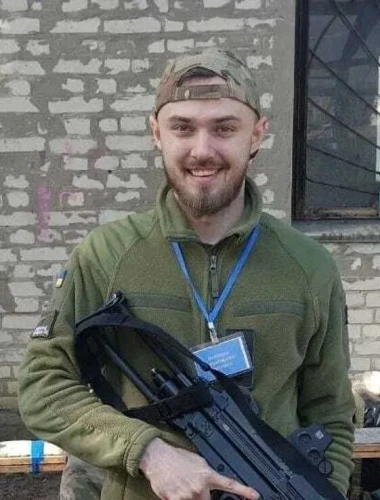
Oleksandr Harnaha is a political prisoner
A Ukrainian prisoner of war has been sentenced to 18 years’ imprisonment on a charge of being a member of the Azov military unit
The ‘Political Prisoners. Memorial’ human rights project, in accordance with international standards, considers Oleksandr Harnaha a political prisoner. Harnaha has been convicted of participating in a terrorist organisation for serving in an official unit of the Ukrainian military. Harnaha’s conviction and prosecution violate his right to a fair trial. We demand that the criminal conviction of Oleksandr Harnaha be quashed and that full compliance with international law be ensured in his treatment.
What were the charges against Oleksandr Harnaha?
Oleksandr Harnaha was mobilised in Ukraine, and he subsequently signed a contract to serve in the Ukrainian military. In early February 2024, he was transferred from the territorial defence of Cherkasy Oblast to the 3rd Separate Assault Brigade, a unit of the Ukrainian armed forces that for a brief period was known as the ‘Azov’ unit. Harnaha was deployed to Avdiivka, where he was captured by Russian forces on 16 February 2024. Russian authorities then remanded him in custody.
Harnaha was prosecuted on charges of participation in the activities of a terrorist organisation (Article 205.5, Part 2, of the Russian Criminal Code) and training for terrorist activities (Article 205.3).
On 7 October 2024, a military court in Rostov-on-Don sentenced Oleksandr Harnaha to serve 18 years in a strict regime penal colony.
Why do we consider Oleksandr Harnaha a political prisoner?
The Russian authorities prosecuted Oleksandr Harnaha for fulfilling his military duty in an official Ukrainian military unit on the grounds that the Azov Battalion had been designated as a terrorist organisation by Russia. We consider this designation unlawful since the unit is part of the Ukrainian armed forces and carries out combat roles in accordance with orders from the Ukrainian military command. Anti-terrorism legislation is inapplicable in the context of an armed conflict. For this reason, Harnaha’s prosecution and conviction on charges of training for terrorist activities is also unlawful. Harnaha underwent training not to commit crimes, but to carry out legitimate military tasks.
At the same time, the decision of the Russian Supreme Court pertained to the Azov unit as part of the Ukrainian National Guard, whereas Harnaha served in a different unit of the same name, which is part of the Ukrainian armed force. Therefore, Harnaha’s prosecution is doubly unfounded, even in the context of many similar cases of this kind.
In international law, Russia’s military actions against Ukraine are illegal and criminal, while Ukraine’s actions in defending itself from aggression are lawful and justified. Defending one’s country from armed invasion is not a crime.
Oleksandr Harnaha is a prisoner of war and was not accused of committing any war crimes. He cannot be lawfully convicted for participating in combat during an armed conflict. The sentence given to him is unlawful; the prosecution itself was in gross violation of the provisions of the Geneva Convention on the Treatment of Prisoners of War.
A detailed description of the case of Oleksandr Harnaha and of our position is available on our website.
Recognition of an individual as a political prisoner does not imply the ‘Political Prisoners. Memorial’ human rights project agrees with, or approves, their views, statements, or actions.
How can you help?
If you have information about the penal institution where Oleksandr Harnaha is being held, please let us know via our Telegram bot or email us at: [email protected]
You can donate to help all political prisoners in Russia.