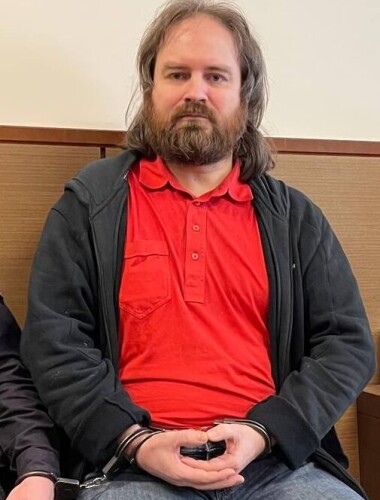

Ilya Vasiliev (Arvi the Hacker) is a political prisoner
An IT enthusiast and head of the Buddhist Moscow Zen Centre has been remanded in custody on charges of spreading ‘fake news’ about the Russian army
The ‘Political Prisoners. Memorial’ human rights project, in accordance with international standards, considers Ilya Vasiliev a political prisoner. He is being prosecuted for ‘deliberate dissemination of information known to be false’ about the Russian army for two posts on Facebook. Vasiliev’s criminal prosecution violates his rights to freedom of expression and fair trial. We demand Ilya Vasiliev be released and all criminal charges against him be dropped.
Who is Ilya Vasiliev and what are the charges against him?
Ilya Vasiliev, known on the Internet under the pseudonym Arvi the Hacker, gained fame in the 2000s as an IT enthusiast and founder of the Civic School of Hackers and a computer festival. Since 2010, he has been a teacher at the Moscow Zen Centre, a Buddhist association. Vasiliev has also been a frequent participant in opposition street protests.
In May 2023, Vasiliev was detained and fined for the administrative-law offence of ‘discrediting’ the Russian army. At that time, his phone was seized and publications he had made on Facebook were found. One year later, these Facebook publications became the basis for a criminal case against him.
On 20 June 2024, Vasiliev was detained on charges of disseminating ‘fake news’ about the Russian army from the motive of political hatred (Article 207.3, Part 2, of the Russian Criminal Code). The prosecution was brought for two posts. Most probably, one was about the massive shelling of Kherson on 24 December 2022, on the eve of the western Christmas, and the other was about a missile attack on a residential building in Dnipro on 14 January 2023.
On 22 June, a court remanded Vasiliev in custody. If convicted, he faces up to 10 years’ imprisonment.
Why do we consider Vasiliev a political prisoner?
The article on the ‘deliberate dissemination of information known to be false about the Russian army,’ under which Vasiliev is being prosecuted, was introduced into the Russian Criminal Code immediately after the start of Russia’s full-scale war against Ukraine. The article effectively prohibits any criticism of the Russian authorities and military, in violation of the right of citizens to freedom of expression. This article contradicts the Russian Constitution, and therefore any charges based on it are unlawful.
Furthermore, information contained in the publications for which Vasiliev is being prosecuted cannot be ‘known to be false.’ As a result of the shelling of Kherson on 24 December 2022 and Dnipro on 14 January 2023, dozens of civilians were killed, and civilian infrastructure was destroyed. These war crimes have been documented in detail, and the fact that it was the Russian army that committed them has been proved by independent experts.
The investigators base their claim that they have proved the motive of political hatred in Vasiliev’s publications on biassed linguistic expertise, lacking in objectivity.
Speaking out against the war and drawing public attention to war crimes cannot, in our opinion, be regarded as offences. Such actions are socially useful, and therefore Vasiliev should not be prosecuted for such publications.
A detailed description of Ilya Vasiliev’s case and of our position is available on our website.
Recognition of an individual as a political prisoner does not imply the ‘Political Prisoners. Memorial’ human rights project agrees with, or approves, their views, statements, or actions.
How can you help?
You can write to Ilya Vasiliev at the following address:
In Russian: 109382, г. Москва, ул. Верхние поля, д. 57, ФКУ СИЗО-7 УФСИН России по г. Москве, Васильеву Илье Владимировичу, 1973 г. р
In English: Ilya Vladimirovich Vasiliev (born 1973), Remand Prison No. 7, Federal Penitentiary Service of Russia for the City of Moscow, 57 Verkhnie Polya Street, Moscow, 109382, Russia.
You can send an email via F-Pismo or ZT (for payment with Russian bank cards) or via PrisonMail (for payment with other bank cards).
Please note that letters in languages other than Russian are highly unlikely to reach the recipient.
You can donate to support all political prisoners in Russia.