
Musician Eduard Sharlot is a political prisoner
He is being prosecuted on charges of desecrating symbols of military glory, insulting the feelings of religious believers, and damaging official documents for his comments criticising Russia’s authorities and their war on Ukraine
The ‘Political Prisoners. Memorial’ human rights project, in accordance with international standards, considers Eduard Sharlot a political prisoner. He is being prosecuted on charges of desecrating symbols of Russia’s military glory, insulting the feelings of religious believers, and damaging an official document for publications he made on social media. Sharlot’s criminal prosecution violates his rights to freedom of speech and fair trial.
We demand the immediate release of Eduard Sharlot and that all criminal charges against him be dropped.
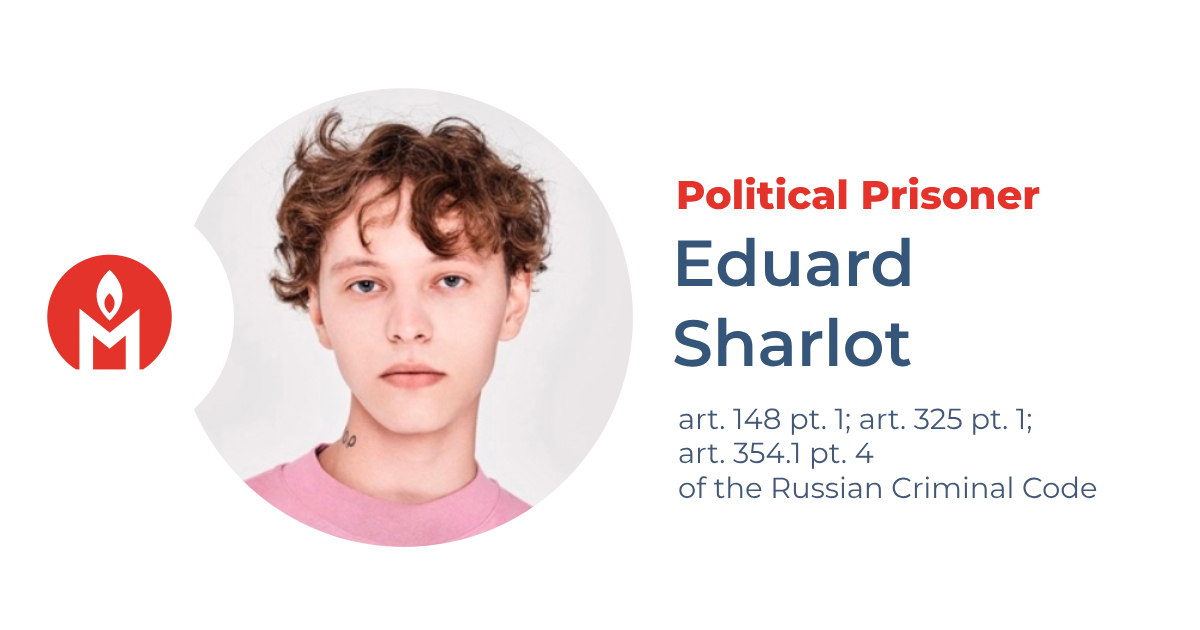
Who is Eduard Sharlot and what are the charges against him?
Eduard Sharlot, 26, from Samara, is well-known in Russia as a singer and musician. In his songs and music videos, he has criticised the Russian authorities, making fun of propagandists and pro-government artists.
In early 2023, Sharlot left Russia for Armenia. On 22 June 2023, Sharlot published a video on his Instagram page that showed him tearing up a huge paper letter Z, the symbol of the Russian invasion of Ukraine, in the colours of the St. George’s Ribbon in protest against the war.
On 26 June 2023, Sharlot published another video in which he could be seen setting fire to his Russian passport and saying that he wanted to go to Kyiv and no longer considers himself a Russian citizen.
On 22 November 2023, Sharlot returned to Russia and was detained at the airport. He was then taken to Samara, where he was remanded in custody on 2 December.
Sharlot was charged with desecrating symbols of military glory (Article 354.1, Part 4, of the Russian Criminal Code) for the video, in which he tore up a large paper letter Z, and a remake of the song ‘Victory Day.’ He was charged with damaging an official document for personal gain (Article 325, Part 1, of the Russian Criminal Code) for the video in which he set fire to his passport.
In addition, Sharlot was charged with insulting the feelings of religious believers (Article 148, Part 2, of the Russian Criminal Code) for a video in which he nailed his military ID together with a photo of Patriarch Kirill, to a crucifix.
Why do we consider Sharlot a political prisoner?
The article on the rehabilitation of Nazism and the desecration of symbols of military glory unreasonably restricts freedom of expression. The provisions of this article criminalise the expression of opinion about past events and prohibit criticism of official symbols associated with the memory of the Second World War. However, even in this context, Sharlot’s prosecution is absurd. The letter Z is not a symbol of military glory, but a symbol of the war unleashed by Russia against Ukraine.
The article that criminalises ‘insulting the feelings of religious believers’ does not meet the principle of legal certainty and contradicts the Russian Constitution, in particular, the provisions affirming the secular nature of the state and enshrining freedom of conscience and expression.
Finally, the charge against Sharlot that he damaged an official document for personal gain is self-evidently without grounds, as he received no benefits from burning his passport.
A detailed description of the case of Eduard Sharlot and the position of the ‘Political Prisoners. Memorial’ human rights project are available on our website.
Recognition of an individual as a political prisoner does not imply the ‘Political Prisoners. Memorial’ human rights project agrees with, or approves, their views, statements, or actions.
How can you help?
You can write to Eduard Sharlot at the following address:
In Russian: 443022, Самара, ул. Садовый проезд, д. 2, ФКУ СИЗО-1 УФСИН России по Самарской области, Шарлоту Эдуарду Валерьевичу 1998 г. р.
In English: Eduard Valeryevich Sharlot (born 1998), Remand Prison No. 1, Federal Penitentiary Service of Russia for Samara region, 2 Sadovy Proezd, Samara, 443022, Russia.
You can also send an electronic letter via OVD-Info (free of charge) and via Zonatelecom (Russian bank cards) or PrisonMail (other bank cards).
It is important to note that letters may not reach Eduard Sharlot at present on account of the fact that he has been sent to undergo a psychiatric assessment.
Please note that letters in languages other than Russian are highly unlikely to reach the recipient.
You can donate to support all political prisoners in Russia.