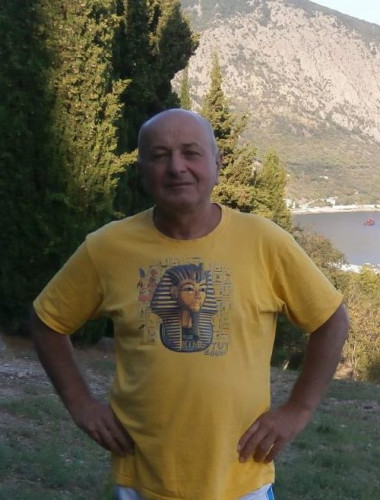
Valery Dobrovolsky is a political prisoner
A 68-year-old native of Ukraine living in Kamchatka has been placed under house arrest on a charge of ‘colluding’ with the Ukrainian Security Service
The ‘Political Prisoners. Memorial’ human rights project, in accordance with international criteria, considers Valery Dobrovolsky a political prisoner. Dobrovolsky is being prosecuted on a criminal charge of ‘collusion with a foreign state’ for allegedly corresponding with representatives of the Ukrainian Security Service. Dobrovolsky’s prosecution violates his right to a fair trial. We demand the release of Valery Dobrovolsky and that all criminal charges against him be dropped.
What are the charges against Valery Dobrovolsky?
Valery Dobrovolsky, who was born in Ukraine, studied at an aviation college there before moving to Kamchatka. He holds both Russian and Ukrainian citizenship. He is now 68 years old and has a significant disability.
FSB officers first interrogated Dobrovolsky in November 2024, but a criminal case was only opened against him on 26 March 2025 when he was charged with collusion with a foreign state (Article 275.1 of the Russian Criminal Code). The details of the charge are unknown, but Dobrovolsky is accused of having ‘carried on communication with representatives of the Ukrainian Security Service for a long time.’
On 29 March, Dobrovolsky was placed under house arrest. This pre-trial measure was repeatedly extended, despite requests by Dobrovolsky and his lawyer to relax the restrictions and allow him at least to take walks, which are important for his health. If convicted, Dobrovolsky faces up to eight years’ imprisonment.
Why do we consider Valery Dobrovolsky a political prisoner?
The offence of ‘collusion’ was introduced into the Russian Criminal Code in July 2022 as yet another tool in the fight against the regime’s so-called ‘internal enemies.’ The provisions of this law do not comply with the principle of legal certainty since, in essence, the law criminalises any communication with foreigners, providing for punishment not for specific actions but for a supposed intention to ‘assist’ in some undefined ‘activities.’
This offence of ‘collusion’ must be rescinded, all related criminal convictions quashed, and ongoing prosecutions dropped.
In our view, if Dobrovolsky’s actions had genuinely constituted a crime, and if the investigative authorities had sufficient evidence, he would have been charged with a different criminal offence. The charge of collusion is being used by the authorities to intimidate the public and avoid the need to prove the guilt of the accused.
Depriving a person with a disability of liberty on charges not related to violence or incitement to violence is unjust and unfounded, causing additional suffering to a person already in poor health.
A detailed description of Valery Dobrovolsky’s case and of our position is available on our website.
Recognition of an individual as a political prisoner does not imply the ‘Political Prisoners. Memorial’ human rights project agrees with, or approves, their views, statements, or actions.
How can you help?
You can donate to help all political prisoners in Russia.