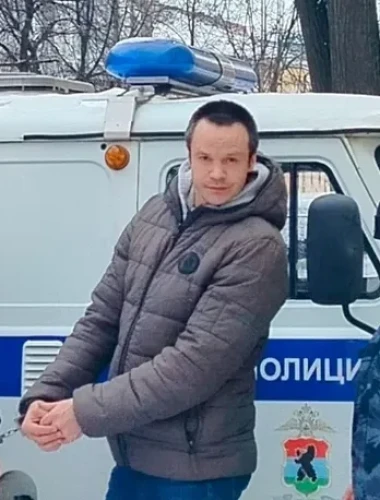
Petro Romaniuk is a political prisoner
A native of Ukraine from Karelia was sentenced to 15 years in a maximum-security penal colony under a terrorism charge after being accused of attempting to set fire to a military enlistment office
Petro Romaniuk was born in the village of Struhy in Khmelnytskyi Oblast, Ukraine, and lived in the Karelian city of Suoyarvi, where he worked as an assistant locomotive driver.
On May 15, 2024, he was detained on suspicion of setting fire to a military enlistment office several days earlier. At the time, an unidentified person, captured by surveillance cameras on a neighbouring building, threw two bottles containing an incendiary mixture at the building. The fire quickly went out, and the incident was discovered only in the morning. The damage to the building was estimated at 50,000 rubles.
The criminal case was initially opened under the article on intentional damage to property by arson (Part 2 of Article 167 of the Russian Criminal Code), but after Romaniuk’s arrest, the charge was reclassified as attempted terrorism and subsequently as a completed offence under the same article. In March 2025, the court sentenced Romanyuk to 15 years in prison: he is to spend the first four years in prison and the remainder in a maximum-security penal colony. The appeal court and the Supreme Court upheld the sentence.
Romaniuk pleaded not guilty and denies any involvement in the arson. The defence pointed out that the person throwing the bottles could not be identified from the unclear video recording, and no fingerprints belonging to Romaniuk were found on the bottles.
The investigation linked the alleged arson to Romaniuk’s negative attitude towards the war. His Ukrainian origin, regular trips to visit relatives in Ukraine, subscriptions to Ukrainian channels, and publications from 2014 about the situation in Donetsk were cited as evidence of his views.
We have serious doubts about the classification of the incident as a terrorist attack. To establish this, the prosecution would have had to prove that the arsonist’s actions intimidated the population, created a real danger of serious consequences, and could have influenced the activities of the authorities. However, the attempted arson took place at night, went unnoticed until morning, and caused relatively minor damage.
Moreover, using Romaniuk’s Ukrainian origin and publications from 11 years ago to substantiate terrorist intent points to the weakness of the evidence and further underscores the political nature of the prosecution. It cannot be ruled out that Romaniuk is, as he claims, genuinely uninvolved in the incident and simply became a convenient target for the security services.
A detailed description of Petro Romaniuk’s case and of our position is available on our website.
How can you help?
You can write to Petro Romaniuk at the following address:
Ru:
600020, г. Владимир, ул. Большая Нижегородская, д. 67, ФКУ Т-2 УФСИН России по Владимирской области, Романюк Пётр Михайлович, 1987 г. р.
En:
600020, 67 Bolshaya Nizhegorodskaya St., Penal Institution T-2 of the Federal Penitentiary Service of Russia for Vladimir Oblast, Romanyuk Peter Mikhailovich, born in 1987.
You can also send emails via ZT (for payment with all bank cards) and Memorial-France (free of charge).
Please note that letters in languages other than Russian are highly unlikely to reach the intended recipient.
You can donate to help all political prisoners in Russia.