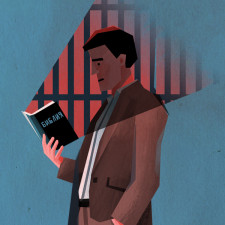
Forced labour for a 100-rouble transfer and six years for ‘teaching religion’
Kirill Suvorov, a former adviser to the head of Moscow’s Krasnoselsky District and a historian specialising in Oriental studies, was arrested in July 2026 on charges of spreading ‘fake news’. The arrest was apparently linked to videos he had posted on social media. On his YouTube channel, Suvorov commented on current affairs and recited his anti-war poems.
Kapitolina Averina, a Moscow resident, worked as a producer on a number of popular entertainment television programmes and had recently been living in Estonia. Her partner, a Ukrainian citizen, fought in the Armed Forces of Ukraine and was killed in May 2023. Averina posted a strongly worded comment on a Telegram channel about the meeting between Putin and Trump, saying that Moscow should be bombed. She was arrested in February 2026 in Ivangorod, where she had travelled to see her mother, and transferred to a remand prison. Averina was sentenced to six and a half years in a penal colony on charges of public calls for terrorism.
Andrey Ivanov, a pensioner from Vologda Oblast who retired on health grounds, was placed under house arrest in December 2025 on charges of public calls for terrorism. In a comment posted in 2021, he wrote that Putin, ‘that bastard’, should be hanged in Red Square. Ivanov was sentenced to two years in a penal colony in April 2026.
Andrey Petrov, a resident of Pskov, worked as a senior data analyst at a stock exchange. A criminal case was opened against him over two old Telegram comments in which he allegedly called for violent reprisals against Putin and his ‘gang’. Petrov was sentenced to six years in a penal colony in June 2026 on charges of public calls for terrorism. On appeal, the term was reduced by four months.
Vasily Fedyushkin from Kaluga Oblast was born in Ukraine. According to investigators, he planned to set fire to a mobile phone mast to bring the ‘special military operation’ to an end. Fedyushkin was detained in January 2026 and transferred to a remand prison. He was later sentenced to eight years in a penal colony on charges of preparing a terrorist attack.
Vitaly Syrykh from Kemerovo Oblast was prosecuted in 2021–22 for his affiliation with Jehovah’s Witnesses, on charges of participating in an extremist organisation, but the case was eventually discontinued. Two years later, he was charged again, this time with organising the activities of an extremist organisation, and sentenced to six years in a penal colony in October 2026. According to investigators, Syrykh coordinated the work of a local group of Jehovah’s Witnesses and ‘taught religion’.
Fyodor Sidushkin, a law student from Moscow, was fined along with a friend following a personal dispute. Sidushkin said that their signatures on the administrative offence reports had been forged and sought to have a criminal case opened. Instead, a criminal case was opened against him over a transfer of 100 roubles he had made several years earlier to Vladislav Pozdnyakov, founder of the Male State movement. Sidushkin was held in custody from February 2026 and sentenced in June to two years of forced labour on charges of financing extremism.
A criminal case was opened against Vitaly Ainulin, a Moscow resident, on the same charge of financing extremism. He was accused of transferring a total of 2,100 roubles to the Anti-Corruption Foundation in seven payments. Ainulin was sentenced to three years in a penal colony in October 2026.
Sergey Vasilyev, an individual entrepreneur from Voronezh, and Maksim Cheremsky, a manager from Moscow Oblast, were prosecuted on charges of financing terrorism over donations to politician Vyacheslav Maltsev. According to investigators, the money was intended to support the activities of a ‘terrorist community made up of members of the Artpodgotovka movement’. Vasilyev was accused of transferring a total of just under 9,000 roubles in several payments and was sentenced to eight years in a penal colony in July 2026. Cheremsky allegedly transferred a total of about 36,000 roubles and was sentenced to nine years in April 2026.
Dmytro Podhorskyi, a resident of Melitopol, was sentenced to 14 years in a penal colony on treason charges. The prosecution stemmed from a transfer of 500 hryvnias (about 1,152 roubles) to support the Armed Forces of Ukraine.
You can read more about these cases, including addresses to write to the political prisoners, on our website.
By staying informed, sharing updates, or making one-off or regular contributions, you can help those affected by political repression in Russia.