Ukrainian civilian held in Russian captivity for four years died shortly after being exchanged
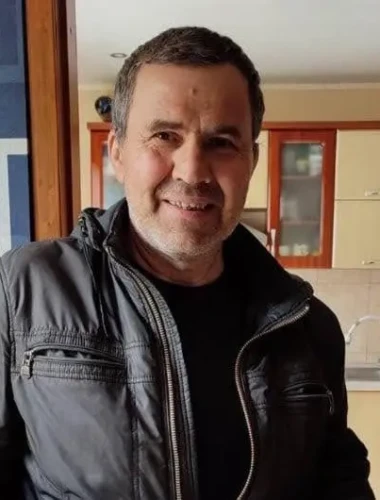
Oleh Kotov, 59, who returned to Ukraine in a prisoner exchange in June, died in late July. By the time he was released, he was already suffering from advanced cancer. The story of the former civilian hostage was reported by Stefan Schocher, a journalist with the German publicationWelt.
Stefan Schocher spoke to Oleh Kotov and his wife in hospital seven days before he died.
‘Oleh Kotov is dying, and he knows it. His first days of freedom after so many days in captivity are his last days on this earth. The soup — his lunch today — he can taste only from the aroma rising to his mouth. His wife, Svitlana, draws it into a syringe, inserts it into a cannula and pumps the liquid through a tube that passes through the wall of his stomach: today’s lunch is basil soup. He sits propped up on his hands, his legs hanging over the edge of the bed — a 59-year-old man, emaciated to the bone. Outside the window, birds are singing; below, in the courtyard at the entrance to the hospital where he is being treated, people are talking. Kotov speaks in short sentences. A rasping sound comes from his lungs. He gasps for air.’
Oleh Kotov was abducted by Russian forces on 23 April 2022 from his home in the village of Kozacha Lopan in Kharkiv Oblast. A retired police officer, this may have been why the occupying forces took a particular interest in him. One of his sons also works for the Kharkiv police. During interrogation, Kotov tried to conceal this, saying that his son worked in construction. The soldiers, however, already had information about his son’s work in the police. Kotov was taken to a basement, where he was beaten and subjected to electric shocks.
He was then transferred to the border village of Hoptivka, where a local hotel was being used as a camp for prisoners of war and civilian hostages. Oleh Kotov said that he continued to be beaten and subjected to electric shocks there, and that three of his ribs were broken during the nearly month-long period he spent at the ‘hotel’.
He was then held for around eight months in Shebekino, Belgorod Oblast. ‘And there again, the “welcome” — truncheons,’Welt paraphrased him. ‘More interrogations. More beatings. The camp’s speciality was sudden night-time attacks by guards wielding 73-centimetre-long truncheons. “Across the buttocks, into the buttocks.” One man there screamed so much… Oleh Kotov pauses. Then came “Krokodil (Crocodile)” again — electric shocks. Or gas canisters tied to the legs and set alight. Hot metal pressed against the soles of the feet. And “Rodnichok (Fontanelle)” — you lie on a bench, a rag is stuffed into your mouth, water is poured in, and you cannot swallow. Or “Mashenka” — a sledgehammer. Or “dental instruments”, which they would lay out during interrogations, almost ritually.’
Oleh Kotov was subsequently held in pre-trial detention facilities in Zaraysk, Moscow Oblast, and Stary Oskol, Belgorod Oblast. He recounted: ‘They pulled an HIV-positive prisoner out of his cell and threw him into a windowless room until he developed pneumonia, and three days later he died. “He left us very quietly.” Another man hanged himself with a bedsheet.’ Kotov himself was told that he had persistent pneumonia, but after overhearing doctors one day, he learned that he had cancer. According to him, once the doctors realised this, the beatings stopped — but he received no treatment either.
On 5 June, Oleh Kotov returned to Ukraine as part of a prisoner exchange.
On 11 August, Russian propaganda outlets began circulating a different account of Oleh Kotov’s death, citing an anonymous Russian security official. The ‘official’ allegedly received information from Ukrainian medical staff that Kotov had been tortured by the Security Service of Ukraine (SBU) and had died of cardiac arrest as a result of the torture. RIA Novosti described Kotov as a soldier and claimed that ‘the reason [for the torture and death] may have been his refusal to sign a contract with the Armed Forces of Ukraine’.