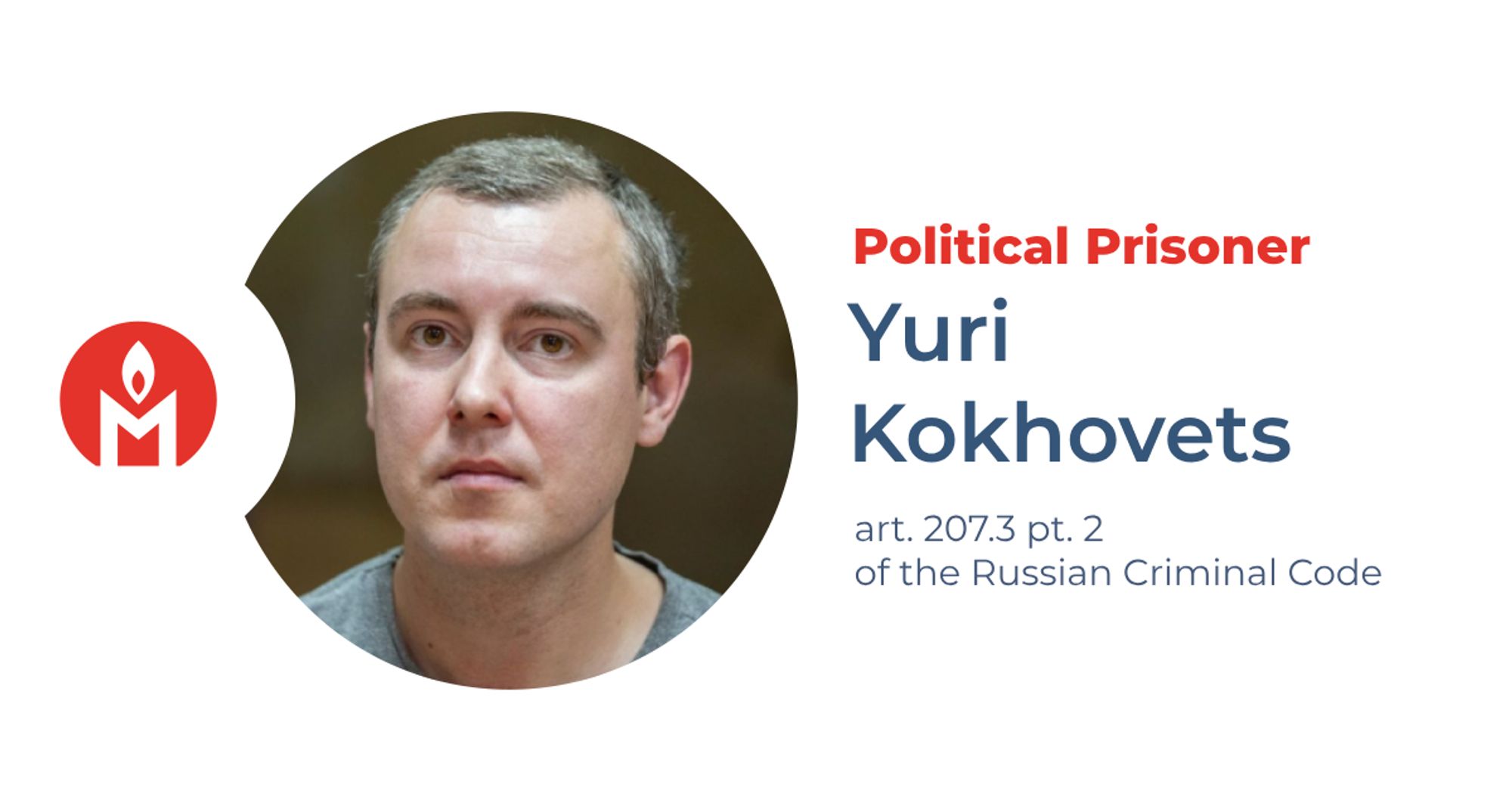
Yuri Kokhovets is a political prisoner
He has been sentenced to five years’ compulsory work on a charge of spreading ‘fakes news’ about Russia’s army for criticising the war in a vox pop
The ‘Political Prisoners. Memorial’ human rights project, in accordance with international standards, considers Yuri Kokhovets a political prisoner. Kokhovets has been convicted of spreading ‘fake news’ about the Russian army for answers he gave to questions put by a journalist. Kokhovets’ criminal prosecution and conviction violated his rights to freedom of expression and fair trial. We demand the immediate release of Yuri Kohovets and that all criminal charges against him be dropped.
What are the charges against Yuri Kokhovets?
On 11 July 2022, Radio Liberty journalists conducted a series of ‘vox pop’ interviews in Moscow streets. Passers-by were asked whether, in their opinion, it was necessary to ‘reduce tensions between Russia and NATO countries.’ The video was then published on the Internet.
One of the participants in the poll was Yuri Kokhovets. In his answers, he criticised the Russian authorities for the war unleashed against Ukraine and for war crimes against civilians, saying ‘all these actions need to be ended.’
A few months later, the video came to the attention of Russia’s security services. They identified Kokhovets and on 24 March 2023 opened a criminal case against him for spreading ‘fake news’ about the army (Article 207.3, Part 1, of the Russian Criminal Code). They considered that Kohovets had spread ‘information known to be false about the use of the Russian armed forces to kill civilians’ in Bucha near Kyiv in Ukraine.
Kokhovets was remanded in custody. Subsequently, a more serious charge was laid against him, with the addition of a ‘motive of political hatred’ (Article 207.3, Part 2).
On 22 April 2024, Kokhovets was sentenced to five years’ compulsory work, with a deduction of 10% of his earnings in favour of the state. During this period Kokhovets is to live under supervision in a correctional centre. Kokhovets was also banned from administering websites for four years.
Why do we consider Kokhovets a political prisoner?
The article on spreading ‘fake news’ about the actions of the Russian army, under which Kokhovets was prosecuted, had become law immediately after the start of Russia’s full-scale war against Ukraine. It effectively bans any criticism of the Russian authorities or the military in violation of the right to freedom of expression. This article contradicts Russia’s Constitution and therefore any related prosecution is unlawful.
Kokhovets gave voice to his personal opinion about the inadmissibility of the war against Ukraine, referring, among other things, to the massacre of civilians by Russian troops in Bucha. The fact that the Russian military is responsible for these crimes is recorded in reports by the Office of the UN High Commissioner for Human Rights.
Kokhovets’ statements were not motivated by ‘political hatred.’ This motive was imputed to him on the basis of a prejudiced assessment by experts lacking in objectivity.
Kokhovets’ case sets a worrying precedent of a criminal prosecution for giving a ‘wrong’ answer during a survey of public opinion.
A detailed description of the case of Yuri Kokhovets and our position are available on our website.
Recognition of an individual as a political prisoner does not imply the ‘Political Prisoners. Memorial’ human rights project agrees with, or approves, their views, statements, or actions.
How can you help?
You can donate to support all political prisoners in Russia.