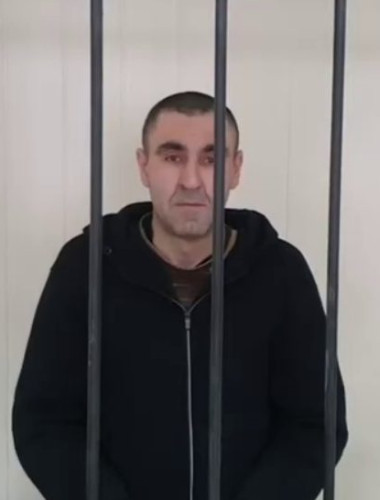
Nikolas Berianidze is a political prisoner
A Georgian has been sentenced to a lengthy term of imprisonment for serving in the Ukrainian Azov Battalion
The ‘Political Prisoners. Memorial’ human rights project, in accordance with international standards, considers Nikolas Berianidze a political prisoner. Berianidze was convicted of mercenarism and an attempt on the life of a military serviceman for serving in the Azov Battalion, a Ukrainian military unit. Berianidze’s prosecution and conviction violated his right to a fair trial and rights guaranteed by the Geneva Convention on the Treatment of Prisoners of War. We demand that Berianidze’s conviction be quashed and all criminal charges against him be dropped, and that his treatment be in full compliance with international law.
What were the charges against Nikolas Berianidze?
Nikolas Berianidze served in the Georgian army and took part in NATO military operations in Iraq and Afghanistan.
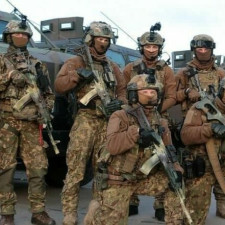
According to the Russian investigative authorities, no later than 2016 Berianidze arrived in Kyiv, where he joined the Azov unit as a military instructor. It is alleged that he received remuneration equivalent to more than 4.7 million roubles for this service.
After the start of Russia’s invasion of Ukraine on 24 February, Berianidze allegedly killed three Russian servicemen in combat. He was taken prisoner on 20 May 2022 and subsequently charged with an attempt on the lives of military service personnel (Article 317 of the Russian Criminal Code) and mercenarism (Article 359, Part 3).
On 27 January 2025, the Russian-controlled ‘Supreme Court of the Donetsk People’s Republic’ sentenced Berianidze to life imprisonment in a special regime penal colony.
On 13 May 2025, an appeal court overturned the sentence and issued a new conviction in the case, details of which have not been made public.
Why do we consider Nikolas Berianidze a political prisoner?
The Geneva Conventions do not recognise as mercenaries those who officially serve in the military forces of one of the parties to an armed conflict.
From 2016 Nikolas Berianidze served under contract in an official unit of the Ukrainian armed forces. Therefore, he cannot be considered a mercenary. Furthermore, there are no grounds to believe that his remuneration exceeded that of other military service personnel. This is another reason he cannot be considered a mercenary.
Nikolas Berianidze has not been charged with war crimes. If he did in fact kill Russian military service personnel, this was in combat in which the combatants were therefore legitimate military targets. Such actions are not a crime.
In essence, Berianidze is being prosecuted simply for participating in hostilities during an armed conflict. Under international law, such prosecution is impermissible, and combatants detained during hostilities are considered prisoners of war.
It should also be recalled that the UN General Assembly has recognised Russia’s invasion of Ukraine as an act of armed aggression. In terms of international law, Russia’s military actions against Ukraine are illegal and criminal, while the actions of the Ukrainian army in defending Ukraine from aggression are lawful and justified.
A detailed description of Nikolas Berianidze’s case and of our position is available on our website.
Recognition of an individual as a political prisoner does not imply the ‘Political Prisoners. Memorial’ human rights project agrees with, or approves, their views, statements, or actions.
How can you help?
You can write to Nikolas Berianidze at the following address:
RU: 283086, Донецк, ул. Кобозева, д. 4, ФКУ СИЗО-1 ГУФСИН России по ДНР, Берианидзе Николасу Георгиевичу, 1984 г. р. (адрес предположительный).
EN: Nikolas Georgievich Berianidze (born 1984), Remand Prison No. 1, Federal Penitentiary Service of Russia for the Donetsk People’s Republic, 4 Kobozeva Street, Donetsk, 283086, Russia (the presumed address).
You can also send an email using ZT (for payment with all bank cards), OVD-Info and Memorial-France (free of charge).
Please note that letters in languages other than Russian are highly unlikely to reach the intended recipient.
We respect the territorial integrity of Ukraine, but to ensure that letters reach their recipients in occupied territories, addresses must be written according to Russian rules.
You can donate to help all political prisoners in Russia.