
FSB Videos: Behind the scenes of dramatic arrests
Key findings
To increase the effectiveness of their repressive policies, Russia’s political leaders have not only expanded the scale of political repression and intensified its severity but have also significantly reworked the accompanying propaganda narratives. Significant changes have occurred in the official media coverage of the activities of the FSB, the main agency of repression.
Since the start of the full-scale invasion of Ukraine, the FSB has noticeably increased its media presence. Short video clips, produced according to specific templates using well-established techniques, have come to play an important role in publicising the FSB’s activities. Such video materials should not be regarded as reliable reports, They are propaganda materials that often distort real events. To make them as impactful as possible, the FSB has launched a production stream of staged videos that show not only suspects’ video confessions but also footage of arrests and searches.
Video footage shot by the FSB is used not only to produce propaganda clips but also to put pressure on a suspect’s relatives and loved ones, as well as to discredit and blackmail the suspect.
The FSB’s video production and methods of organisation are yet further indications of the serious changes that have taken place within the country’s main intelligence agency. As the primary agency of political repression, the FSB has become a completely opaque and unaccountable organisation, and one that employs ever more cynical and unlawful methods.
A report based on individual criminal prosecutions
This report is based, in part, on materials from 70 randomly selected criminal prosecutions that show signs of political motivation and unlawfulness from among those analysed in recent years. Summaries of these cases are published on our website (summaries for several of them will be published shortly). All these prosecutions were initiated after the start of the full-scale war. In all instances, the case files refer to video recordings made by FSB officers. Almost always, the footage served as the basis for subsequent propaganda videos. There are several cases in which videos were not published, but we know that they were made from the accounts of detainees or other sources. We also take these cases into account to provide a fuller understanding of how the process of creating such video materials is organised. Appendix 1 provides a list of criminal prosecutions used in writing this report, hyperlinks to our fact sheets on these prosecutions, as well as links to the corresponding videos published by the FSB.
It should be noted that we examined only relatively short videos used by the FSB to provide media coverage of specific criminal investigations. As a rule, their duration does not exceed two minutes, although occasionally they are somewhat longer. At the same time, in recent years the FSB, in collaboration with regional and federal television stations, has produced a whole series of propaganda films about politically motivated prosecutions. These films are naturally of longer duration. Typically, they feature several individuals prosecuted in criminal cases. It is evident that journalists played a significantly greater role in their production. These films have not been analysed in our review.
The changing role of the FSB in the media landscape
With the start of the full-scale invasion, the FSB became much more prominent in the media landscape. This was because of the security service’s role in the war against Ukraine as well as the tightening of the repressive regime within Russia. In previous reports, we noted that the FSB has become the primary agent of political repression. Politically motivated prosecutions investigated by the FSB, primarily involving charges of terrorism or treason, currently dominate the landscape of politically motivated prosecutions.
All of this has inevitably affected the FSB’s media presence. As an indicator of this media presence, we have calculated the frequency of mentions of the FSB in the Telegram channels of the leading government news agencies RIA Novosti and TASS.
Diagram 1
% of posts mentioning the FSB of the total number of posts (as a % of the total number of posts on Telegram)
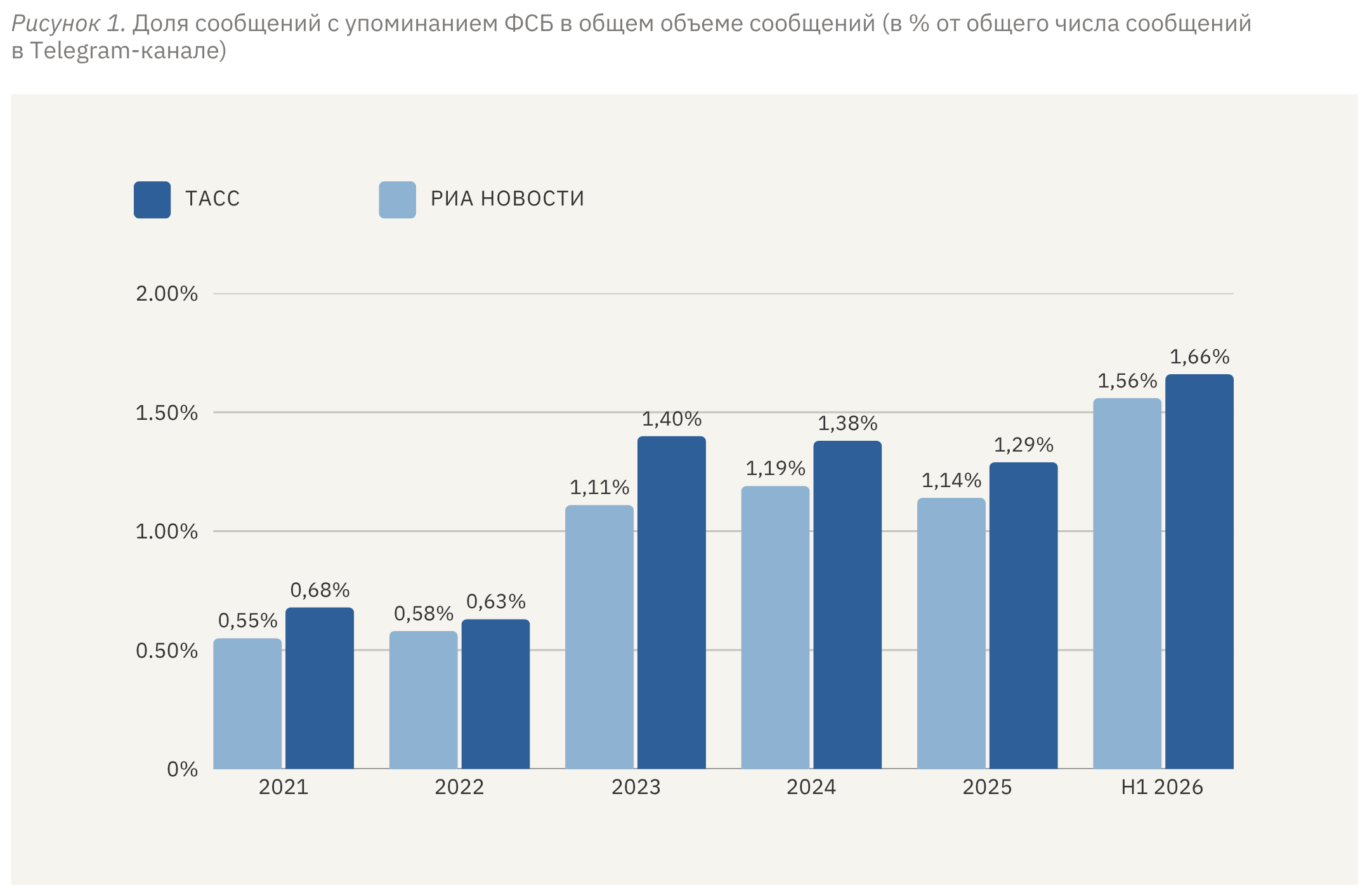
RIA Novosti / TASS
As can be seen in Figure 1, mentions of the FSB increased by two or three times in the period from the start of the full-scale war to the middle of 2026.
The changes in the FSB’s media presence were not merely quantitative. Wartime conditions and the need to demonstrate effectiveness in the fight against ‘internal enemies’ raised the bar for coverage of the security service’s activities. Reports on the FSB’s successes were not only more numerous; they were also supposed to be more convincing, vivid, and memorable. The FSB addressed this task by expanding its video production. Video lends credibility to a message and has a powerful propaganda effect.
Diagram 2
% of posts containing video of all posts mentioning the FSB (as a % of the total number of posts mentioning the FSB on Telegram)
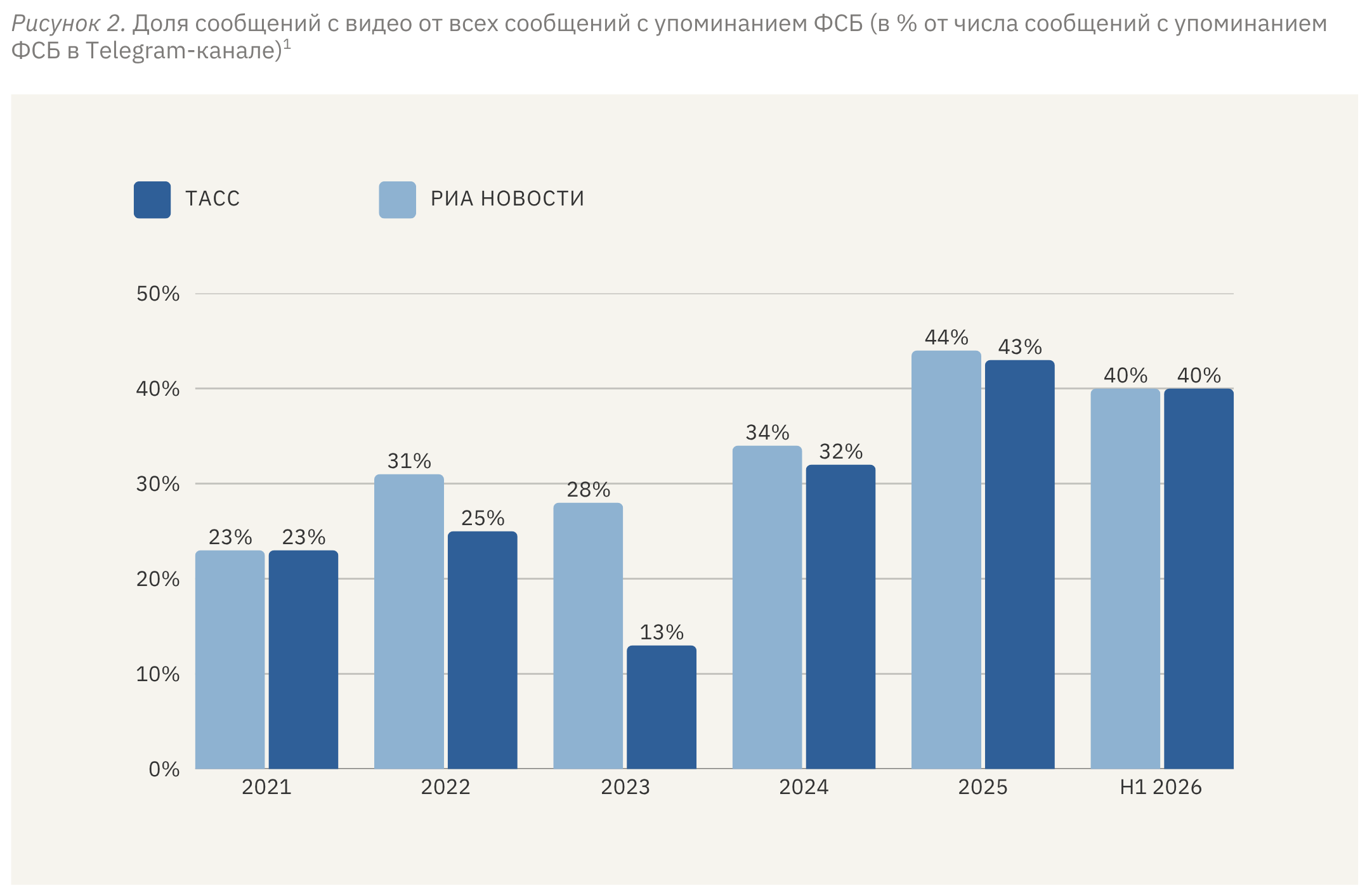
RIA Novosti / TASS
Over the years of the full-scale invasion, the proportion of reports mentioning the FSB that includes video footage almost doubled. Bearing in mind that some reports on the FSB are not initiated directly by the security service but form part of the wider news agenda, it is safe to say that video content appears more frequently in the news materials produced by the FSB than these figures would suggest.
It is worth noting separately that the increase in the amount of video material in news agencies’ publications about the FSB has not been related to any general shift in the policies of RIA Novosti and TASS, such as an increase in the role of video content. The proportion of reports containing video material has not changed significantly over these years. Meanwhile, reports mentioning the FSB contain video material roughly twice as often as the ‘average’ news agency report.
Since the start of the war, it is not only the frequency of video material used in reports about the FSB that has changed, but also the subject matter of these stories. Even a cursory glance at reports on the FSB’s activities that contain video material clearly demonstrates this difference. In the pre-war period, FSB video material was thematically more diverse. For example, shortly before the war, videos showed how FSB officers pursued migrants, cracked down on illegal crab fishing, apprehended a teenager planning an attack on a school, carried out large-scale arrests of underground arms dealers, or seized birds of prey from smugglers and released them. Topics covered in the video content were extremely varied including, for example, materials on Islamists, a university rector accused of corruption, an underground casino, hackers and dried molluscs. By 2021, materials relating to Ukraine (Ukrainian agents, neo-Nazis linked to Ukrainians, and so on) already accounted for a significant proportion of the posts. However, these stories accounted for a relatively small proportion of the total volume. With the outbreak of full-scale war, the FSB’s video material has, in most cases, come to focus on Ukrainian themes, with a significant proportion relating to criminal cases involving terrorism and offences against state security.
Our project monitors criminal cases that show signs of political motivation and unlawful prosecution. All cases described below fall into this category. To what extent conclusions regarding the media coverage of these cases can be generalised to all criminal cases investigated by the FSB, and their coverage in the media, is a question to which we have no definitive answer. However, it is logical to assume that the FSB handles media coverage of various types of cases in a similar manner.
Typical video used in relation to politically motivated prosecutions
In videos used by the FSB to provide propaganda support for politically motivated criminal prosecutions, several standard elements can be identified. Every video produced by the security service includes one or more of these.
● Undercover filming. Footage showing the suspect committing or preparing to commit a crime (stashing or retrieving items from a hiding place, photographing objects, practising throwing Molotov cocktails, etc.). CCTV footage may also be used.
● Arrest. Sometimes this element also includes footage of officers’ entry into a residential property or other related circumstances.
● Presentation of the results of a search or inspection. Seized items, messages on a mobile phone, etc.
● Transport of the detainee. The transfer of the suspect between places of detention, the court, FSB offices, etc.
● Confession. Direct speech by the person arrested in which they describe the circumstances of the case, admit guilt, express remorse, etc.
Video footage published by the FSB should not be regarded as factual news reports on cases under investigation. These videos form part of an information war and serve very specific purposes. In today’s world, such a war requires appropriate tools, and the FSB is rising to this challenge by producing hundreds of short, sometimes dynamic and dramatic, clips every year. Below, we examine specific examples of videos from ‘political’ cases and attempt to explain why FSB videos are structured in the way that they are, and what this tells us about the security service itself.
Undercover filming
Video recordings provided by the FSB sometimes begin with footage intended to demonstrate the unlawful activities of those involved prior to arrest. This is intended to lend credibility to the narrative that follows and immediately dispel any possible doubts regarding the suspect’s guilt.
Footage from undercover surveillance is used for this purpose. For example, Valentina Tagirova is shown carrying a large black bag to a hiding place. Veronika Netunaeva is seen filming on her mobile phone near a hydroelectric power station and on the city’s streets. Denis Popov is shown filling a jerrycan at a petrol station and then throwing a bottle containing a flammable mixture at the wall of a derelict building bearing the words, ‘No to war.’ Vadim Selin is seen visiting a hiding place.
From a production point of view, the distinctive feature of such videos is that they are not easy to make. To do so, it is necessary to keep the suspect under surveillance until their arrest. Often, FSB officers resolve this problem quite simply. All the examples of covert filming cited above were taken from cases involving a sting operation. Security forces established contact with the victims, persuaded them of the need to carry out certain actions, documented what was happening (in particular, by filming it) and then carried out the arrest. Of the 70 cases examined in this report, covert filming featured in six videos. All six of these cases were based on a sting operation. You can read more about the methods used by the FSB, which have become routine, in our report, Fraudsters from the FSB: How law enforcement agencies fabricate prosecutions for terrorism and treason.
However, operational video footage filmed prior to arrest is used relatively rarely in published media since it can appear unimpressive, and from the video it is often not entirely clear exactly what is happening.
Arrest
This is, of course, the most striking and dynamic part of any security service video. Footage of arrests is intended to demonstrate the professionalism of FSB officers and the agency’s ability to effectively suppress unlawful activities. For disloyal citizens, it is meant to serve as a vivid lesson as to what will happen if their disloyalty results in concrete actions.
The FSB’s public relations team understands this perfectly and makes active use of such videos. Of the 70 cases we examined, footage of arrests features in almost two-thirds. Operatives are likely tasked not merely with filming the arrest, but with doing so as vividly and dramatically as possible. In many video recordings, the arrest scene is filmed from several angles. For example, in the video of the arrest of Gennady Osmak, a journalist from Kherson region, the footage was shot by at least three cameramen.
The brutality of arrests
Above all, an arrest must be as brutal as possible. The message to the audience is, as it were, that ‘political’ criminals are enemies and traitors, and the FSB has no intention of standing on ceremony with them. The suspect is thrown to the ground, their arms twisted behind their backs and they are handcuffed. Sometimes a special forces officer sits on an arrested person’s legs, while another holds his head in place by clamping his legs around it. This is exactly how the arrest of former Yandex employee Sergei Irin took place. Once the handcuffs are on, a special forces officer may grab the suspect by the hair or simply lift their head up and force them to state their name, or the suspect is filmed being shown an officer’s ID. These scenes are filmed in close-up. An example of this is what happened to 19-year-old student Vsevolod Kulikov, whose arrest shows signs of being the result of a sting operation. The way in which the arrested person is shown, lying on the ground completely in the power of the security services with their head unnaturally lifted up and held by a special forces officer, being forced to state their name or shown looking at an FSB officer’s ID card held in front of their face, is probably considered particularly effective by the security services. Such footage often features in staged videos of arrests. We return to the subject of staged videos in more detail below.
This does not mean that all arrests in politically motivated cases take place in the same manner (an example of a ‘gentle’ arrest can be seen, for instance, in the case of civil aviation pilot Sergei Samoilov). Rather, such a video illustrates what the ideal arrest looks like from the perspective of the FSB’s public relations officers. Most likely, the proportion of aggressive arrests in the videos published is higher than in actual practice. It is certainly higher in staged video recordings.
It is worth noting, however, that the arrests of women and minors in published videos tend to be handled more circumspectly. Women are not usually thrown to the ground, special forces officers do not sit on them, nor lift their heads by their hair. It is difficult to say how this plays out in real life. Perhaps the FSB simply prefers not to show such footage, believing it might be perceived negatively.
Display of weapons
However, arrests are not always carried out in such an aggressive manner. Other techniques are used to make a video more dramatic. One popular method is the ostentatious display of weaponry.
An example of this is the arrest of Ekaterina Korovina, a resident of Luhansk region. A team of investigators arrived in the village where Ekaterina Korovina lived, accompanied by men with automatic rifles. This is broadly understandable, as the occupied territories are not the safest place for Russian security forces. However, the presence of an armed man in the frame in the investigator’s office at the moment the young woman is reading out her confession, or in the same office when she is told that she has been detained, can hardly be explained as anything other than a directorial choice.
Weapons in the frame are, first and foremost, a hallmark of arrests in the occupied territories, although the practice is not geographically limited. Video of the arrest in Moscow of Mark Kislitsyn, later sentenced to 12 years’ imprisonment for transferring 865 roubles to support the Ukrainian armed forces, shows a special forces’ officer travelling in the minibus holding a pistol, with a close-up of the weapon. Later, despite the fact that having to hold the pistol in one of his hands hinders him during the arrest, he nevertheless displays this pistol. The officers involved had no reason to expect armed or active resistance from Kislitsyn, which is why only two special forces officers carried out the arrest. The pistol was completely unnecessary for the arrest but very useful for dramatic effect. It is worth adding that the video of Kislitsyn’s arrest was likely staged, as suggested by the fact that one of the cameramen was already positioned at the scene of arrest before the minibus carrying the special forces arrived and Kislitsyn emerged from the building to meet them. If the minibus, or Kislitsyn, had been moving at a slightly different speed, the arrest might have taken place at a different point, but the cameraman had taken up the appropriate position. Kislitsyn’s behaviour also appears unnatural. He carries on walking as if nothing were amiss, even though the special forces officer with a pistol is running straight towards him. Finally, towards the end of the video, a police officer in uniform can be seen in the frame, who, it would appear, had been standing next to the cameraman at the time of the arrest. Of course, he may have been there by chance, or he may simply have been helping to organise the filming.
Staged arrests
Ruslan Sidiki. Two versions of one arrest.
Ruslan Sidiki was convicted of attacking a military airfield and blowing up a railway line. He did not deny the charges, but his account of his arrest differs radically from that of the FSB.
Ruslan Sidiki describes his arrest as follows. On 29 November 2023, as he was leaving an apartment block on the outskirts of Ryazan, he was stopped by a police officer. The officer compared Sidiki’s face with a photofit image and urged him to accompany him to the police station. Sidiki agreed.
The FSB describes the incident quite differently, and the security service’s version is backed up by a video. In this video, Sidiki is seen walking in winter in an area of garages but is overtaken by a vehicle carrying special forces officers and is apprehended. Next, a calm Sidiki is seen standing, presumably next to that very car, describing in detail, and completely calmly, how he was recruited by the Ukrainian security services and carried out terrorist attacks on their orders.
In point of fact, between the moment Sidiki agreed to go to the police station and the staged video of his arrest, he had been subjected to electric shock torture, beatings, threats to ‘flay the skin off his genitals’ and to rape him ‘with various objects.’ Upon his arrival at the remand prison, multiple wounds were recorded to his head and wrists, bruises around his eye and large haematomas on his back.
Staged videos of arrests have become a firmly entrenched FSB practice. It is difficult to say what proportion of all arrest scenes in politically motivated cases published by the FSB are staged. It is not always possible to determine from a single video alone whether it is staged, and information from those detained may be lacking. Furthermore, in some cases, genuine footage of the arrest may be edited together with material filmed later. In the videos we have examined, about a quarter of all arrests show signs of being staged. The figure may well be higher. Below, we describe several such cases and highlight characteristic features of staged videos.
Footage of staged arrests often appears implausible in certain details, but the rapid pace of events leaves the viewer no time to reflect, and these moments simply go unnoticed.
One technique, two different arrests
One of the techniques used by the FSB in making arrests in urban settings involves grabbing the suspect by the legs from behind and turning them over. As a result, the suspect is disoriented and ends up on the ground. All this only serves to heighten the stunning effect of a sudden, forceful arrest.
An example of this technique was used in the arrest of Gennady Novitsky from Rostov. Although he was 62 years old at the time, posed no danger and was unable to offer resistance, FSB officers presumably decided to film particularly dramatic footage in real-life conditions. The video shows a special forces officer flipping the man over. Taken by surprise, Novitsky falls heavily to the ground. In the moments following the arrest, he is in shock.
However, in the case of the arrest (from 1:21) of Yury Kayev from Kherson, when FSB officers decided to use the same technique, we see a completely different turn of events. The detainee lands nimbly on his hands, and subsequently, lying on the ground, answers the security officers’ questions calmly and clearly. This was not just a matter of Kayev being 20 years younger than Novitsky.
Kayev himself described the circumstances surrounding the footage of his arrest as follows. For a week following his arrest, he was subjected to brutal and varied forms of torture. About a month later, he was allowed to have a shower for the first time. He was told to wash and shave, and was given a clean T-shirt and shorts, which he had brought from home. He was then taken to Nekrasova Street in Kherson, where he was handed a black bag containing his passport, mobile phone and his Red Cross staff ID. He was then ordered to walk along the pavement and told his arrest was going to be filmed and it was important to fall in such a way as not to injure his face. Everything went to plan on the first take.
Secluded locations
Security officers do not always manage to film what they need in a single take. To avoid attracting the attention of passers-by, the ‘directors’ choose locations for filming where they will not be disturbed. A significant proportion of arrests, judging by the footage, take place in deserted locations.
Yury Kayev’s alleged accomplices, Sergei Kabakov and Konstantin Reznik (defendants in the so-called ‘Kherson Nine’ case) were taken to an island for filming.
The brothers Aleksei and Vladimir Settarov, both residents of Crimea, were walking through fields along some sort of country lane when suddenly a minibus carrying special forces officers blocked their path. After their arrest, standing next to the security forces’ minibus, the brothers answered questions without any visible signs of agitation.
Aleksei Dekhonov from Komsomolsk-on-Amur was walking in an area of garages when a minibus carrying special forces suddenly appeared. In fact, Dekhonov had been initially jailed on an administrative-law charge of petty hooliganism, as he allegedly used ‘crude, obscene language, behaved provocatively and failed to respond to instructions.’ As is often the case, his short administrative-law jail term was followed by the opening of a criminal case against him. He was charged with transferring 4,000 roubles to the Ukrainian armed forces.
Evgeny Vitushkin, a resident of Chelyabinsk region also charged with transferring money to the Ukrainian armed forces, was shown fiddling with the lock on his garage door for a very long time and failing to notice a minibus that parked behind him from which special forces rushed out.
The ever-present cameraman
Another indication that a video was staged, as already mentioned, is the ability of security service officers responsible for filming to arrive at the scene of arrest before the special forces and to choose their vantage point with precision. In the aforementioned video of Evgeny Vitushkin’s arrest, the cameraman is already filming the moment the special forces jump out of the van. Yet Vitushkin pretends not to notice this, even though the cameraman is just a few metres from him. A similar situation occurred during the arrest of Mark Kislitsyn, described above.
Not brutal, but humiliating
Another scenario for arrests, used in footage regularly published by the FSB, involves early-morning raids. Security forces break into an apartment, catch people undressed and film the whole thing. This approach is often used against individuals well-known to the general public.
One example of this is the arrest of former municipal councillor Galina Filchenko. She and her husband were literally dragged out of bed. Not only did the security officers not allow them to get dressed, but they also filmed the incident and subsequently published the footage.
Another example is the arrest of Oksana Bagirova, a former candidate for the Komi parliament. Wearing only a nightdress and not yet fully awake, Bagirova was forced to sit at her kitchen table and read documents presented by the security forces, while she was filmed for subsequent publication.
Presumably, in the view of the FSB, showing people caught off guard and half-dressed is intended to have the ‘right’ educational effect.
Search and seizure of items
Footage of a search and of items discovered, or of a body search, lends credibility to the scene and draws the viewer into the events. Such an element features in roughly one in five videos.
These shots may also show items that have no criminal aspect whatsoever, for example legally owned firearms for which a licence has been issued, or perfectly harmless items. For example, in the video of the arrest of Artem Khoroshilov, a research fellow at the Institute of General Physics of the Russian Academy of Sciences, only (from 0:26) ribbons, badges and flags bearing Ukrainian symbols are shown. In the video of the arrest of Sergei Irin, a former Yandex employee, only items he had with him are shown (from 0:26), namely an English textbook, a wallet containing cash and bank cards, adapters, etc. Even such items can, in the view of the security forces, indirectly confirm the suspect’s guilt or lend the video an air of realism and credibility.
Sometimes those arrested claim they never saw the items before. A typical incident occurred during a search of Nikita Ivanovich’s home. He was accused of plotting an assassination attempt against Tikhon (Shevkunov), Metropolitan of Simferopol and Crimea. Ivanovich states (from 1:00) in the middle of the search that the mobile phone and spade that had been found do not belong to him. This episode was included in the original version of the published video. However, subsequently, some media outlets replaced the video with a different version, which no longer included this episode.
Transporting a detainee
‘Feet together,’ a special forces officer orders a man who has just been arrested and is still lying on the ground. Once this command has been obeyed, it is easier for the special forces officers to lift the man to his feet and lead him to the vehicle. This is often where the next part of the video begins, which we have termed ‘transportation.’
It might seem that transporting an arrested person from one place to another does not involve any drama. However, this is a very common element of the videos, occurring in about a quarter of the cases we examined.
In this part of the video, the detainee is loaded (‘packed’) into a vehicle, then led out of it and taken to an administrative building, usually an FSB office or a court, where they may be led through corridors, placed in a cage or glass enclosure [an ‘aquarium’] in a court, or in a cell in a remand prison or temporary detention facility. This section can take up a considerable amount of time in the video.
The obvious purpose of this element of the video, apart from providing a logical link between the suspect’s arrest and appearance in court or in questioning, is to demonstrate the suspect’s helplessness and the absolute power wielded over them by the FSB. The detainee is no longer in control of their own fate. They are entirely in the hands of the law enforcement officers. Several characteristic techniques are used to achieve this.
Posture
A detainee is often led with their hands bound behind their back, which the special forces officers either raise upwards or they tilt the person’s head downwards. As a result, the arrested person is forced to lean forwards while they move. From the security services’ perspective, this is presumably intended to demonstrate the suspect’s humiliation and helplessness. Examples of such footage can be seen here (from 0:14) and here (from 0:16). It is worth noting that this applies to male detainees. Women were not shown in this manner in the videos reviewed here.
Cages, cells and locks
Often, the final stage of transportation is a cage or a glass ‘aquarium’ in a courtroom, or a cell in a remand prison. Close-ups are shown of a lock being turned or handcuffs being removed.
Signs
A less obvious feature of this element of a video is the display of a sign on the building of the regional FSB headquarters. Although FSB videos are marked with the relevant inscription or emblem, either directly on the footage or in the text accompanying the clip, special forces officers deliberately lead the detainee past the sign bearing the office’s name, while the cameraman draws attention to it. Examples of such elements can be seen here (from 0:15), here (from 1:02) and here (from 1:00). Filming such shots involves leading detainees through the main entrance of the regional FSB headquarters. This probably breaches internal regulations, since there are separate entrances from the courtyard for detainees. However, FSB officers from various regions continue to use such elements in their videos. Perhaps this is a result of some sort of internal competition, a desire to showcase the successes of their region or department.
A bag over the head
From detainees’ accounts, we know the FSB often transports them with a bag or sack over their heads. However, in the videos provided by the FSB, such footage is relatively rare. In one example, Denis Popov is shown being led away with a bag over his head; in another, immediately after his arrest, a bag is placed over the head of Ruslan Gornostaev, a resident of Orel region. It is unclear why FSB officers prefer not to show detainees in this state. Perhaps they are unsure whether such images would be viewed positively even by a loyal audience. In some cases, the bag appears to have been deliberately left out of the shot. At the point in the video where Sergei Chunosov (from 0:14) is being led into the FSB headquarters. While the camera is filming from behind and Chunosov’s head is bent forward and out of sight, he moves strangely, as though bouncing, just before the step. He is probably unable to see the step and is reacting to a warning from an FSB officer, but it is impossible to make out whether he is wearing a bag over his head.
Confessions
Confessions by those arrested are key elements of FSB videos. In the cases we examined, confessions feature as frequently as arrests and in almost two-thirds of the videos.
Confessions immediately after arrest
The FSB begins trying to extract confessions immediately after an arrest has been made. In some cases, it is precisely behind-the-scenes footage of such confessions that appears in published videos. One example is that of Nikita Zhuravel, lying on the floor of a minibus with his hands tied behind his back, recounting how he burnt a copy of the Koran. Another is that of Vadim Selin (from 0:35), who fell victim to a sting operation, kneeling in a bus in front of FSB officers with his hands tied behind his back answering questions. There are visible abrasions on his hands. Subsequently, at his trial, Vadim Selin retracted his initial confessions, stating he had made them under duress. He explained that at the time of his arrest and during his first interrogation, he had been subjected to violence, which included being shocked with a stun gun. Despite numerous motions by the defence, the judge ruled the initial ‘confession’ admissible as evidence.
The FSB sometimes publishes staged videos which are passed off as confessions made immediately following an arrest. This was the case, for example, in the previously mentioned instance of Ruslan Sidiki.
Confessions during the investigation
In most cases, however, videos contain confessions made in FSB offices. These confessions have their own distinctive features. Suspects often begin to speak in a strange, formal language, like that used in investigative documents.
Aleksei Larionov from Kostroma says (from 0:41) the following: ‘I voluntarily joined a Ukrainian terrorist organisation [edited] … In early 2025, I communicated with handlers from Ukraine via the Telegram messaging app. To maintain confidentiality, I chose the pseudonym ‘Suetolog.’ At the request of a Ukrainian handler, I carried out tasks to the detriment of the Russian Federation.’ The word ‘confidentiality’ is uttered by the man with obvious difficulty, and the text seems either to have been learnt by heart or to be read out.
These confessions contain not only accounts of actions committed, but most often also include qualifying elements necessary to bring the more serious charges under the Criminal Code.
Take, for example, the case of Andrei Alekseev, who, while describing a failed arson attack on a military enlistment office, twice in half a minute legally characterises his actions in a way that suits the investigation: ‘A certain user named Albert wrote to me with a proposal to carry out a terrorist act […] my terrorist act was not carried through to the end.’
Those detained often do not understand why they are required to utter such strange, official-sounding language. This is how Bogdan Ziza, a graffiti artist from Crimea, described it: ‘It was only six months later, when the investigation had concluded and I was able to look at the case files, that I realised the video in there wasn’t the one shown on Russian TV. I realised why they’d come back then and re-recorded it. They needed me to quote Article 205 of the Russian Criminal Code so they could charge me with terrorism.’
One more take
The FSB officers have plenty of time to extract the confessions they require. Wording is fine-tuned, agreed with their superiors, and videos are re-recorded. Many of those detained speak of this.
Denis Popovich, alleged accomplice of the aforementioned Nikita Ivanovich, who is also accused of attempting to assassinate Metropolitan Tikhon, stated the following at Meshchansky district court in Moscow: ‘The charges brought against us, and the videos broadcast in the media, were indeed [based on confessions] extracted under the influence of electric shocks. Several takes were recorded so that we would give specific, precisely calibrated statements.’
Bogdan Ziza, mentioned above, said the following: ‘There are at least five videos of my “apology.” The first one ended up in the media, the second in the case file, and a few more were rejected. They were filmed by FSB officers. At first, they calmly ask you to say everything they need on camera. Then, when you refuse, they start threatening you, trying to persuade you … As for me, they first forced me to record one video, which they sent to some of their superiors for review. Then another, after the boss replied that I didn’t seem to be repenting very sincerely. I deliberately showed no emotion, so they beat me again. I’m not a very good actor, and the script kept changing all the time. First, I was supposed to apologise to the Russian army, then to Putin. In the end, even they realised that the latter was going too far. It all dragged on for so long that I was willing to agree to anything, just so long as they’d leave me alone.’
Remorse, but no apology
Confessions published by the FSB contain two main messages. First, the suspect admits to having committed the acts of which they are accused. This is intended to put an end to any doubts about what happened. The detainee has confessed, so they must be guilty, and the investigators’ version is the only possible one.
Second, the suspect must express remorse and urge others not to repeat their mistakes. Evidently, such appeals, in the view of the FSB, have a certain educational and prophylactic effect. Furthermore, in this context, those detained are portrayed as weak, confused individuals.
Here are some typical examples of such videos. Marina Belousova, a resident of Zaporizhzhia region, says (from 0:10) she made a mistake by transferring money to support the Ukrainian armed forces. After that, her whole life was turned upside down. Now she no longer wants to live, and urges others not to make the same mistake. Sergei Fomenko, a resident of Crimea, in a confession which lasts more than five minutes, admits his mistake (from 5:00) and urges anyone who has been contacted by Ukrainian representatives to report it to the FSB.
Confessions published by the FSB rarely end with apologies from those detained. It is likely that apologies are viewed by FSB officers as something frivolous, out of proportion to the gravity of the offence. The implication is that, in cases handled by the FSB, one cannot get off with a mere apology: the punishment must be harsher. Possibly, the practice of recording apologies was more widespread in the past, but since appears to have been abandoned. In cases examined in this report, apologies were made on three occasions. In 2022, Bogdan Ziza and Andrei Alekseev apologised. It is likely that an apology by Kseniya Svetlishina, from Crimea, was recorded in late 2023 when she was accused of writing pro-Ukrainian slogans on park benches. However, this was never published and Svetlishina was later convicted of high treason and sentenced to 13 years and three months’ imprisonment.
How is consent obtained?
Consent to take part in staged videos can be obtained in a wide variety of ways ranging from deception to torture. Moreover, one does not preclude the other. It is also worth noting that by no means all video recordings of such confessions are published.
Georgy Tabuev, probably victim of a sting operation, was arrested while receiving a parcel from a stranger in Donetsk. The parcel contained a homemade explosive device. In court, he described the subsequent events as follows. The handover of the parcel itself was filmed several times; the FSB then decided to film the seizure of the parcel in the apartment where Tabuev lived. An FSB officer promised him a sentence of two years’ imprisonment if he took part in the filming, including showing where the parcel was allegedly stored and unpacking it on camera. Tabuev agreed and did everything demanded of him. This was followed by a month without any legal status, during which Tabuev was held in safe houses and regularly subjected to torture. At his trial, he was sentenced to 15 years’ imprisonment. On appeal, the sentence was reduced to 14 years and 9 months. The video was not published.
Ekaterina Korovina, a resident of Luhansk region, was asked to record the video of her confession (described above) following her arrest. Korovina agreed but struggled to memorise the dictated text of the confession. Eventually she read it out from a piece of paper held in front of her by one of the operatives. She was then released under travel restrictions. Three months later she was re-arrested. She was sentenced to 10 years’ imprisonment.
The video recording of the confession by Igor Pokusin, a native of Odessa and resident of Khakassia, was also not published but is mentioned in the case file. His wife describes how the video was made as follows: ‘They fired shots over his head. They said: “Admit you were travelling to Ukraine to join the Ukrainian armed forces.” And they filmed [this confession] on video. He says: “Well, what else can I do?” They simply told him: “We’re going to kill you now, and we’ll keep shocking you with the stun gun,” knowing he had a stent in his heart. “Your little heart won’t be able to take it,” they said. They tightened the handcuffs so much his hands swelled up.” Igor Pokusin died in custody 18 months after his arrest.
According to relatives of Sergei Fomenko, from Crimea, whose five-minute confession was mentioned above, during one of the first court hearings he took off his shirt. His back was completely black.
There is evidence that agreeing to record a video of a confession is a prerequisite for those abducted in the occupied territories to be released from incommunicado detention. The website Tribunal. Crimean Episode has described the situation: ‘First, they select a victim and abduct them. Then, for a long time (sometimes several years), they keep the abducted person in limbo at an unknown location, with an unknown status and a completely unclear future. In FSB jargon, the procedure is called “detention for questioning” and it is, of course, unlawful. Then, when “the client is ready,” the “anti-espionage” officials suggest they record a confession, drafted by the investigator, on camera. This is followed by the so-called “thaw,” when the abducted person is given the opportunity to inform their loved ones of their whereabouts and arrest, to receive legal assistance and parcels from the outside world, and to write letters.’
Timing of publication
As mentioned above, videos provided by the FSB cannot be regarded as reliable information about a case. Nor can conclusions be drawn about when the events shown took place based on the date the video was published. FSB reports do not, as a rule, contain dates. News of an arrest may be published shortly after the fact, or several months later. The accompanying video may have been filmed at the time of the actual arrest, or it may be staged. In some cases, real footage is likely to be edited together with footage shot later.
A decision when to publish video footage relating to a specific criminal case is likely made taking into account a wide range of factors. It is hardly possible to identify all of these, but some are relatively obvious.
The high-profile nature of the case
When the FSB are forced to respond to high-profile incidents, they endeavour to demonstrate maximum efficiency and report success as soon as possible.
Nikita Zhuravel was detained on 20 May 2023, the day after a video showing the Koran being burnt appeared on the Utro Dagestan Telegram channel. The video, showing the young man lying on the floor of a minibus and making a confession, was published by the FSB no later than 21 May.
On 9 May 2023, blogger Anatoly Shary published a video on his Telegram channel that had previously been filmed and uploaded to his YouTube blog by Aleksei Sidorov, a resident of Chelyabinsk. Sidorov had called on Ukrainians to march on the Kremlin. The following day, a video was published showing special forces breaking down a door and detaining Sidorov.
Videos relating to the detention of public figures may also be published promptly. Galina Filchenko, a former Moscow city councillor, was detained on the morning of 4 March 2026. A corresponding video appeared the same day.
However, when a case is not known to the public, publication may be delayed for months or timed to coincide with specific events, such as the case being referred to court or a verdict being handed down.
The thoroughness of the prosecution case
If the case is not in the public domain, the certainty of the charges becomes a key factor in determining the date of publication. The FSB seeks to avoid situations where information made public might subsequently contradict the charges brought.
For this reason, materials relating to cases based on sting operations by the security services can be published quickly. Often in such cases, the case is almost entirely fabricated even before the suspects are detained. The charges are already clearly defined by the FSB, which is why it confidently publishes related videos soon after the arrest. For example, videos showing the arrests of two women featured in our report on prosecutions based on sting operations (those of Valeriya Zotova and Veronika Netunaeva) were published three and four days, respectively, after their arrest. Information about cases where the charges are straightforward and clear can also be published quickly. Tamara Parshin, from Khabarovsk, was charged with making several money transfers to Ukrainian funds totalling 2,500 roubles. The video of her arrest was published five days later.
In cases where the FSB are still deliberating what charges to bring against those arrested, in other words while the fabrication of the case is still in progress, publication is postponed.
‘The Berdyansk Partisans’
Damian Omelianenko and Artur Shashenok, residents of occupied Berdyansk, were detained on 16 November 2022. Omelianenko likely attracted the attention of the security services because he had previously studied at Kharkiv Air Force University and had completed compulsory military service in the Ukrainian armed forces. Shashenok was acquainted with Omelianenko. For Omelianenko, this was already his second arrest. After being tortured at the time of his first arrest, Omelianenko told his mother that he would not be able to endure such an event a second time. The third person detained in this case, Oleksiy Makarenko, served in the Azov Battalion between 2015 and 2016. He went missing in August 2022.
For the first few months, the detainees had no legal status, were denied contact with the outside world, and were subjected to torture. Despite the potential for the story to attract widespread attention (after all, the case involved the arrest of several alleged ‘Ukrainian agents’) publication was delayed while the fabrication of the case was still in progress. Finally, on 9 February 2023, the FSB announced the arrest of members of a Ukrainian sabotage and reconnaissance group and the uncovering of a series of high-profile assassination attempts on staff of the occupation administrations. The news was backed up by a video showing the arrest of the Berdiansk residents and their confessions. The videos of the arrests were clearly staged. The details did not match either the timing or the circumstances of the actual arrests. Makarenko, who went missing in August, is shown being arrested during a colder time of year (in particular, trees are completely bare of leaves). Following his arrest, special forces officers, with automatic rifles at the ready, staged a spectacle outside his home, demonstrating their tactical skills. While in fact Omelianenko and Shashenok had been detained separately from one another, in the video the two of them emerge from a building together. They walk out strangely, not like two people walking side by side, but one after the other, as if the two acquaintances had decided for some reason to walk in single file. At the first shout from the FSB officers, without a moment’s hesitation and without even turning towards the special forces rushing them, they simply lie down on the ground.
Although the confessions were evidently rehearsed at length, the two men become confused and gave incorrect dates for the assassination attempts. Omelianenko even admits on camera that he took part in the murder of Oleg and Liudmila Boiko, staff of the occupation authorities. However, at the subsequent trial, the FSB decided not to charge Omelianenko with this offence. Most likely, despite a pause of several months, the FSB were nevertheless in a hurry to release a video relating to the case. However, the first trial was adjourned, and the case was referred to the prosecutor. Nevertheless, in his second trial, the murder of the Boikos did eventually feature in the charges.
Misleading information
In some cases, the FSB does not merely conceal when an arrest took place but deliberately misleads the public.
Adrian-David Kercho, a Romanian national, travelled to Abkhazia to visit a young woman with whom he had been corresponding. It is possible that he fell victim to a sting operation while there. On 28 November 2024, Kercho was detained by Abkhazian security services. On 13 December, Kercho was deported from the partially recognised republic. In fact he was simply handed over to the FSB. TASS even reported on the deportation, albeit referring to the young man as ‘David Kerch Adrian.’ Immediately after he was handed over, while in the car, FSB officers beat him, put a bag over his head, and then passed him to the police. A series of short jail terms for administrative-law offences followed, during which Kercho was periodically taken out of the temporary detention centre, beaten and forced to confess to espionage. He was made to memorise a script about an alleged offence of passing information about Russian air defence systems to a ‘Ukrainian agent,’ information supposedly obtained using a drone. Finally, on 15 April 2025, a staged re-enactment of his arrest was filmed. The video was published on 25 April, which the FSB then declared was the official date of Kercho’s arrest. Kercho was remanded in custody. He was ultimately sentenced to 15 years’ imprisonment.
Non-public video
The FSB publishes only a small fraction of the video footage it records during investigations. A great deal of operational video footage documenting investigative procedures is produced. And then there is video footage recorded for other purposes.
Pressure on loved ones
Video recordings are used to put pressure on relatives and loved ones. Ilya Ukrainsky, a student from Irkutsk, underwent two administrative-law jail terms prior to his official arrest on a criminal charge. He was subsequently held for three months at an unknown location. During a search of his home, security forces showed Ukrainsky’s mother a video of her son being beaten and crying. Combined with threats, they used the video to put pressure on her to sign statements and other documents without reading them. Ilya Ukrainsky subsequently reported that from late February to late May 2023, he was held without any legal status at Remand Prison No. 2 of the Federal Penitentiary Service of Russia for Voronezh region in Borisoglebsk. There are reports that this remand prison is used to hold Ukrainian prisoners of war. Ukrainsky stated he spent the entire time in solitary confinement, was subjected to intimidation and torture, and was shot in the leg during interrogations.
To discredit or entertain
It is not always possible to distinguish what videos FSB officers record out of professional necessity from those they record for their own amusement. This is particularly true, of course, in the occupied territories and in relation to Ukrainian military personnel and civilians, but not exclusively.
Aleksandr Novosad from Chelyabinsk related at his trial what happened to him during a search: ‘They put me on the floor, pulled down my trousers, blindfolded me and placed something made of paper in my hands. They took a photo of me with my backside exposed. They didn’t hit me at that time. But they wrapped me in New Year’s fairy lights, which they’d taken from the bedside table. They switched them on and laughed, saying I looked like a Christmas tree.’
Yury Kayev, a defendant in the ‘Kherson Nine’ case, recounted that at one point a former officer of the Ukrainian Security Service and veteran of the Anti-Terrorist Operation, Senior Lieutenant Anatoly Zubritsky, was brought into his cell. Zubritsky had been brutally tortured and was completely blue from bruises from head to toe. ‘They went to his home without him and brought back some of his books, documents relating to his apartment, service certificates and university diplomas, and forced him to sign them and to write messages to them, signing as “Captain of the Ukrainian Security Service”.’ They also made a video in which he was made to say that on 9 May all the officers of the Ukrainian Security Service had gone to the Eternal Flame, where veterans of the Great Patriotic War were gathering, and the Ukrainian officers beat the elderly men and took their medals from them.’
Archive
It is possible that somewhere within the FSB there is a video archive containing thousands of videos. Perhaps FSB officers use this footage to conduct training sessions and masterclasses. Or perhaps they plan to use these videos for future intimidation and blackmail.
Conclusion
In recent years, the FSB has engaged in the systematic production of video materials for propaganda purposes.
These videos evidently serve a number of purposes:
● to create an atmosphere of total control,
● to demoralise and intimidate those the FSB considers disloyal, and prevent undesirable actions by them,
● to demonstrate the effectiveness of the work of the FSB,
● to impose the FSB’s own version of events in relation to specific cases.
Real-life footage does not always turn out to be particularly impressive. The FSB’s solution to this problem has been the production of staged videos. Most videos published by the FSB have been filmed in this way.
One might even view this development with a degree of irony, given the empty posturing and whitewashing so prevalent within the Russian system of state power. However, in essence, this ramping up of ‘video production’ is a direct continuation and institutionalisation of the practice of torture that has become widespread within Russian law enforcement agencies, particularly the FSB.
Appendix 1
List of individuals featured and respective videos