
A chronicle of deaths resulting from political repression (2022–2026)
Every new death of a political prisoner is a loss of hope for their release. Responsibility for these deaths lies with the investigators and courts who unjustifiably deprived people of their liberty, with the prison staff and doctors who refused medical care, with the security service operatives who tortured detainees and with the entire repressive judicial, investigative and penal system and the authorities of the Russian Federation as a whole.
Since the start of the full-scale invasion of Ukraine, at least 69 people have died in places of detention (as well as during searches, while under house arrest or shortly after release). They include 63 men and six women.
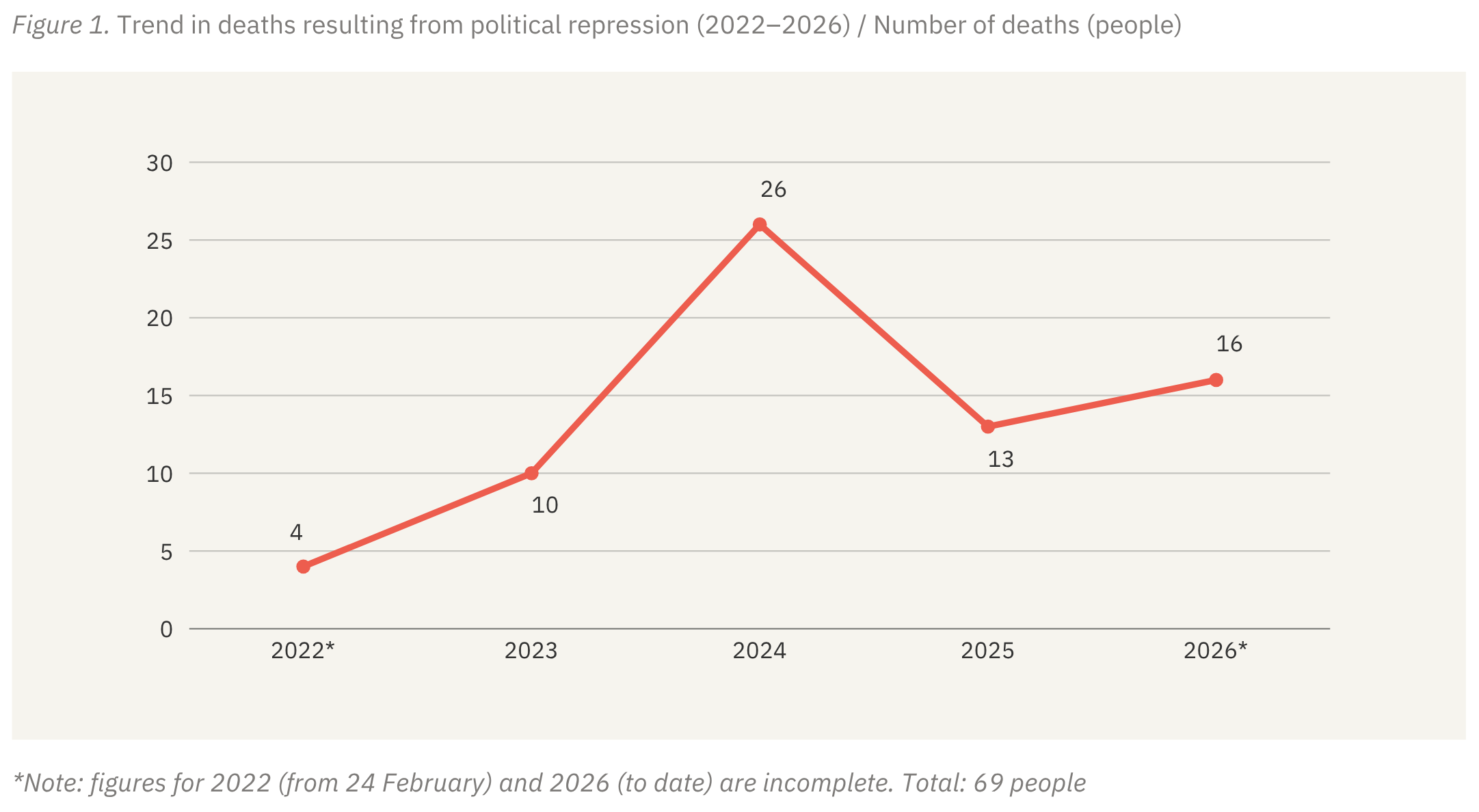
Of these, four died in 2022, 10 in 2023, 26 in 2024, 13 in 2025 and 16 by the end of October 2026.
The youngest of those who died were the Ukrainians Danylo Dakhov and Pavlo Hrymak, both aged 18. The oldest was Valery Mitko, who died of illness aged 81. The average age at the time of death was around 51.
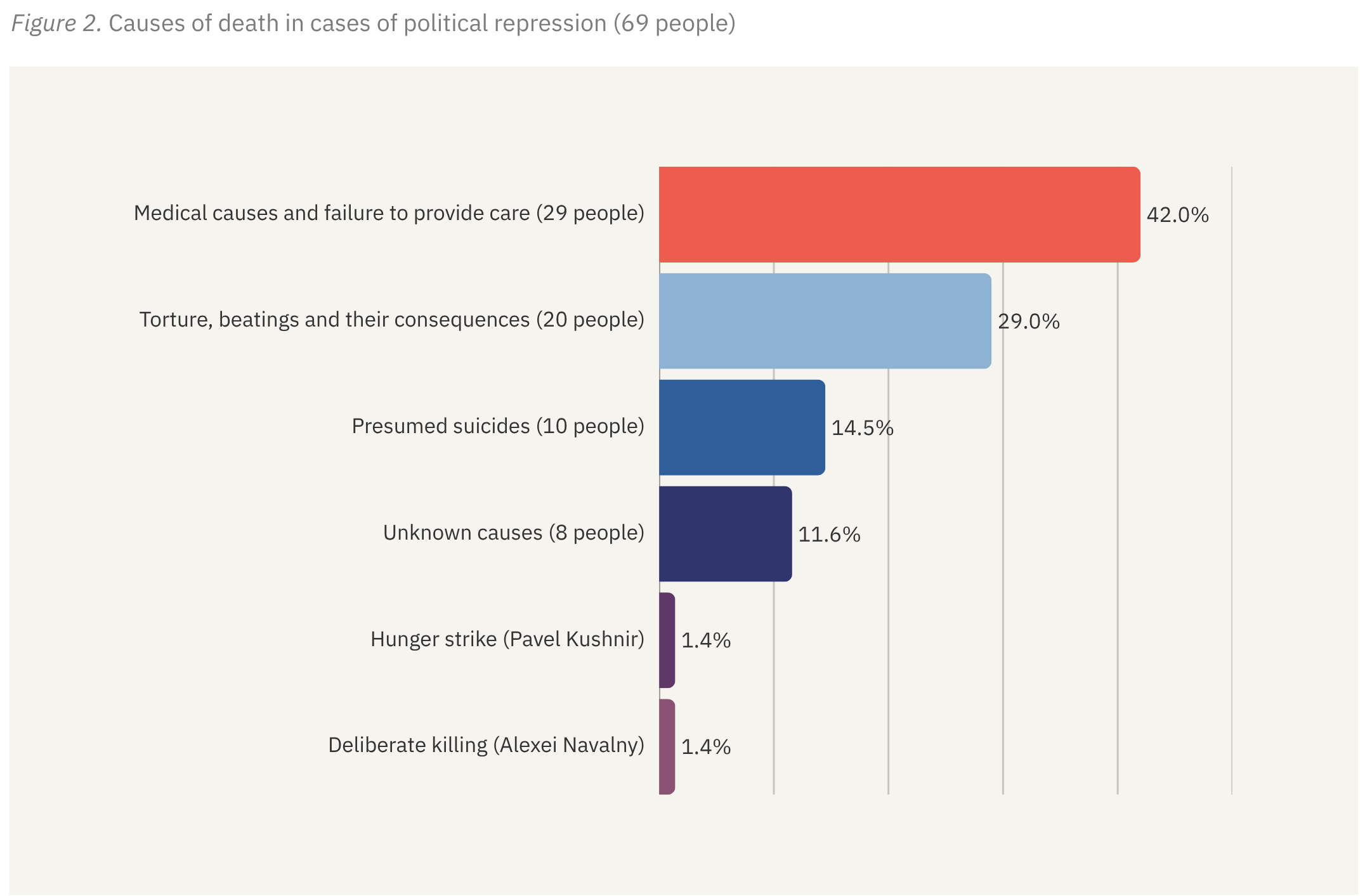
Of the 69 deaths, at least 29 were from medical causes (illness and failure to provide medical care), at least 20 were the result of beatings, torture or their consequences, and 10 are presumed to be suicides or to have occurred in circumstances resembling suicide. The causes of death of a further eight people (Aleksandr Perov, Dmitry Polunin, Oleh Pronko, Roman Zarovnyaev and Volodymyr Udovyka in 2024; Oleksandr Markov while being transferred in 2025; and Rustam Khalikov and Nikolai Popov in 2026) are currently unknown. In addition, one person died as a result of a protest hunger strike and one was deliberately killed in a penal colony.
1. Medical causes and failure to provide care
Most often, people deprived of their liberty for political reasons die of natural causes linked to the deterioration of their health in captivity, namely illness and the failure to provide medical care (or its incomplete or untimely provision). To date, we know of 29 such cases. In 2022, three people died of these causes; in 2023, five; in 2024, seven; in 2025, four; and so far in 2026, 10.
Of the 29 people prosecuted who died as a result of illness, 18 died in facilities run by the Federal Penitentiary Service (remand prisons, prisons, penal colonies and prison hospitals); nine died shortly after release or while at liberty under another measure of restraint (prohibition of certain actions, written undertaking not to leave the area); and two died under house arrest.
According to the available data, eight died of cardiovascular diseases (heart attack, heart failure), six of cancer, three of strokes and two of lung diseases; in 10 cases the exact cause of death is unknown.
The average age of this group at the time of death was around 59. It can be said that mortality in this group is to a considerable extent ‘age-related’. Chronic illnesses in captivity are aggravated by stress, harsh conditions and incomplete or untimely medical care, and sometimes by its complete absence. Older people are therefore the most vulnerable category in terms of health in remand prisons and penal colonies, where they often do not receive the necessary specialist care. At the same time, investigators, judges and Federal Penitentiary Service staff alike tend to regard complaints about health as feigned and as an attempt to evade or reduce responsibility, while sentences involving long-term imprisonment are increasingly handed down to very elderly people without regard for their state of health.
In some cases it is known that prisoners who later died had publicly reported a deterioration in their health, but their appeals were ignored.
For example, 56-year-old Vladimir Osipov requested hospitalisation during a court hearing. An ambulance was called to the court on several occasions because his blood pressure had risen to critical levels. Nevertheless, Yuliya Terekhova, a judge of the Lyubertsy City Court, dismissed the complaints as a ‘breach of court rules’, removed Osipov from the courtroom and refused to adjourn the proceedings or authorise his hospitalisation. A few months after the verdict was handed down, Vladimir Osipov died of a heart attack in a remand prison.
Another example is that of 64-year-old Oleg Tyryshkin who declared, at his appeal hearing, that he could barely breathe: ‘My legs won’t carry me any more… Why must I suffer like this?’ During the video link hearing, he lay down on the floor of his cell as he was unable to stand. Nonetheless, a medical assistant at the remand prison told the judge that ‘all indicators are normal’, while the judge described the man’s behaviour as ‘malingering’. Oleg Tyryshkin died in hospital, where he was taken from the remand prison following a heart attack.
We know of numerous complaints about health and requests for medical assistance, including in penal colonies, but many of these went unanswered.
Kostiantyn Shyrinh, aged 62, who died in a penal colony, had repeatedly sought medical help. He needed heart surgery, which never took place.
Dzhemil Hafarov, aged 60, suffered from kidney failure and heart disease while in a remand prison. In November 2022, he suffered a heart attack, after which he was barely able to get out of bed. His lawyer asked the head of the facility to transfer Hafarov to a private clinic. An official refusal to transfer him was received the day Hafarov died of acute cardiovascular failure.
Aleksandr Lubin, aged 68, had a Group II disability and needed constant access to humidified oxygen, which was not available in the remand prison. He was released from the remand prison under the prohibition of certain actions only after a request from the European Court of Human Rights. However, the lack of treatment during his prosecution undermined his health, and Lubin died in intensive care a month after sentencing.
Valery Bailo, aged 67, developed an inflammation in his only remaining tooth while in the remand prison. He was unable to chew prison food and suffered from severe stomach pains. For more than six months the authorities at the facility took no action. His lawyer believes Bailo died of malnutrition and starvation.
Sergei Sviridov, aged 46, was terminally ill with an advanced form of cancer. Despite pleas from prison doctors, the courts in Krasnoyarsk refused three times over the course of a year to release him, cynically citing, among other things, the fact that he had no family and no one to look after him if he was released. It was only when Sviridov fell into a coma and lost the ability to breathe unaided that the court agreed he be transferred from the prison hospital to a hospice. Sviridov died in the hospice two weeks after his release.
A case of particularly egregious cruelty was the detention and remanding in custody of Dmitry Kolker, aged 54, a scientist who suffered from terminal pancreatic cancer. He was taken into custody directly from hospital in a critical condition and died in Lefortovo three days later.
2. Deaths from beatings and torture
The second largest group of deaths in politically motivated cases consists of those who died as a result of brutal beatings or other forms of torture. According to our data, this group comprises 20 people and includes both confirmed and documented cases of torture, as well as cases where sources and circumstances point to a high probability of torture. It is important to note that this classification is provisional, as torture may also have featured in the deaths of other individuals where it caused illness and subsequent death or led to suicide.
In Russia proper, torture is used against detainees in politically motivated cases, as a rule to extract confessions or to force them to incriminate themselves or others.
Kirill Buzmakov, a resident of Stavropol Krai, was a member of a private chat group of Stavropol bikers in which eight people discussed their hobby and criticised the invasion of Ukraine. They came to the attention of the FSB in October 2022 after one of the participants, Sergei Dudchenko, organised a solo protest motorbike ride in Essentuki carrying a Ukrainian flag. On 8 October 2022, Kirill Buzmakov was detained by officers of the FSB Directorate for Stavropol Krai. The security forces began to fabricate a group case, the Case of the Stavropol Bikers, alleging a ‘terrorist community’ and a plot to set fire to a military enlistment office in Pyatigorsk. Kirill was tortured to extract a confession. Officers beat him, held a gun to the back of his head and told him he was ‘no longer needed’. During these beatings, Buzmakov suffered a fractured facial bone, which subsequently led to the development of cancer. For a year and a half, the authorities refused to hospitalise Buzmakov, telling him he would only receive treatment if he incriminated himself and his friends. It was not until May 2024, by which time the cancer was terminal, that the court agreed to release him from the remand prison and place him under house arrest. On 28 May 2024, Buzmakov underwent emergency surgery at a civilian hospital. The surgeons had no choice but to remove his jaw and tongue. Buzmakov, aged 38, died two months later.
Rifat Dautov was detained in January 2024 in Ufa as part of the large-scale ‘Baimak case’ of ‘mass riots’. The day after his detention, his relatives were summoned to the mortuary to identify him. The security forces were quick to claim that Dautov had died of ‘acute heart failure against a background of severe alcohol intoxication’. However, his relatives claimed that Rifat led an exceptionally healthy lifestyle and did not drink alcohol at all. Numerous signs of beatings were found on his body, and the post-mortem examination revealed signs of severe blood loss, indicating he had been beaten to death within the first hours after his detention.
Physical violence against Russian citizens is mainly used at the pre-trial investigation stage. By contrast, Ukrainian prisoners of war and abducted civilians are subjected to constant violence in places of detention, including beatings and torture in remand prisons and abuse in penal colonies. This report does not cover Ukrainians deprived of liberty outside the context of criminal prosecution, among whom, as far as is known, there are many more deaths; we usually have almost no information about these cases. Nonetheless, even within the group considered in this report, 12 of the 20 people we place in this category died as a result of torture and were Ukrainian citizens, primarily residents of the occupied territories and prisoners of war, as well as Krzysztof Galos, a Polish citizen abducted in Ukraine by Russian security forces. They account for about 17% of all the deaths described in this report.
In the summer of 2022, during the Russian occupation of Kherson, the FSB abducted ten men there. A case was fabricated against them over a ‘terrorist community’ that was allegedly preparing assassinations of collaborationist officials (the Case of the Kherson Nine).
All those abducted were held for months in a secret prison in inhumane conditions without any legal status. The detainees were given just one litre of water per day for an overcrowded cell; they were not taken out to use the toilet; they were kept handcuffed to an iron grate, and suspended from it, for days on end; and they were beaten and tortured with electric shocks on a daily basis. According to eyewitnesses, Vasyl Stetsenko, a former employee of the Kherson Environmental Inspectorate, was methodically ‘kicked by three at a time’ by security service officers. After one beating, Stetsenko lost consciousness never to regain it. He died on 3 August 2022 on the floor of one of the basement cells. To conceal the murder of a man who had not even been officially arrested, Russian security forces secretly removed Vasyl Stetsenko’s body to an unknown location. The site of his burial has not been established. In court, when asked about Stetsenko’s whereabouts, security service officers claimed he had ‘managed to escape’.
Ukrainian journalist Viktoriia Roshchyna was abducted in August 2023 while investigating secret prisons in the occupied territory of Ukraine’s Zaporizhzhia Oblast. She was held in cellars in Melitopol, where she was subjected to systematic torture, and was subsequently transferred to Taganrog Remand Prison No. 2, notorious for its use of torture. Her cellmates testified that Roshchyna had been in a state of severe emaciation, weighed approximately 30 kilograms and was denied medical care. According to an official letter from the Russian Ministry of Defence, Viktoriia Roshchyna died on 19 September 2024 while being transferred between places of detention. Her remains were handed over to Ukraine in February 2025 as part of an exchange of the bodies of the dead. Experts identified numerous signs of violence and torture, as well as the absence of several internal organs. Several doctors and forensic experts suggested that the Russian side had deliberately removed these organs to conceal evidence of torture.
Oleksandr Ishchenko was a Ukrainian prisoner of war and defender of Mariupol who served in the Azov Regiment. He was taken prisoner in spring 2022 and charged with forcible seizure of power and participation in a terrorist organisation. In July 2024, aged 55, he died in Remand Prison No. 5 in Rostov-on-Don; the court was informed of his death at a subsequent hearing. After his body was returned to Ukraine in a prisoner exchange, a forensic medical examination revealed multiple rib fractures, a closed chest injury and signs of torture with electric shocks.
Residents of the Chechen Republic are another category of detainee whose deaths regularly result from torture. It is extremely difficult to obtain full information about individuals abducted and tortured in Kadyrov’s Chechnya, though details are available in some cases. For instance, it is known that Mansur Abdulkadyrov was abducted by security forces in December 2024. At a police station, he was subjected to brutal torture and forced to agree to fight in the war against Ukraine under threat of a fabricated criminal case. He died as a result of the torture. Aslan Dombaev, abducted in February 2025, was also tortured to make him agree to fight against Ukraine. Dombaev was beaten until he fell into a coma, after which he was allowed to be taken to hospital. He died on 17 March 2025. Ismail Mukhadiev, aged 45, died as a result of beatings and electric shock torture. His ‘offence’ was, as far as is known, to have ‘liked’ a social media post which the security forces deemed unacceptable. On 30 January 2025, he was detained and subjected to electric shock torture at the Ministry of Internal Affairs office in Grozny. He died the following day. That same month, 19-year-old Vishkhan Tazurkaev, who had been taken from his place of work by the security forces, also died because of electric shock torture at Argun district police station. Shovda Shamaeva, a 37-year-old pre-school teacher, was abducted by security forces on 5 September 2025 and subjected to torture at a police station. On 8 September 2025, her body was handed over to her relatives with a demand that they conceal the cause of death.
3. Presumed suicides, fatal hunger strike and deliberate killing
A further 10 people whose prosecutions were politically motivated are known or believed to have taken their own lives while in detention or because of criminal prosecution. In 2023, two people are believed to have taken their own lives; in 2024, four; in 2025, one; and so far in 2026, three.
We include in this category those who took their own lives not only in places of detention, but also in connection with searches, interrogations or the initiation of criminal proceedings. Vadim Stroikin, aged 59, is believed to have thrown himself out of the window of his St Petersburg apartment when security service officers came to search it in a case concerning the financing of the Armed Forces of Ukraine. Minniyar Baiguskarov took his own life in the town of Meleuz in Bashkortostan after being interrogated in the ‘Baimak case’, during which, according to his relatives, he was beaten by law enforcement officers.
Given the lack of transparency in the penitentiary system, it is difficult to confirm that a person in detention alleged to have taken their own life in fact did so. CCTV cameras often ‘break down’, and suicide notes can either be forged or, conversely, disappear if they contain anything that could be incriminating for prison staff, such as allegations of torture. Since investigations into the circumstances of death are conducted as a mere formality, and criminal cases are almost never opened, it is reasonable to assume that some ‘suicides’ were the result of torture and abuse, while others were in fact murders. On the other hand, harsh conditions of detention, feelings of loneliness, despair and helplessness, disagreement with the actions of investigators, court verdicts and extremely long prison sentences, as well as a desire to protest against injustice, war and repression at the cost of one’s own life, also lead victims of politically motivated prosecutions to take their own lives.
The anarchist Roman Shvedov from the village of Zimovniki in Rostov Oblast, accused of setting fire to a district administration building (an act classified by the investigative authorities as a terrorist attack), took his own life in the Rostov remand prison in December 2024, a few hours after being sentenced to 16 years’ imprisonment. Previously, Shvedov had refused assistance from human rights organisations because he considered his situation hopeless and had asked that resources be channelled towards helping other political prisoners.
Andrei Kotov, director of the travel company Men Travel, was charged with ‘organising the activities of an extremist LGBT organisation’. According to the investigative authorities, Kotov’s firm organised tourist trips for members of the LGBTQ+ community. Kotov himself categorically denied involvement in any such movement. He reported being tortured with a stun gun at the time of his arrest. In Moscow Remand Prison No. 5, he was placed in a punishment cell and denied warm clothing and the daily medication he required. It was reported that he was blackmailed with the disclosure of information about his sexual orientation. A criminal case was also opened against him for producing pornographic material. On 29 December 2024, Andrei Kotov was found dead in his cell. The investigative authorities and the Federal Penitentiary Service cited suicide as the official cause of death.
The claim that Anatoly Berezikov took his own life raises serious doubts. A musician and activist, Berezikov had been distributing anti-war leaflets in Rostov-on-Don on behalf of the Ukrainian project I Want to Live. The security services held him in a special detention centre by means of ‘carousel’ administrative arrests, demanding that he confess to treason. A few days before his death, Berezikov managed to tell his defence lawyer that FSB operatives were beating him, torturing him with a stun gun and openly threatening him: ‘We’ll kill you and make it look like suicide.’ On the eve of his death, Berezikov’s lawyer personally documented and photographed multiple marks on his client’s body resulting from electric shock torture. The following day, the security forces reported that Anatoly Berezikov had taken his own life in his cell at the special detention centre.
The death of Pavel Kushnir, aged 39, is not included in our statistics on suicides, as suicide and hunger strike have different legal natures. Nevertheless, Kushnir’s death was a consequence of his opposition to his politically motivated prosecution. Pavel Kushnir, a musician and anti-fascist, was detained in the spring of 2024 in the Jewish Autonomous Oblast and charged with public justification of terrorism over anti-war and anti-fascist videos on his YouTube channel, which had only five subscribers. Almost immediately after his arrest, Kushnir announced a lengthy protest hunger strike against the charge, which lasted for two months; a few days before his death he went on a dry hunger strike. He died in Remand Prison No. 1 in Birobidzhan on 28 July 2024 as a result of severe exhaustion and dehydration.
Khristolub Vegan, a Christian preacher and anti-war blogger charged with insulting the feelings of religious believers and rehabilitating Nazism, also went on hunger strike. Sentenced to three years in a settlement penal colony, Khristolub, rather than reporting to his place of detention voluntarily, took to the streets holding a pacifist placard. He was subsequently fined for ‘discrediting the army’, arrested for failing to report to his place of punishment and forcibly transferred to a general-regime penal colony. According to an official statement relayed to his father, Khristolub Vegan took his own life on 17 April 2026. Acquaintances suspect he may have died while on a dry hunger strike or because of force-feeding. On the day news of Khristolub’s death broke, a pre-recorded video appeared on the blogger’s YouTube channel in which he said that if the video were published, then ‘either they have tortured me or they have killed me…’ and insisted that under no circumstances would he take his own life. He also asked for an independent forensic examination in the event of his death. However, this was never carried out, which casts doubt on the suicide version.
As described in detail above, many victims of politically motivated prosecutions were literally beaten and tortured by the security forces. Nevertheless, we single out from this tragic series of cases that of the Russian opposition politician Alexei Navalny, whose death we regard as a deliberate and targeted killing. Navalny was murdered on 16 February 2024 at Penal Colony No. 3 ‘Polar Wolf’ in Kharp, beyond the Arctic Circle. The combination of symptoms and circumstances allows us, in our view, to speak of a premeditated murder, for which responsibility lies not only with the immediate perpetrators, but also with the leadership of the Russian Federation and Vladimir Putin personally. Moreover, the other deaths of political prisoners described above are not tragic accidents either, but the inevitable consequence of the brutal political repression unleashed by the regime.
Those who have died as a result of political repression: a list of names
Below we list the 69 prisoners known to us who have died since the start of the full-scale invasion of Ukraine.
1. Mansur Abdulkadyrov, a resident of the village of Tsotsi-Yurt in the Kurchaloevsky district of the Chechen Republic, was abducted and tortured by local security forces in December 2024, who demanded that he go to fight against Ukraine. He died of severe injuries.
2. Andrei Viktorovich Akuzin, aged 53, who lived in Khabarovsk, was an artist and co-founder of the Karma Kagyu Buddhist School of the Diamond Way. He was detained on 2 April 2026 for anti-war comments on social media and was likely charged with public calls for terrorism (Article 205.2, Part 2 of the Russian Criminal Code). On 8 April 2026, the day after his birthday, according to the official version, he took his own life in a remand prison.
3. Minniyar Bulatovich Baiguskarov, aged 65, a farmer living in the village of Temyasovo in Bashkortostan, was detained in January 2024 in connection with alleged rioting following a public gathering in Baimak (Article 212, Part 2 of the Russian Criminal Code). In January 2024, he took his own life in the town of Meleuz in Bashkortostan after an interrogation during which, according to his relatives, he was beaten by law enforcement officers.
4. Valery Semenovich Bailo, aged 67, a resident of the village of Kholmskaya in Krasnodar Krai, was detained in April 2024. On 3 July 2024 he was sentenced to two and a half years’ imprisonment for participating in the activities of the Jehovah’s Witnesses (Article 282.2, Part 2 of the Russian Criminal Code). On 21 March 2025, Bailo died in a remand prison of illness and severe emaciation.
5. Anatoly Aleksandrovich Berezikov, aged 40, a resident of Rostov-on-Don, was a musician, an electronic music artist, a jazz performer and a concert organiser. He was arrested in a series of ‘carousel’ administrative cases for putting up anti-war leaflets. The authorities intended to open a treason case against him (Article 275 of the Russian Criminal Code). Berezikov told his lawyer that, to make him confess, law enforcement officers tortured him with electric shocks, beat him and threatened to kill him. On 14 June 2023, Berezikov died in a special detention centre in Rostov-on-Don. The official cause of his death was declared to be suicide.
6. Pavlo Hennadiiovych Bozhko, aged 31, a Ukrainian citizen from Berdiansk, served in the 501st Separate Marine Battalion of the 36th Separate Marine Brigade of the Armed Forces of Ukraine. Taken prisoner by Russian troops, Bozhko was charged with the use of prohibited methods of warfare (Article 356) and murder (Article 105 of the Russian Criminal Code). In 2023, he died in Penal Colony No. 1 in Tula Oblast because of torture and ill-treatment.
7. Andrii Hermanovych Borzunov, aged 52, a citizen of both Ukraine and Russia and a resident of the occupied part of Ukraine’s Donetsk Oblast, was accused of participating in a terrorist community (Article 205.4, Part 2 of the Russian Criminal Code) for allegedly assisting agents of the Security Service of Ukraine who were planning to kill the head of the Izolyatsia detention centre in Donetsk, a place notorious for torture. He was reportedly under a written undertaking not to leave the area and died of a stroke no later than 3 December 2024.
8. Kirill Sergeevich Buzmakov, a resident of Zheleznovodsk, was a motor sports enthusiast, a candidate for the title of Master of Sport and worked as a sales representative. He was accused of plotting a terrorist attack (Article 30, Part 1 and Article 205, Part 2 of the Russian Criminal Code) and subjected to torture to extract a confession and incriminate fellow members of a biker chat group. Buzmakov developed cancer while on remand because of the torture. However, he was denied the necessary medical care and not released until the cancer had become terminal. He died on 20 July 2024.
9. Khristolub Bozhy Vegan, formerly Dmitry Yevgenyevich Kuznetsov, aged 43, a resident of the village of Korshevo in Bobrovsky district, Voronezh Oblast, was a preacher, video blogger and pacifist. On 5 February 2025, he was sentenced to three years’ imprisonment for online posts on charges of defamation of Second World War veterans (Article 354.1, Part 4) and insulting the feelings of religious believers (Article 148 of the Russian Criminal Code). On 17 April 2026, he died in a penal colony in Voronezh Oblast. According to the official version, he took his own life.
10. Rustem Rizaiovych Virati, aged 61, a Crimean Tatar activist from occupied Crimea, was a builder and restorer actively involved in the life of the Crimean Tatar community. In 2023, he was detained in Novooleksiivka, Ukraine’s Kherson Oblast, which was under Russian occupation at the time. He was tortured and charged with participating in the Crimean Tatar volunteer Noman Çelebicihan Battalion (Article 208, Part 2 of the Russian Criminal Code). He was sentenced to eight years’ imprisonment. He died no later than 10 February 2025 in a prison in the town of Dimitrovgrad, Ulyanovsk Oblast, presumably because of the torture he had endured.
11. Nikolai Pavlovich Voishchev, aged 70, a resident of Maikop in the Republic of Adygea, was charged with establishing an extremist community because of his membership of the Jehovah’s Witnesses (Article 282.1, Part 1 of the Russian Criminal Code). He was sentenced to three years’ imprisonment. While in prison, he did not receive the necessary medical care. He was released on 28 April 2025 and died less than a year later as a result of the progression of cancer.
12. Krzysztof Galos, aged 55, a Polish national, travelled to Ukraine on 20 April 2023 to see the scale of what was happening with his own eyes. He was abducted by the Russian military in the occupied part of Ukraine’s Zaporizhzhia Oblast and transferred to Remand Prison No. 2 in Taganrog. According to Ukrainian prisoners held there, Galos was brutally beaten and tortured, in particular for not knowing Russian. He died on 4 July 2023. The Russian Ministry of Foreign Affairs confirmed his death only much later, putting forward an official version that he died of ‘heart failure’.
13. Dzhemil Abdullaiovych Hafarov, aged 60, a resident of the village of Stroganovka in occupied Crimea, was an activist with the Crimean Solidarity movement. On 11 January 2023, he was sentenced by the Southern District Military Court in Rostov-on-Don to 13 years’ imprisonment on charges of involvement in Hizb ut-Tahrir (Article 205.5, Part 2; Article 30, Part 1; and Article 278 of the Russian Criminal Code). Hafarov died of heart and kidney failure in Remand Prison No. 5 in Novocherkassk on 10 February 2023, after the authorities refused to hospitalise him despite his critical condition.
14. Pavlo Hrymak, aged 18, a young man from the occupied city of Melitopol in Ukraine’s Zaporizhzhia Oblast, was abducted by Russian security forces in August 2023. In April 2024, a propaganda video was circulated suggesting that Hrymak had collaborated with the Security Service of Ukraine and would be tried on several serious charges under the Russian Criminal Code. In May 2024, his parents were informed that Pavlo had allegedly been blown up by a homemade explosive device during his arrest. He was very likely subjected to torture and may have died as a result. The date of his death is not known. His body was not returned to his parents.
15. Rifat Fuatovich Dautov, aged 37, a resident of Bashkortostan, worked in the gas industry on a rotational basis. On 25 January 2024, he was detained by security forces in connection with the ‘Baimak case’. On the night of 25–26 January 2024, Dautov died while being transported in a prison van, apparently because of torture, injuries and severe loss of blood.
16. Danylo Dakhov, aged 18, a young man from the occupied city of Melitopol in Ukraine’s Zaporizhzhia Oblast, was abducted by Russian security forces in August 2023. In April 2024, a propaganda video was circulated suggesting Danylo had been collaborating with the Security Service of Ukraine and would be tried on several serious charges under the Russian Criminal Code. In May 2024, his parents were informed that Danylo had allegedly been blown up by a homemade explosive device during his arrest. He was very likely subjected to torture and may have died as a result. The date of his death is not known. His body was not returned to his parents.
17. Aleksandr Nikolaevich Demidenko, aged 61, a resident of Belgorod Oblast, was a teacher of geography and computer science. Since the spring of 2022, Demidenko had worked as a volunteer helping Ukrainian refugees leave Russia via the only open humanitarian corridor at the Kolotilovka–Pokrovka checkpoint in Belgorod Oblast. He was detained on charges of unlawful possession of weapons (Article 222.1, Part 1) and treason (Article 275 of the Russian Criminal Code). Held at a Belgorod remand prison since 1 November 2023, he died there on 5 April 2024. According to the Federal Penitentiary Service, Demidenko took his own life.
18. Viktor Pavlovych Demchenko, aged 71, a Ukrainian citizen and resident of the occupied town of Mospyne in Ukraine’s Donetsk Oblast, was charged with espionage, participation in a terrorist community and unlawful possession of weapons (Article 276; Article 205.4, Part 2; and Article 222, Part 1 of the Russian Criminal Code). On 31 December 2023, Demchenko died of a stroke in a prison hospital in Rostov.
19. Aslan Dombaev, a resident of the town of Urus-Martan in the Chechen Republic, was detained in mid-February 2025 and subjected to torture for refusing to take part in the invasion of Ukraine. He died on 17 March 2025, presumably because of torture.
20. Aleksandr Leonidovich Dotsenko, aged 65, a resident of the village of Taitsy in Gatchina district, Leningrad Oblast, was a pensioner and jewellery artist. In January 2024, he and his wife were arrested for leaving anti-war leaflets in a shop and charged with making public calls for terrorist activity (Article 205.2, Part 1 of the Russian Criminal Code). On 8 July 2024, Dotsenko was sentenced by a military court to three years in a settlement penal colony (his wife, Anastasia Dyudyaeva, was sentenced to three and a half years in a penal colony in the same case). On 12 February 2026, while in a penal colony near St Petersburg, Dotsenko suffered a massive heart attack and was admitted to Mariinsky Hospital. He died on 19 February 2026.
21. Roman Vyacheslavovich Zarovnyaev, aged 31, from the town of Kachkanar in Sverdlovsk Oblast, was charged with committing a terrorist act (Article 205, Part 2) and preparing to commit a terrorist act (Article 30, Part 1 and Article 205, Part 2 of the Russian Criminal Code) for setting fire to battery and relay cabinets on the Kachkanar–Nizhny Tagil–Ekaterinburg railway line on 30 April 2023. He was remanded in custody in May 2023. He died in a remand prison no later than August 2024. The cause of his death is not known.
22. Andrii Vasylovych Zdorenko, aged 40, a Ukrainian citizen, served as a driver in the 55th Separate Artillery Brigade Zaporizhzhia Sich of the Armed Forces of Ukraine. Together with five other Ukrainian prisoners of war, Zdorenko was charged with committing war crimes. According to the Russian prosecution, the Ukrainian servicemen fired from a combat position in Mariupol at the settlements of Staryi Krym and Volodarske and at the village of Berdianske, resulting in the deaths of two civilians and injuries to two others. Zdorenko was taken prisoner on 21 May 2022 in Mariupol and tortured. He died during his trial no later than 3 September 2025.
23. Oleksandr Oleksandrovych Ishchenko, aged 55, a resident of Mariupol, voluntarily joined the territorial defence unit of the Azov Special-Purpose Regiment as a military driver on 25 February 2022. On 26 March 2022, he was taken prisoner by Russian forces. As part of the prosecution of the case of the ‘24 Azov fighters’, Ishchenko was charged with forcible seizure of power (Article 278) and participation in the activities of a terrorist organisation (Article 205.5, Part 2 of the Russian Criminal Code). He died during his trial on 22 July 2024 at Remand Prison No. 5 in Rostov-on-Don. According to the Russian authorities, he died of natural causes. However, a post-mortem examination indicated that the cause of death was multiple bodily injuries consistent with torture.
24. Vladimir Nikolaevich Kazantsev, aged 52, was a resident of Chelyabinsk Oblast, a lawyer, human rights defender and environmental activist. On 19 October 2022, Kazantsev was sentenced to four years’ imprisonment on charges of large-scale fraud (Article 159, Part 3) and preparing to commit fraud on an exceptionally large scale (Article 30, Part 1 and Article 159, Part 4 of the Russian Criminal Code). Environmental activists in Chelyabinsk regarded his prosecution as retaliation for his civil society activities. On 17 December 2024, Kazantsev died of cardiovascular disease at Penal Colony No. 11 in the town of Kopeisk, Chelyabinsk Oblast.
25. Roman Vyacheslavovich Kovalev, a resident of Moscow, was a Candidate of Physical and Mathematical Sciences, an associate professor, deputy head of the Department of Spacecraft at the Moscow Institute of Physics and Technology and head of the Centre for Heat Transfer and Aerogasdynamics at the Central Research Institute of Mechanical Engineering. Arrested in the summer of 2019, on 22 June 2020 he was sentenced to seven years in a high-security penal colony on a charge of treason (Article 275 of the Russian Criminal Code). On 13 April 2022, Kovalev was released on health grounds because he was suffering from terminal-stage cancer. He died two weeks after his release, on 27 April 2022.
26. Dmitry Borisovich Kolker, aged 54, from Novosibirsk, was a professor of physics specialising in laser physics, non-linear optics and spectroscopy, who headed the Laboratory of Quantum Optical Technologies at Novosibirsk State University. On 30 June 2022, he was arrested on suspicion of treason (Article 275 of the Russian Criminal Code). Kolker was transferred to the Lefortovo Remand Prison in Moscow from a private clinic in Novosibirsk where he was being treated for terminal-stage cancer. On 3 July 2022, he died at Lefortovo Hospital, three days after his arrest.
27. Aleksandr Sergeevich Kondratov, aged 52, worked for many years in the Russian and Ukrainian film industry as a production designer and won the Golden Eagle and TEFI awards for his work on the 2007 television series Liquidation. From about 2012, he lived in Kyiv with his family. In spring 2026, he travelled to Russia to renew his international passport and was detained at the airport. After more than 70 days of carousel arrests, a court remanded him in custody on a charge of treason over six internet posts. On 23 October 2026, he was taken from the remand prison to Botkin Hospital in Moscow. His death became known on 26 October. According to unofficial information, the cause of death was a heart attack.
28. Andrei Yevgenyevich Kotov, aged 48, was a resident of Moscow and director of the travel company Men Travel. He was detained in late November 2024 and charged with organising and participating in the activities of an extremist organisation (Article 282.2, Parts 1 and 2 of the Russian Criminal Code) in a case concerning the so-called ‘international LGBT movement’. Kotov was held in Remand Prison No. 5 and placed in a punishment cell. On 29 December 2024, he was found dead in his cell. According to the Federal Penitentiary Service, he took his own life.
29. Oleh Anatoliiovych Kotov, aged 59, was a Ukrainian citizen, a pensioner and a resident of the occupied settlement of Kozacha Lopan in Ukraine’s Kharkiv Oblast. Kotov had served in the police force prior to the full-scale invasion. On 23 April 2022, the Russian military detained him at his home. He was held by Russian security forces for over four years without charge. On 6 June 2026, he was released as part of a prisoner exchange and told journalists he had been subjected to torture and inhumane treatment in captivity. At the end of July that year, he died in a Kyiv hospital of cancer.
30. Ibrahim Zhyvdatovych Kudzhanov, aged 52, was a Ukrainian citizen who lived in the village of Bahachka in Ukraine’s Luhansk Oblast. Until 2019, he served as a driver in the Aidar Battalion and had a Group II disability. On 6 February 2024, Russian security forces removed Kudzhanov from the hospital where he was recovering from a heart attack and placed him in a remand prison. On 16 October 2024, a military court sentenced Kudzhanov on a charge of participation in a terrorist community (Article 205.4, Part 2 of the Russian Criminal Code) to five and a half years’ imprisonment. Kudzhanov’s son, 21-year-old college student Artem Kudzhanov, had been detained before his father and sentenced to 12 years’ imprisonment on a charge of espionage. Artem Kudzhanov stated he had been tortured to force him to testify against his father. On 8 July 2026, it emerged that Ibrahim Kudzhanov had died. The cause of death was a further heart attack.
31. Pavel Mikhailovich Kushnir, aged 39, a resident of Birobidzhan in the Jewish Autonomous Oblast, a pianist, writer and activist, was arrested in May 2024 on a charge of making public calls for terrorist activity (Article 205.2 of the Russian Criminal Code) for anti-war videos published on his YouTube channel, which had few viewers. On 28 July 2024, he died in a remand prison in Birobidzhan as a result of a dry hunger strike.
32. Viktor Ivanovich Lapitsky, aged 68, a resident of St Petersburg and a Jehovah’s Witness, was under house arrest from September 2023 on a charge of organising the activities of an extremist organisation (Article 282.2, Part 1 of the Russian Criminal Code). In November 2024, he died of an illness.
33. Aleksandr Nikolaevich Lubin, aged 68, a resident of Shadrinsk in Kurgan Oblast, was a Jehovah’s Witness who had a Group II disability and required constant use of an oxygen concentrator. In July 2021, he was charged with organising the activities of an extremist organisation (Article 282.2, Part 1 of the Russian Criminal Code) and remanded in custody. After a month in pre-trial detention and a request to the European Court of Human Rights, he was released from custody and placed under the prohibition of certain actions. In early October 2024, the Shadrinsk City Court sentenced Lubin to a fine of 500,000 roubles. A month later, on 11 November 2024, he died in intensive care.
34. Oleksandr Markov, aged 74, a pensioner and resident of the occupied part of Ukraine’s Zaporizhzhia Oblast, was detained on 8 May 2024. In February 2025, he was sentenced on a charge of treason (Article 275 of the Russian Criminal Code) to 14 years in a high-security penal colony for transferring money to Ukrainian bank accounts. He died on 26 June 2025 while being transported between prisons. The exact cause of death is not known.
35. Elena Eduardovna Markova, aged 61, a pensioner, lived in the village of Kratovo in Ramensky district, Moscow Oblast. On 6 May 2023, she was detained on a charge of participating in Artpodgotovka, which has been declared a terrorist organisation (Article 205.5, Part 2 of the Russian Criminal Code), and organising the ‘Heavenly Regiment’ campaign (a mass release of balloons with strips of foil attached to them) to disrupt the operation of air defence systems during the 9 May parade. On 1 November 2023, she died of heart failure at Moscow Remand Prison No. 6.
36. Yevhen Serhiiovych Matvieiev, aged 64, was mayor of the town of Dniprorudne in Ukraine’s Zaporizhzhia Oblast. On 13 March 2022, he was detained by Russian military forces who occupied the town. According to official data from the Office of the Prosecutor General of Ukraine, Yevhen Matvieiev died on 7 September 2024 in Remand Prison No. 3 in the town of Kizel, Perm Krai, in the Russian Federation. A forensic medical examination established that his death was caused by multiple severe injuries. Ukrainian prisoners of war who had been exchanged and were held in the same remand prison as Matvieiev reported that he had been beaten to death during a so-called ‘intake procedure’.
37. Sergei Gafetdinovich Mingazov, aged 57, lived in Khabarovsk and was a news editor at Forbes and a lecturer in Russian language and literature at the Pacific State University. On 26 February 2025, for online posts about Bucha, he was convicted of spreading military ‘fake news’ (Article 207.3, Part 2(e) of the Russian Criminal Code) and fined 700,000 roubles. On appeal, the fine was increased. However, on cassation, the court quashed the verdict and referred the case for a retrial. Pending the retrial, Mingazov was placed under the prohibition of certain actions. He died of cancer on 2 July 2026, before a new verdict could be handed down.
38. Valery Bronislavovich Mitko, aged 81, lived in St Petersburg and was a professor specialising in hydro-acoustics and president of the Arctic Public Academy of Sciences. He was also a retired captain of the first rank. On 11 February 2020, Mitko was placed under house arrest on a charge of treason, allegedly in favour of China, which he denied. This measure of restraint was extended several times. The court prohibited him from going for walks, despite his age and the poor state of his health following heart attacks, repeated hospitalisations and stent placements. He died on 2 October 2022.
39. Ismail Mukhadiev, aged 45, was a resident of the village of Serzhen-Yurt in the Chechen Republic. On 30 January 2025, he was detained by local security forces, presumably for ‘liking’ a post deemed unacceptable. The following day, 31 January 2025, he died as a result of electric shock torture at the Ministry of Internal Affairs building in Grozny.
40. Alexei Anatolyevich Navalny, aged 47, lived in Moscow and was a leading opposition politician, a lawyer, founder of the Anti-Corruption Foundation and the author of anti-corruption investigations. In 2020, he was poisoned by the security services and taken to Germany for treatment. When he returned to Russia in January 2021, he was detained at the airport and subsequently sentenced to 19 years’ imprisonment in a maximum-security penal colony on trumped-up charges of ‘extremism’ (Article 282.1, Part 3; Article 282.3, Part 1; Article 280, Part 2; and others of the Russian Criminal Code). On 16 February 2024, Navalny was murdered at Penal Colony No. 3 ‘Polar Wolf’ in Kharp, Yamalo-Nenets Autonomous Okrug, presumably by poisoning.
41. Sergei Vladimirovich Nevorotin, aged 59, lived in Bezhetsk, Tver Oblast, where he worked as a powerlifting coach and held anti-war views. In August 2023, he was charged with spreading military ‘fake news’ (Article 207.3, Part 2 of the Russian Criminal Code). On 28 December 2023, he was sentenced to six years’ imprisonment. On 4 September 2024, because of a cancer diagnosis, he was released on medical grounds. A few months later, on 10 January 2025, he died in hospital.
42. Vladimir Pavlovich Osipov, aged 56, lived in the town of Dzerzhinsky in Moscow Oblast and worked as an estate agent. In November 2024, he was arrested and charged with spreading military ‘fake news’ in online posts (Article 207.3, Part 2 of the Russian Criminal Code). In November 2025, Osipov was sentenced to six years and six months in a penal colony. During the trial and while on remand near Moscow, his health deteriorated sharply and doctors regularly recorded that he suffered from critically high blood pressure. Nonetheless, Osipov was transferred to Ukhta in the Komi Republic. On 18 March 2026, he died of a heart attack in a remand prison in Ukhta.
43. Aleksandr Anatolyevich Perov, aged 54, was a resident of St Petersburg and a driver for a construction firm. He set fire to the porch of a military enlistment office, an action he claimed he carried out on the instructions of fraudsters. He was charged with committing an act of terrorism (Article 205, Part 1 of the Russian Criminal Code). On 11 July 2024, he died in custody. The exact cause of his death is not known.
44. Tetiana Volodymyrivna Plachkova, aged 52, was a Ukrainian citizen and entrepreneur who lived in the occupied city of Melitopol in Ukraine’s Zaporizhzhia Oblast. Together with her husband, she was detained by Russian security forces on the night of 25–26 September 2023, charged with espionage (Article 276 of the Russian Criminal Code) and remanded in custody. She died on 23 May 2024. Her death certificate listed pneumonia, pulmonary oedema and cerebral oedema as the causes of death.
45. Igor Borisovich Pokusin, aged 62, a resident of Abakan in the Republic of Khakassia, was a civil society activist and poet who had formerly worked as a civil aviation pilot. He suffered from a chronic heart condition. Pokusin was detained on 8 December 2022 while attempting to leave Russia and charged with defacing a street Z-banner and putting anti-war graffiti on the walls of a building, as well as preparing to commit treason by intending to fight in the Armed Forces of Ukraine (Article 30, Part 1 and Article 275 of the Russian Criminal Code). On 19 January 2024, Pokusin was sentenced to eight years and one month in a high-security penal colony. On 11 June 2024, he died in custody of illness.
46. Dmitry Valeryevich Polunin, aged 49, was a resident of the city of Anapa in Krasnodar Krai. He was arrested no later than September 2023. On 10 July 2024, he was sentenced to an unknown term of imprisonment for confidential cooperation with a foreign entity (Article 275.1 of the Russian Criminal Code). On 21 September 2024, he died in custody; the details are not known.
47. Nikolai Yuryevich Popov, aged 44, lived in Balashikha, near Moscow, and was detained in 2026 on charges of making public calls for extremist activity and incitement of hatred or enmity (Article 280, Part 2 and Article 282, Part 2 of the Russian Criminal Code). He died on 7 July 2026 in custody; the causes and circumstances of his death are not known.
48. Oleh Pronko, a Ukrainian citizen and resident of the occupied part of Ukraine’s Kherson Oblast, was charged in 2024 with ‘international terrorism’ (Article 33, Part 5, Article 361, Part 1 and Article 222.1, Part 3 of the Russian Criminal Code). He died in custody in 2024; the causes and circumstances of his death are not known.
49. Vasily Viktorovich Raskov, who lived in Ekaterinburg, was charged in 2024 with passing technical military data to the Security Service of Ukraine and with ‘international terrorism’ (Article 33, Part 5, Article 361, Part 1 and Article 222.1, Part 3 of the Russian Criminal Code). He was remanded in custody but released on 20 February 2025 under the prohibition of certain actions on account of a serious illness. He died six weeks later, on 2 April 2025.
50. Viktoriia Volodymyrivna Roshchyna, aged 28, was a Ukrainian journalist who was abducted by Russian security forces in occupied Melitopol on 3 August 2023. She was held in places of detention in Melitopol and subsequently in Remand Prison No. 2 in Taganrog, where cruel treatment and torture brought her to a state of extreme emaciation. She died on 19 September 2024 while being transferred between places of detention. Her body, which was returned to Ukraine as part of an exchange, showed signs of torture.
51. Sergei Aleksandrovich Sviridov, aged 46, a resident of Barnaul, was arrested in January 2024 and charged with confidential cooperation with a foreign entity, attempting to commit a terrorist act, participating in the activities of a terrorist organisation and undergoing training for terrorist purposes (Article 275.1; Article 30, Part 3 and Article 205, Part 1; Article 205.5, Part 2; and Article 205.3 of the Russian Criminal Code). On 26 August 2024, Sviridov was sentenced to 17 years and seven months’ imprisonment. Even though Sviridov suffered from a progressive form of cancer, the courts refused to release him for medical treatment. It was only when Sviridov fell into a coma and lost the ability to breathe unaided that the court agreed to release him for transfer to a hospice. Sviridov died in the hospice on 12 June 2026, two weeks after his release.
52. Nataliia Mykolaivna Sevostianova, aged 50, was a Ukrainian citizen and resident of the town of Dniprorudne in Ukraine’s Zaporizhzhia Oblast. On 14 July 2023, she was detained by Russian troops who had occupied the town at the start of the invasion. On 15 September 2023, her body, bearing signs of torture, was found in the mortuary.
53. Roman Anatolyevich Sidorkin, aged 52, who lived in Kursk Oblast, was arrested in 2023 on charges of treason, preparing to carry out sabotage at an infrastructure facility and unlawful possession of weapons (Article 275; Article 30, Part 1 and Article 281, Part 2; and Article 222, Part 1 of the Russian Criminal Code). According to the prosecution, Sidorkin and his ex-wife planned to blow up an infrastructure facility to undermine Russia’s economic security and defence capability. In July 2023, Sidorkin was sentenced to 17 years’ imprisonment. On 9 January 2026, Sidorkin died of pneumonia in a prison hospital in Saratov.
54. Mykola Yuriiovych Skyba, aged 28, was a Ukrainian citizen who served in the 12th Operational Purpose Brigade of the National Guard of Ukraine named after Dmytro Vyshnevetskyi. On 17 May 2022, Skyba was taken prisoner in Mariupol at the Azovstal steelworks. His wife was sentenced to 13 years’ imprisonment on charges of treason and the financing of terrorism for transferring money to the Armed Forces of Ukraine. Skyba himself died on 13 March 2024 in the Kamyshin Remand Prison in Volgograd Oblast of illness and emaciation.
55. Vasyl Serhiiovych Stetsenko, aged 39, was a resident of occupied Nova Kakhovka and chief specialist in the control department of the State Environmental Inspectorate of Kherson Oblast. In the summer of 2022, he was abducted by Russian security forces in Kherson. The Russian authorities planned to make him the tenth defendant in the so-called Case of the Kherson Nine, accusing him of participating in a terrorist community and preparing to commit an act of international terrorism (Article 205.4, Part 2; Article 30, Part 1 and Article 361, Part 1 of the Russian Criminal Code). Stetsenko, like the other abductees, was held in a secret prison in the basement of the former National Police headquarters in Kherson. On 3 August 2022, Vasyl Stetsenko died in his cell as a result of severe beatings and torture.
56. Vadim Vladimirovich Stroikin, aged 59, who lived in St Petersburg, was a songwriter who held anti-war and opposition views. On 6 February 2025, during investigative actions in a criminal case concerning participation in the activities of a terrorist organisation (Article 205.5, Part 2 of the Russian Criminal Code), opened over his alleged money transfers to the Armed Forces of Ukraine, Stroikin fell from his apartment window. According to the official version, the singer-songwriter’s death was suicide.
57. Vishkhan Tazurkaev, aged 19, who lived in the town of Argun in Chechnya, was abducted in early January 2025 by security forces from his place of work. He was taken to the Argun branch of the Ministry of Internal Affairs and subjected to electric shock torture. He died of his injuries. The local security forces advised his relatives, who discovered signs of torture on his body, to describe the incident as a suicide.
58. Lyudmila Nikolaevna Tokareva, aged 70, was a pensioner who lived in the city of Ulan-Ude in the Republic of Buryatia. Acting on the instructions of fraudsters, she set fire to a former military enlistment office. She was detained on 2 August 2023, charged with committing an act of terrorism (Article 205 of the Russian Criminal Code) and remanded in custody. On 4 August that year, because of a deterioration in her health, her measure of restraint was changed to the prohibition of certain actions. She died a week later, on 12 August 2023, of a stroke.
59. Oleg Vasilyevich Tyryshkin, aged 64, who lived in Anzhero-Sudzhensk in Kemerovo Oblast, was a pensioner and retired miner and trade union activist who was detained in October 2024 for a comment on the VK social media site about the murder of Akhmat Kadyrov, posted in 2021 or 2022. On 9 December 2024, he was sentenced on a charge of public justification of terrorism (Article 205.2, Part 2 of the Russian Criminal Code) to two years’ imprisonment. Although Oleg Tyryshkin was seriously ill with a brain cyst, he was never allowed to have the operation he needed. On 4 February 2026, his condition deteriorated sharply; after emergency hospitalisation, he died in the hospital to which he had been taken from the remand prison after a heart attack.
60. Roman Vladimirovich Tyurin, aged 55, lived in the village of Olgino in Omsk Oblast. In 2024, for anti-war posts and videos on the Odnoklassniki social media site, including a post about looting by Russian troops in occupied Enerhodar, Tyurin was convicted in four successive cases of spreading military ‘fake news’, repeated ‘discrediting’ of the Russian Armed Forces, public calls for activities directed against state security, displaying prohibited symbols and public justification of terrorism (Article 207.3, Part 2; Article 280.3, Part 1; Article 280.4, Part 2; Article 282.4, Part 1; and Article 205.2, Part 2 of the Russian Criminal Code). The sentences amounted to a total of six and a half years in a general-regime penal colony. On 17 February 2025, he died in custody of illness.
61. Volodymyr Illich Udovyka, aged 56, was a Ukrainian citizen and resident of Starobilsk in Ukraine’s Luhansk Oblast who served as an assistant grenadier in the 24th Separate Assault Battalion Aidar of the Armed Forces of Ukraine in 2017–18, before being discharged into the reserves. Detained in 2022, on 21 December 2023 he was sentenced to five years’ imprisonment on a charge of participation in a terrorist community (Article 205.4, Part 2 of the Russian Criminal Code). Udovyka died in a remand prison in 2024. The causes and circumstances of his death are not known.
62. Rustam Osmanovich Khalikov, aged 49, lived in Chelyabinsk. In November 2019 he was arrested on charges of membership of Hizb ut-Tahrir and incitement to join the banned organisation (Article 205.5, Part 2 and Article 205.1, Part 1.1 of the Russian Criminal Code). In May 2021, a military court sentenced Khalikov to 12 years’ imprisonment. He was serving his sentence at Penal Colony No. 4 in Penza Oblast when he died on 27 September 2026. The causes and circumstances of his death are not known.
63. Shovda Shamaeva, aged 37, was a resident of the town of Sernovodskoye in the Chechen Republic and worked as a pre-school teacher. She was abducted by security forces on 5 September 2025 and subjected to torture at a police station. On 8 September 2025, her body was handed over to her relatives with a demand that they conceal the cause of death.
64. Roman Valeryevich Shvedov, aged 39, was a resident of Rostov Oblast and an anarchist who was arrested on 30 September 2022 for setting fire to the district administration building in the Zimovnikovsky district. The security forces classified Shvedov’s act as a terrorist attack causing significant damage (Article 205, Part 2(c) of the Russian Criminal Code). Shvedov took his own life on 18 December 2024 in a Rostov remand prison five hours after he had been sentenced to 16 years’ imprisonment.
65. Kostiantyn Semenovych Shyrinh, aged 62, was a Ukrainian citizen and resident of occupied Crimea who was sentenced on 15 October 2021 to 12 years’ imprisonment on a charge of espionage (Article 276 of the Russian Criminal Code) for allegedly recruiting the Russian servicewoman Tatyana Kuzmenko, with whom he lived in a common-law marriage. Shyrinh required heart surgery and repeatedly sought medical assistance. However, he was never provided with the necessary medical treatment and died on 7 February 2023 in a penal colony in Orenburg Oblast.
66. Zaur Mikhailovich Shogentsukov, aged 59, was a resident of Kabardino-Balkaria who was detained in Ukraine after illegally crossing the border with the intention of joining the Freedom of Russia Legion. He was held in an immigration detention centre, after which he was extradited to Russia and was likely subjected to torture. He died in custody and his body was handed over to his relatives on 19 December 2025.
67. Igor Viktorovich Yakovenko, aged 51, was a resident of Ust-Labinsk in Krasnodar Krai. On 30 May 2025, Yakovenko was arrested on a charge of attempting to join the Freedom of Russia Legion by sending an application via Telegram, having presumably landed on a phishing site created by the Russian security services. On 3 October 2025, he was sentenced to five years’ imprisonment in a penal colony on a charge of preparing to participate in the activities of a terrorist organisation. While held at the Elets Prison, he began to suffer from high blood pressure, severe headaches and deteriorating eyesight. After a new criminal case was opened against him, he was transferred to Krasnodar Remand Prison No. 1. A few days before his death, a medical examination revealed he had an inoperable brain tumour, after which he was returned to the remand prison ‘for palliative care’. His death became known on 8 October 2026.
68. Vladimir Fyodorovich Yarotsky, aged 41, a resident of Pyatigorsk in Stavropol Krai, was detained on 5 December 2023 and charged over anti-war posts with public justification of terrorism, spreading military ‘fake news’ and desecrating symbols of military glory (Article 205.2, Part 2; Article 207.3, Part 1; and Article 354.1, Part 4 of the Russian Criminal Code). On 21 May 2025, he was sentenced to five and a half years’ imprisonment. On the night of 6–7 May 2026, Yarotsky took his own life, unable to endure the harsh conditions of detention at Penal Colony No. 9 in Krasnodar Krai.
69. Sergei Borisovich Yatsenko, aged 46, an entrepreneur who lived in the city of Blagoveshchensk in Amur Oblast, was arrested on 15 February 2023 on a charge of treason (Article 275 of the Russian Criminal Code). He was accused of passing secret information about Russian nuclear weapons to the Chinese security services, a charge he denied. On 8 November 2023, according to the official version, which his relatives do not believe, Yatsenko took his own life at Remand Prison No. 1 in Blagoveshchensk.